
Mari Carmen, ventriloquist behind Doña Rogelia, dies at 80
Mari Carmen died at 80. While press reports cite a fall, radio testimony suggests a prior heart attack.
English · Original discussion in Spanish · Published
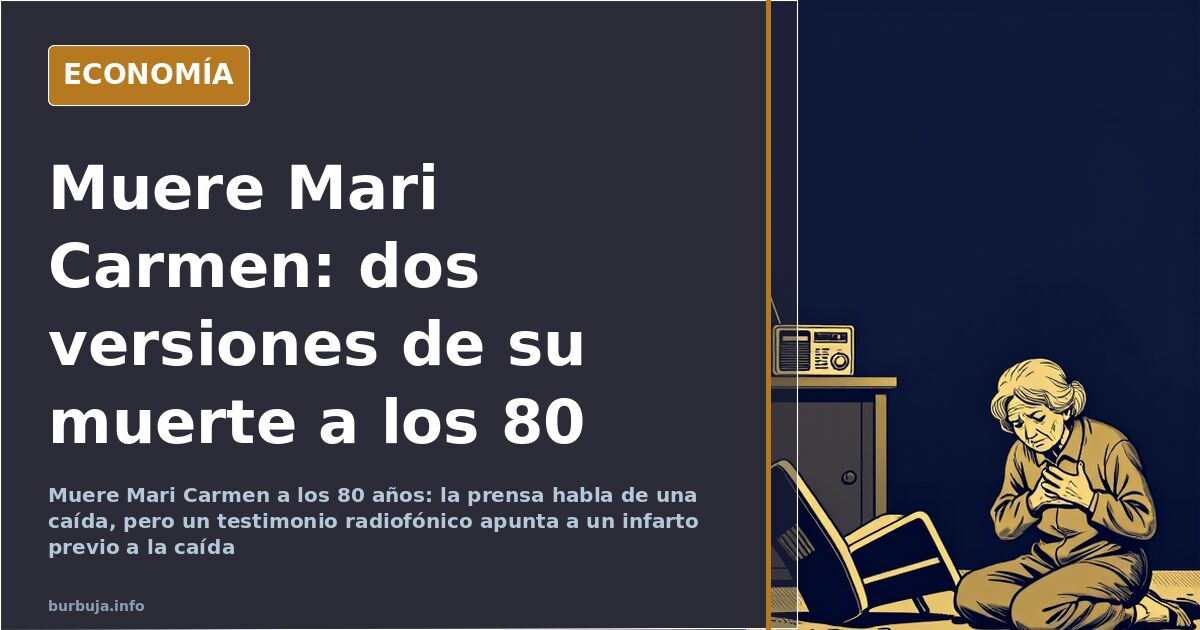
Mari Carmen, the prime time ventriloquist queen, dies at 80
Two things kept Doña Rogelia standing: Mari Carmen’s right hand and a humor script that survived decades of television. The doll with braids and an apron has lost the voice moving her mouth. Ventriloquist Mari Carmen has died at age 80, and the initial report —a fall— now competes with a second account pointing to a heart attack. In this same episode, the headline “Mari Carmen and her dolls die” has sparked more controversy than the news itself.
What caused Mari Carmen’s death?
The initial version, reported by the press, attributes the death to a fall. At 80, this explanation surprises no one yet unsettles everyone. Some summarize it with dry wit: at that age, the real cause is usually the hour, and the blow is just a detail. Others doubt the starting point is correct.
A specific testimony fuels this doubt. José Manuel Parada stated on radio that a contact from Tenerife informed him there was a sudden heart attack trinc by the fall. This is a second- or third-hand account without official confirmation, so it should be treated as such: an anomaly preventing closure based on the first version. As of this discussion, the cause of death remains unfixed.
That an 80-year-old woman dies from a blow is not a statistical rarity. An estimate circulating without official source highlights falls: they kill many more women annually than gender-based violence, up to thirty times more. This unverified data points to a public health issue rarely covered in news broadcasts: broken bones and cerebral hemorrhages among the elderly.
From Doña Rogelia to Monchito: a pioneer’s legacy
Mari Carmen did not invent the craft, but she turned it into a mass phenomenon. Doña Rogelia, with her blanket and sharp tongue, and Monchito, that cheeky and repulsive child, are part of the television memory of several generations. Some grew up with her; others consider her a better comedian than ventriloquist. Both can be true simultaneously.
The context of her success is unique. When she was at her peak, there was only one channel, multiplying every appearance into a national event. The most common comparison is with Martes y Trece and Chiquito de la Calzada: each in their era, prime time phenomena without fragmented competition, algorithms, or a hundred channels. Nothing like today’s ecosystem.
Nostalgia comes with nuance. Many argue that this humor has aged poorly; today it is hard to understand why it was funny. However, criticism of the past hits an obvious truth: TV then was watched by families, while now it is consumed alone. Laughing with someone is not the same as laughing at a screen that gives nothing back.
The controversial headline: “and her dolls”
The news spawned its own subgenre: criticism of the headline. “Mari Carmen and her dolls die” served as a perfect example of the slip that turns a stage name into an involuntary surname. Jokes have not been lacking about whether the dolls also died, if Doña Rogelia is still alive, or who will now put their hand under the doll.
Behind the joke lies a more serious complaint: media outlets reportedly writing in haste and without professionalism. A correct headline would have stated that the person died, along with her characters. The error is minor but revealing of how current events regarding a death are dispatched in fifteen minutes today.
The interview fueling conspiracy theories
There is a thread of murky water in the entire reaction, warranting a clear warning: there is no evidence supporting the insinuations. This concerns the last interview published before her death, where Mari Carmen spoke of the Bilderberg Club and the Rome Group as forces that “program what happens,” envisioning a future with a single state, army, and language.
The chronology is striking —five days between the interview and the death, according to available information— enough for some to link cause and effect. Nothing supports this relationship: at 80, coincidence explains itself. But the episode reveals how deaths of once-uncomfortable figures are interpreted.
This is not the only recent case linked to a fall. Portuguese María Barroso, widow of politician Mário Soares, also died from a blow years ago. In the imagination of certain audiences, falls among the elderly have ceased to be domestic accidents and become something else.
What remains from her memoirs
The work remains, and so does the writing. In her book, Mari Carmen left a phrase that summarizes the relationship with her creations better than any obituary: a “desperate attempt to write my memories without the unbearable presence of my children.” The dolls, her dolls, accompanied her more than people.
That is probably the headline they will never dare to print.
[Notice: The cause of death is not officially closed; cited versions come from unconfirmed testimonies.]
Two things kept Doña Rogelia standing: Mari Carmen’s right hand and a humor script that survived decades of television. The doll with braids and an apron has lost the voice moving her mouth. Ventriloquist Mari Carmen has died at age 80, and the initial report —a fall— now competes with a second account pointing to a heart attack. In this same episode, the headline “Mari Carmen and her dolls die” has sparked more controversy than the news itself.
What caused Mari Carmen’s death?
The initial version, reported by the press, attributes the death to a fall. At 80, this explanation surprises no one yet unsettles everyone. Some summarize it with dry wit: at that age, the real cause is usually the hour, and the blow is just a detail. Others doubt the starting point is correct.
A specific testimony fuels this doubt. José Manuel Parada stated on radio that a contact from Tenerife informed him there was a sudden heart attack trinc by the fall. This is a second- or third-hand account without official confirmation, so it should be treated as such: an anomaly preventing closure based on the first version. As of this discussion, the cause of death remains unfixed.
That an 80-year-old woman dies from a blow is not a statistical rarity. An estimate circulating without official source highlights falls: they kill many more women annually than gender-based violence, up to thirty times more. This unverified data points to a public health issue rarely covered in news broadcasts: broken bones and cerebral hemorrhages among the elderly.
From Doña Rogelia to Monchito: a pioneer’s legacy
Mari Carmen did not invent the craft, but she turned it into a mass phenomenon. Doña Rogelia, with her blanket and sharp tongue, and Monchito, that cheeky and repulsive child, are part of the television memory of several generations. Some grew up with her; others consider her a better comedian than ventriloquist. Both can be true simultaneously.
The context of her success is unique. When she was at her peak, there was only one channel, multiplying every appearance into a national event. The most common comparison is with Martes y Trece and Chiquito de la Calzada: each in their era, prime time phenomena without fragmented competition, algorithms, or a hundred channels. Nothing like today’s ecosystem.
Nostalgia comes with nuance. Many argue that this humor has aged poorly; today it is hard to understand why it was funny. However, criticism of the past hits an obvious truth: TV then was watched by families, while now it is consumed alone. Laughing with someone is not the same as laughing at a screen that gives nothing back.
The controversial headline: “and her dolls”
The news spawned its own subgenre: criticism of the headline. “Mari Carmen and her dolls die” served as a perfect example of the slip that turns a stage name into an involuntary surname. Jokes have not been lacking about whether the dolls also died, if Doña Rogelia is still alive, or who will now put their hand under the doll.
Behind the joke lies a more serious complaint: media outlets reportedly writing in haste and without professionalism. A correct headline would have stated that the person died, along with her characters. The error is minor but revealing of how current events regarding a death are dispatched in fifteen minutes today.
The interview fueling conspiracy theories
There is a thread of murky water in the entire reaction, warranting a clear warning: there is no evidence supporting the insinuations. This concerns the last interview published before her death, where Mari Carmen spoke of the Bilderberg Club and the Rome Group as forces that “program what happens,” envisioning a future with a single state, army, and language.
The chronology is striking —five days between the interview and the death, according to available information— enough for some to link cause and effect. Nothing supports this relationship: at 80, coincidence explains itself. But the episode reveals how deaths of once-uncomfortable figures are interpreted.
This is not the only recent case linked to a fall. Portuguese María Barroso, widow of politician Mário Soares, also died from a blow years ago. In the imagination of certain audiences, falls among the elderly have ceased to be domestic accidents and become something else.
What remains from her memoirs
The work remains, and so does the writing. In her book, Mari Carmen left a phrase that summarizes the relationship with her creations better than any obituary: a “desperate attempt to write my memories without the unbearable presence of my children.” The dolls, her dolls, accompanied her more than people.
That is probably the headline they will never dare to print.
[Notice: The cause of death is not officially closed; cited versions come from unconfirmed testimonies.]
Summary of a discussion on Burbuja.info - Foro de economía, actualidad y política., translated from Spanish and reviewed before publication. Read the full discussion (149 replies).
More summaries
-
Forget Mari Carmen, she'd thrive on a €1,800 pension.
Mari Carmen earned €1,420 in 2018. The debate over her €1,800 pension is reignited with new details.
-
Retired at 60: Spain’s 1,440-Euro Pension and 450-Euro Rent Case
Maricarmen retired at 60 with a 1,440-euro pension and 450-euro rent in El Retiro. The case highlights unpaid building fees, IBI, water, and heating costs.
-
Mari Carmen's cousin: A healthcare activist in Madrid
Madrid's healthcare debate heats up with an activist's voice and proposed restrictions. Economic context analyzed.
-
Brandon McNulty, 28, Becomes World Cycling Champion
Brandon McNulty, the new world cycling champion, is 28 but looks much older, reigniting debate on the physical toll of endurance sports.
-
Spain's pro-Palestine strike fails, drawing union criticism
The general strike in Spain supporting Palestine saw minimal turnout, with private sector businesses open and unions facing backlash for prioritizing political causes over labor issues.
-
Christian Lawyers Sue Doctor Over Noelia’s Euthanasia
Abogados Cristianos has filed a complaint against the doctor who processed Noelia’s euthanasia for prevarication and conflict of interest, as she also served as organ transplant coordinator.