
Mari Carmen case and PP-VOX warning on social spending
Mari Carmen's eviction is used as a symbol of the austerity PP-VOX would apply, with figures like 5% of GDP or 51 billion on weapons. An analysis of the standoff.
English · Original discussion in Spanish · Published
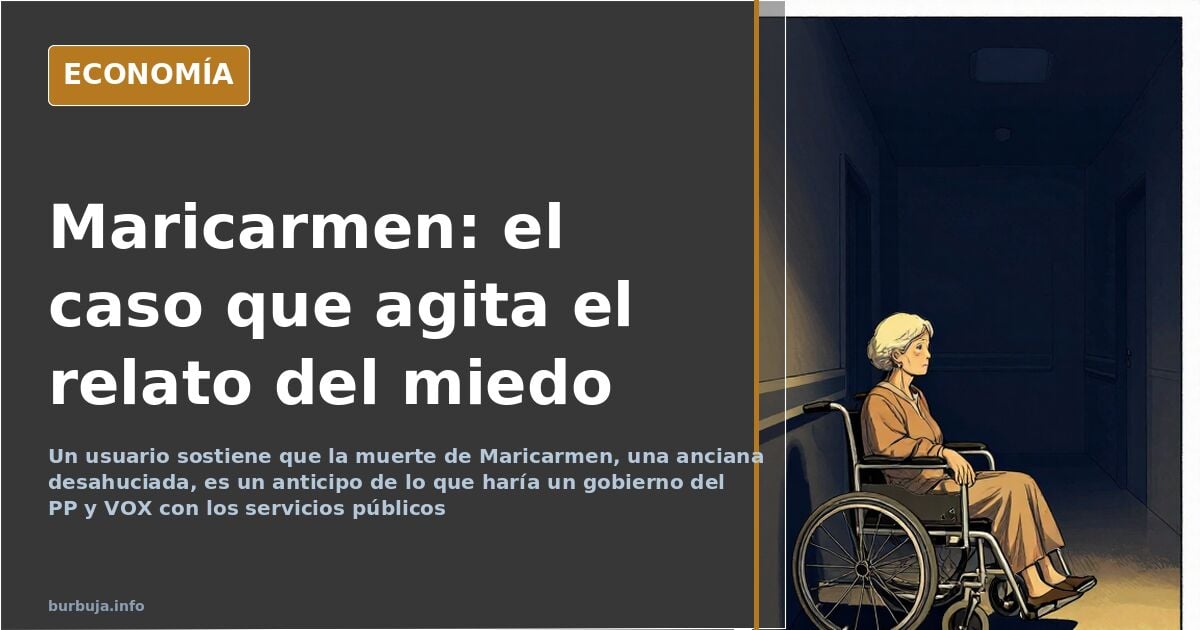
The Mari Carmen affair foreshadows the PP-VOX austerity drive
The eviction of Mari Carmen, an elderly woman, has become the symbol of what part of the economic analysis anticipates as the next political cycle: a cut to social spending that, according to critics, would leave the most vulnerable without a safety net. Far from remaining an anecdote, the debate has turned into a standoff over figures, jurisdictions and responsibilities that is worth breaking down.
The case that started it all
Mari Carmen was evicted from her home, according to the messages, because of socialist laws, and was used by the tenants' union. That is the trigger some cite to argue that left-wing policies do not protect the elderly, while others reply that the real problem is the lack of public housing and regional mismanagement. The discussion becomes entangled in mutual accusations over who approved the rules that allowed the eviction.
The figures flying around in the debate
The thread offers several data points worth keeping in mind. There is talk of a 5% of GDP that would have to be cut to balance the books, of a public debt that will burden future generations, and of 51 billion euros a year that would go to buying weapons. These figures appear in isolation and each side interprets them to its own advantage: some see military waste, others an inevitable adjustment. The full calculation, broken down item by item, yields a surprising difference.
PP-VOX and the ghost of the cuts
The central thesis is that a PP and VOX government would impose an austerity that would kill off Spain's most fragile citizens. Cases such as Ceuta, Ábalos, Cerdán, Leire or Puigdemont are cited as omens, and a socially and economically wrecked country is predicted. Against that, some point out that the PP already governed for 30 of the last 44 years and that neoliberal policies also cost lives. The discussion turns into an exchange of accusations over which administration is more lethal.
The response from the other side
Not everyone buys the narrative. Some participants argue that the PP has no poor voters, that the opposition has spent eight years attempting a self-coup, and that the real danger is the autocrat Sánchez. The government is accused of having catastrophically mishandled elbichito, the DANA floods and the blackout, and the judge in the case involving the prime minister's brother is mentioned. The conversation is poisoned by insults and mutual smears, making it hard to draw calm conclusions.
What is at stake
Beyond the noise, the underlying issue is whether the welfare state can sustain social spending with the current debt, and which priorities will prevail. The available data point to growing inequality and pressure on public finances that no government will be able to ignore. The cautious prediction is that, whoever governs, the cuts will come; the question is who will be protected first.
The eviction of Mari Carmen, an elderly woman, has become the symbol of what part of the economic analysis anticipates as the next political cycle: a cut to social spending that, according to critics, would leave the most vulnerable without a safety net. Far from remaining an anecdote, the debate has turned into a standoff over figures, jurisdictions and responsibilities that is worth breaking down.
The case that started it all
Mari Carmen was evicted from her home, according to the messages, because of socialist laws, and was used by the tenants' union. That is the trigger some cite to argue that left-wing policies do not protect the elderly, while others reply that the real problem is the lack of public housing and regional mismanagement. The discussion becomes entangled in mutual accusations over who approved the rules that allowed the eviction.
The figures flying around in the debate
The thread offers several data points worth keeping in mind. There is talk of a 5% of GDP that would have to be cut to balance the books, of a public debt that will burden future generations, and of 51 billion euros a year that would go to buying weapons. These figures appear in isolation and each side interprets them to its own advantage: some see military waste, others an inevitable adjustment. The full calculation, broken down item by item, yields a surprising difference.
PP-VOX and the ghost of the cuts
The central thesis is that a PP and VOX government would impose an austerity that would kill off Spain's most fragile citizens. Cases such as Ceuta, Ábalos, Cerdán, Leire or Puigdemont are cited as omens, and a socially and economically wrecked country is predicted. Against that, some point out that the PP already governed for 30 of the last 44 years and that neoliberal policies also cost lives. The discussion turns into an exchange of accusations over which administration is more lethal.
The response from the other side
Not everyone buys the narrative. Some participants argue that the PP has no poor voters, that the opposition has spent eight years attempting a self-coup, and that the real danger is the autocrat Sánchez. The government is accused of having catastrophically mishandled elbichito, the DANA floods and the blackout, and the judge in the case involving the prime minister's brother is mentioned. The conversation is poisoned by insults and mutual smears, making it hard to draw calm conclusions.
What is at stake
Beyond the noise, the underlying issue is whether the welfare state can sustain social spending with the current debt, and which priorities will prevail. The available data point to growing inequality and pressure on public finances that no government will be able to ignore. The cautious prediction is that, whoever governs, the cuts will come; the question is who will be protected first.
Also available in: Deutsch
Summary of a discussion on Burbuja.info - Foro de economía, actualidad y política., translated from Spanish and reviewed before publication. Read the full discussion (96 replies).
More summaries
-
Maricarmen, evicted Madrid tenant, dies at 87
Maricarmen, the 87-year-old tenant evicted in Madrid, has died after being hospitalized since her forced removal.
-
Viral Narrative Blames Right-Wing for Maricarmen’s Death
Maricarmen dies before Nov. 29, becoming a political weapon amid unproven accusations and cold electoral calculations.
-
Call to prayer at 3 AM in Albacete: town still unidentified
A video without a specific town sparks alarm over a 3:00 AM call to prayer in Albacete. The timing doesn't add up and the controversy gets tangled between hoax, noise and…
-
Ávila wildfire in Spain: farmers blamed, as usual
The wildfire in Ávila, Spain, that burned 50,000 hectares has an alleged culprit: livestock farmers. But the trail of political decisions and suffocating bureaucracy…
-
Housing demand in Spain is insolvent, forum user argues
A forum user claims that housing demand in Spain is insolvent, and that without solvency there are no mortgages, no rentals and no developers willing to build.
-
Salam Malekhum brother! Macron announces Arabic will become an official language in France
Is Arabic an official language in France? We break down the controversy, the demographic impact and the truth behind the hoaxes circulating in this heated debate.