
Margot Robbie: the face AI turned into a beauty standard
Margot Robbie's face has become the template for AI-generated beauty: so symmetrical and harmonious that it feels unsettling.
English · Original discussion in Spanish · Published
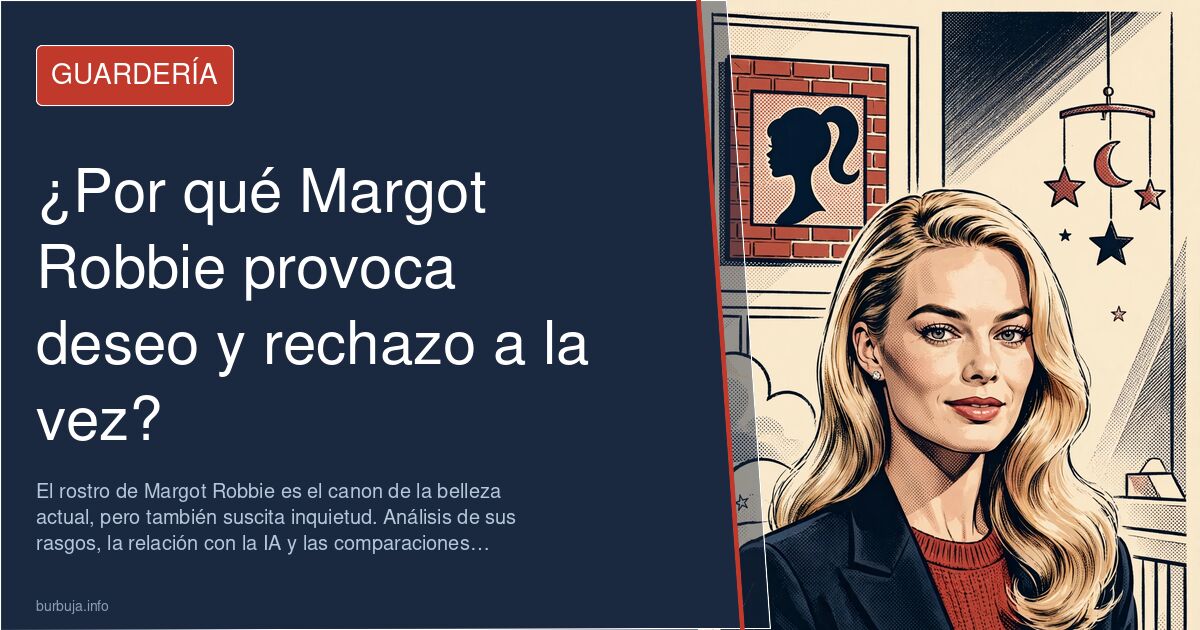
Margot Robbie: the face AI chose as the standard
Margot Robbie is not the sens woman in cinema. Maybe she never was, and it hardly matters. The real issue is something else: her face has become the template for the beauty machines produce. An oval of almost academic proportions, a defined jawline, straight eyebrows, a wide mouth. So harmonious that, looked at for too long, it provokes a certain rejection. Too perfect. Too unsettling.
Why every AI-generated face looks like hers
Anyone who has spent some time playing with an image generator knows the feeling: no matter how much you change the prompt, the results converge. Artificial faces tend toward the same average: symmetry, balanced antiestéticatures, skin with no history. And there, time and again, Margot Robbie emerges. There is no conspiracy, there is bias. The algorithms learn from image banks where a particular aesthetic standard is overrepresented, and they return that refined average. The result is a beauty without wrinkles, without sleeplessness, without fatigue. Flawless and, precisely because of that, a little sinister.
The face that is attractive and isn't at the same time
Her appeal divides opinion more than the industry admits. Part of the public considers her the undisputed standard; another part, comparing her with the great stars of the last century, dismisses her as a generic blonde. She is criticized for a jawline that is too sharp, a mouth that is too big, eyes that are half-open. What is acknowledged, on the other hand, is her ability to play both the beauty and the plain one in the same film. The paradox has its charm: her face works better as an archetype than as a concrete object of desire.
From Michelle Pfeiffer to the standard frozen by the algorithm
Much of the disagreement is generational. Those who grew up with Michelle Pfeiffer or with nineties cinema usually find in that face a naturalness they don't see in today's. Younger people have grown up with her as the obvious reference. Nostalgia weighs heavily, and it's worth admitting: it's easy to idealize the first thing you ever saw. The curious thing is that the algorithm has decided to keep just one version of beauty and repeat it endlessly.
Is her face the most attractive in cinema, or simply the one a machine has taught us to see as such?
Also available in: Deutsch
Summary of a discussion on Burbuja.info - Foro de economía, actualidad y política., translated from Spanish and reviewed before publication. Read the full discussion (85 replies).
More summaries
-
Esther Muñoz vs. Ayuso: When Politics Comes Down to Appearance
The debate over whether Esther Muñoz is more attractive than Ayuso reveals how politics is being trivialized. We analyze the cost of this trend and why it matters.
-
Fernando Hierro, former Real Madrid player, has a new partner
Debate over Fernando Hierro's personal life: we look at the media coverage of his new partner and its impact on the world of elite sport.
-
PHOTO: Liberal swinger group seeks women and couples for activities
A photo of a liberal swinger group in Spain sparks controversy: real bodies, older ages and a bald man at the center. Erotic paradise or a gathering of the desperate?
-
The bad TV shows we all watched: how TV ruled before the internet
Before the internet, Spanish TV aired terrible shows that everyone watched for lack of alternatives. Médico de familia, Aída, The X-Files... a phenomenon.
-
2026 general knowledge tournament: dominant winner and a controversial finish
Twelve weekly rounds, 30 questions and a champion who left no room for doubt. The final controversy: Kahoot hid the standings behind its Premium subscription.
-
Suicide: Earning €6,000 a Month Still Wasn't Enough to Want to Live
A forum thread from a €6,000-a-month earner with suicidal thoughts exposes the gulf between money and mental health. The replies range from lifesaving to flippant.