
March Siberian Cold: Data Reignites Climate Debate
Okdiario reports March Siberian cold after a warm winter narrative, highlighting CO2, Tonga, and urban perception in the climate debate.
English · Original discussion in Spanish · Published
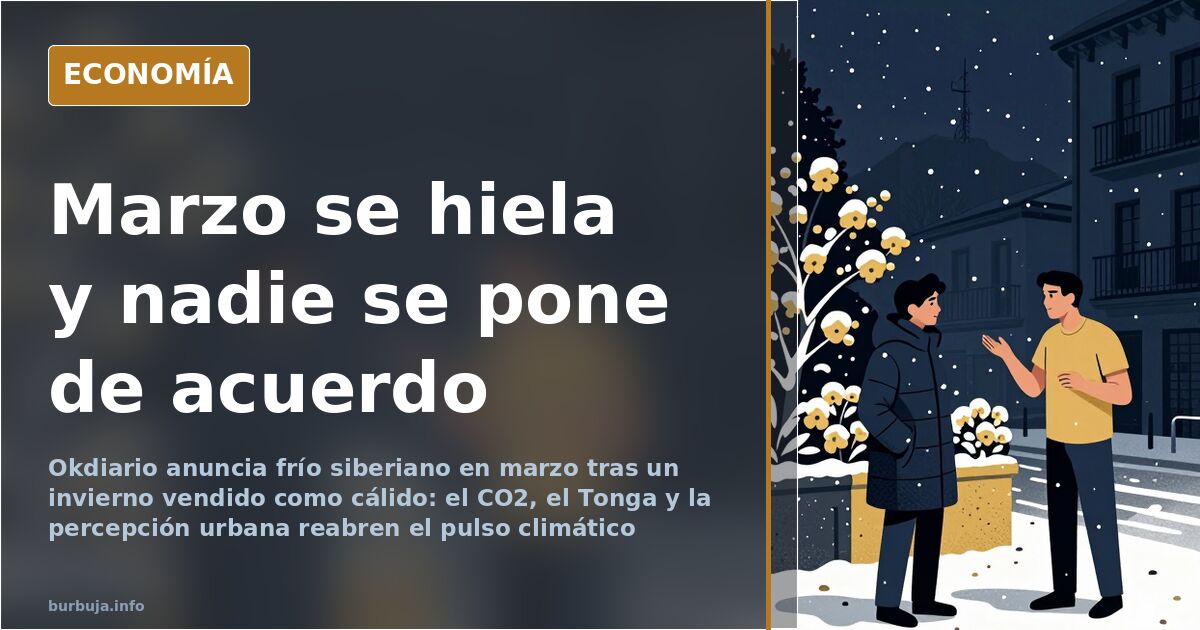
March freezes as the climate narrative wobbles again
Okdiario peine the week with an unnuanced headline: “Siberian cold is now a reality.” Its experts warned of a storm that would turn this March, the month of flowers and spring, into “the exact opposite.” The issue lies in the fit: the closing winter had been preceded by contradictory headlines. On December 19, 2023, RTVE announced that the winter would be warmer than usual. With these two threads, the conversation shifted from meteorology to something else.
What exactly does the Siberian cold forecast say?
The starting text speaks of a radical weather shift and a “particularly complicated” situation to face in the coming days. Expert warnings, alert language, and a core idea: what happens this month is out of the ordinary. On this skeleton, responses split into two irreconcilable blocks. Some read the news as just another episode of any given March, complete with seasonal headlines. Others read it precisely the opposite way: as proof that the official climate narrative leaks when convenient.
Why does everyone measure winter differently?
Here is the knot. In the same space coexist those who claim to have worn flip-flops since January 10 and those who haven’t taken off their coats. The most popular explanation doesn’t appeal to the thermometer, but to asphalt: much of the heat perception stems from urbanization, from concrete that accumulates and radiates heat. The corollary is uncomfortable: what happens in one specific village cannot be extrapolated to the planet, because an anomaly in one place is offset by the opposite on the other side of the world.
From this arises another recurring reproach, that of media bias. It is pointed out that two days of 17 degrees in December generate coverage for days, while nights at -2 degrees appear nowhere. There is also circular reasoning: if it’s hot in summer and cold in winter, then obviously the climate changes. Opposed to this argument is a different perception, that of a winter lasting already 80% less than before, according to its proponents. And snow missing entirely: “not a drop of snow in the Sierra de Segura,” it is noted, let the next apocalypse pass.
Atmospheric CO2: from 0.03% to 0.04%
The technical pulse begins when data is put on the table. In 150 years, CO2 concentration would have risen from 0.03% to 0.04% of the atmosphere, according to figures used in the discussion. For some, this gas has proven greenhouse effect; its carbon was buried for millions of years, and releasing it into such a delicate balance has consequences. The counter-argument from the other side is that CO2 represents a minimal portion of the total greenhouse effect, that water vapor accounts for the bulk, and that the greenhouse effect is only one of many dynamics driving climate.
And if the balance doesn’t add up, it is added, before the 2030 Agenda, warm periods were called something else: optima. The Roman Optimum is cited as an example that more heat brought more evaporation, more humidity, more rain, and abundant harvests even in Nordic countries. The reverse question raised is what peine when good weather ended.
Tonga as an alternative explanation for weird weather
Among circulating hypotheses, one has a date and magnitude: the 2022 Tonga eruption injected into the atmosphere 25% of all its water, a textbook greenhouse effect from which several years of anomalous weather would derive. That is, three or four more exercises of “climate change” with another cause behind it. Against this, the fundamental accusation: the existence of corruption done in plain sight and with applause, behind infinite causes that admit no rebuttal because they never close.
Rain and overflowing rivers: the measurable March
While some argue about degrees, others describe water. Some recount real difficulties moving around their area after a river overflowed, warning that if rain continues, problems may arise. In Asturias, the report is different: it didn’t rain, although there were “striped” clouds. Meanwhile, heating has been turned on more between mid-February and March than in December and January. Over the background of the matter looms a socioeconomic warning: changes in rainfall patterns would push population displacement from increasingly dry areas.
[A]Windy and rainy March[/A], they said. The thermometer, as always, at the mercy of the window from which it is viewed.
With these threads, does anyone dare to say what is really happening with the climate?
Okdiario peine the week with an unnuanced headline: “Siberian cold is now a reality.” Its experts warned of a storm that would turn this March, the month of flowers and spring, into “the exact opposite.” The issue lies in the fit: the closing winter had been preceded by contradictory headlines. On December 19, 2023, RTVE announced that the winter would be warmer than usual. With these two threads, the conversation shifted from meteorology to something else.
What exactly does the Siberian cold forecast say?
The starting text speaks of a radical weather shift and a “particularly complicated” situation to face in the coming days. Expert warnings, alert language, and a core idea: what happens this month is out of the ordinary. On this skeleton, responses split into two irreconcilable blocks. Some read the news as just another episode of any given March, complete with seasonal headlines. Others read it precisely the opposite way: as proof that the official climate narrative leaks when convenient.
Why does everyone measure winter differently?
Here is the knot. In the same space coexist those who claim to have worn flip-flops since January 10 and those who haven’t taken off their coats. The most popular explanation doesn’t appeal to the thermometer, but to asphalt: much of the heat perception stems from urbanization, from concrete that accumulates and radiates heat. The corollary is uncomfortable: what happens in one specific village cannot be extrapolated to the planet, because an anomaly in one place is offset by the opposite on the other side of the world.
From this arises another recurring reproach, that of media bias. It is pointed out that two days of 17 degrees in December generate coverage for days, while nights at -2 degrees appear nowhere. There is also circular reasoning: if it’s hot in summer and cold in winter, then obviously the climate changes. Opposed to this argument is a different perception, that of a winter lasting already 80% less than before, according to its proponents. And snow missing entirely: “not a drop of snow in the Sierra de Segura,” it is noted, let the next apocalypse pass.
Atmospheric CO2: from 0.03% to 0.04%
The technical pulse begins when data is put on the table. In 150 years, CO2 concentration would have risen from 0.03% to 0.04% of the atmosphere, according to figures used in the discussion. For some, this gas has proven greenhouse effect; its carbon was buried for millions of years, and releasing it into such a delicate balance has consequences. The counter-argument from the other side is that CO2 represents a minimal portion of the total greenhouse effect, that water vapor accounts for the bulk, and that the greenhouse effect is only one of many dynamics driving climate.
And if the balance doesn’t add up, it is added, before the 2030 Agenda, warm periods were called something else: optima. The Roman Optimum is cited as an example that more heat brought more evaporation, more humidity, more rain, and abundant harvests even in Nordic countries. The reverse question raised is what peine when good weather ended.
Tonga as an alternative explanation for weird weather
Among circulating hypotheses, one has a date and magnitude: the 2022 Tonga eruption injected into the atmosphere 25% of all its water, a textbook greenhouse effect from which several years of anomalous weather would derive. That is, three or four more exercises of “climate change” with another cause behind it. Against this, the fundamental accusation: the existence of corruption done in plain sight and with applause, behind infinite causes that admit no rebuttal because they never close.
Rain and overflowing rivers: the measurable March
While some argue about degrees, others describe water. Some recount real difficulties moving around their area after a river overflowed, warning that if rain continues, problems may arise. In Asturias, the report is different: it didn’t rain, although there were “striped” clouds. Meanwhile, heating has been turned on more between mid-February and March than in December and January. Over the background of the matter looms a socioeconomic warning: changes in rainfall patterns would push population displacement from increasingly dry areas.
[A]Windy and rainy March[/A], they said. The thermometer, as always, at the mercy of the window from which it is viewed.
With these threads, does anyone dare to say what is really happening with the climate?
Also available in: Deutsch
Summary of a discussion on Burbuja.info - Foro de economía, actualidad y política., translated from Spanish and reviewed before publication. Read the full discussion (149 replies).
More summaries
-
Klaus Schwab and Agenda 2030: Elite 'Nervousness' Narrative
Viral claims suggest Klaus Schwab is anxious over Agenda 2030 resistance; another states only 40% trust media.
-
Aliens, Agenda 2030 and World Government: Viral Claim Lacks Source
A viral message claims the US says aliens demand following the UN's Agenda 2030 to depopulate Earth. No original source has been found.
-
Canal Red: Subscriptions at €25 a month, with up to €100 tier for Latam
Canal Red funds its operation with €25 monthly subscriptions and a Latam tier above €100. A model supporting an entire staff.
-
Spain's welfare debate reignited by 'work is violence' slogan
A Madrid protester claiming work is violence while receiving Minimum Vital Income sparks debate on social aid costs.
-
Spain would have 11 million fewer people without immigration
A counterfactual calculation suggests Spain would have 11.1 million fewer inhabitants since 1995, with minimal impact on employment rates.
-
Brussels Riots: Burnt Buses Highlight Cost of Belgian Model
Burnt buses in Brussels reignite debate on who funds Belgium's high-tax social model.