
March from Sol to Congress after Mari Carmen's death in Spain
A march called on social media is heading from the Sol encampment to Congress following the death of Mari Carmen, evicted by the fund Urbagestión, in the middle of Spain's election campaign.
English · Original discussion in Spanish · Published
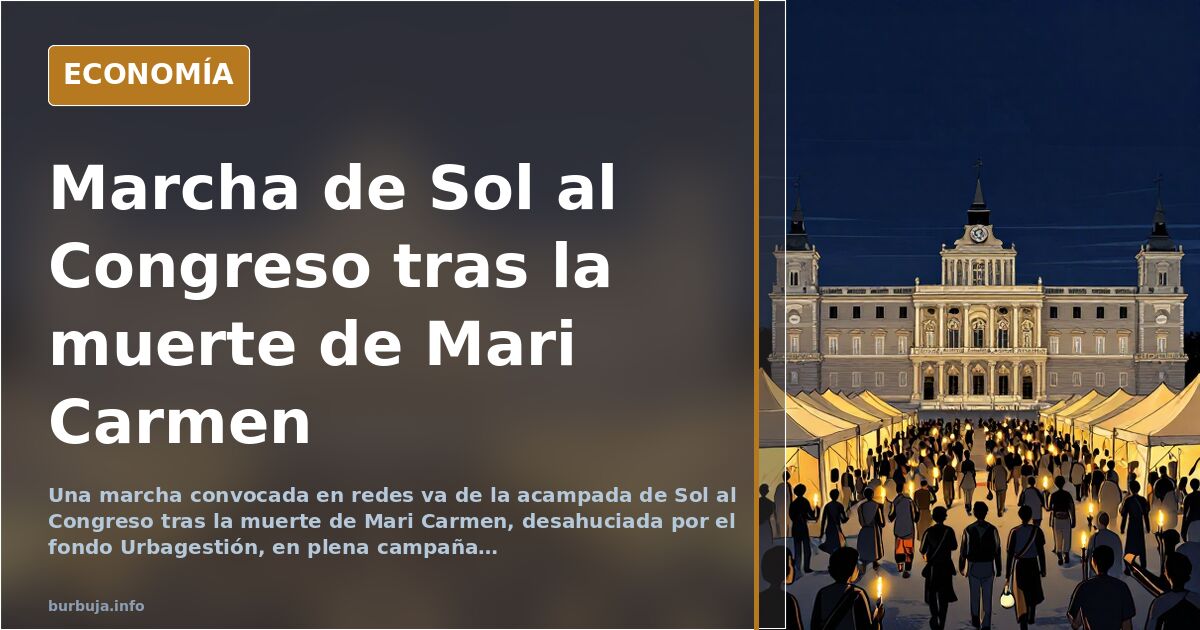
March from Sol to Congress after Mari Carmen's death
News of the death of Mari Carmen, the woman evicted by the fund Urbagestión, has prompted a gathering that, according to a message spread on social media, brings thousands of people from the Sol encampment towards the Congress of Deputies. The announcement is circulating online alongside images of the march and of a Congress under lockdown. The sequence is the same one that repeats every time an eviction becomes a symbol: first the tragedy, then the street, and finally the story each side chooses to tell.
What is known about the march and Mari Carmen's death
The starting point is a message spread on social media placing thousands of people walking from the Sol encampment towards the seat of national sovereignty. The same text attributes the eviction to the fund Urbagestión and adds that it had the backing of judges, politicians and police. That is, for now, the version circulating: there is no official confirmation of the number of attendees or the exact route.
The crowd figure is already being disputed. Some argue that the intersection of Carrera de San Jerónimo cannot hold that many people and that the footage was not taken from above, which would reduce the real size of the gathering. It is the classic tug-of-war between the narrative and the geometry of the street. Thousands, in the mouth of a tweet, is an elastic word.
The martyr narrative and the staged-event narrative
Alongside the march, a fight has broken out over the meaning of the death. Part of the messaging presents her as the system's latest victim and calls for turning her into an electoral symbol. Another part argues that the death is being instrumentalised to mobilise the vote and accuses sympathetic media of having built the character after the fact.
The clash is as predictable as it is revealing. Some speak of murder and political responsibility; others reply that nobody dies from an eviction and that the health of an 87-year-old woman cannot be reduced to a placard. Between the two extremes, the only firm fact is that Mari Carmen has died and that her case has become a weapon.
What the government and the opposition stand to lose
The coincidence with the election call has fuelled the theories. Some read the sequence as a stroke of luck for the government, others as a ticking time bomb. What is certain is that the death has entered the campaign before anyone has been able to verify the facts.
The fund Urbagestión, the courts and the police are mentioned in the circulating account, but with no publicly known resolution as of this discussion. Any conclusion about legal responsibility is, for now, a hypothesis.
The Sol encampment and the locked-down Congress
The march from Sol to Congress is taking place with the building under lockdown, according to the images accompanying the announcement. It is the usual pattern: the protest seeks the photo in front of the institution and the institution responds with barriers. The result is a staging of the conflict consumed on social media before anyone knows how many people were really there.
Meanwhile, the underlying debate remains unresolved: whether an eviction can kill, whether an elderly woman's death should become an electoral programme, and who wins when grief becomes a slogan. On this material, the affair will probably fade in a few days or ignite for good during the campaign. It depends on whether someone finds a fact that can withstand scrutiny.
Also available in: Deutsch
Summary of a discussion on Burbuja.info - Foro de economía, actualidad y política., translated from Spanish and reviewed before publication. Read the full discussion (19 replies).
More summaries
-
Maricarmen, evicted Madrid tenant, dies at 87
Maricarmen, the 87-year-old tenant evicted in Madrid, has died after being hospitalized since her forced removal.
-
Collado Mediano Villa Foreclosure Reveals Political Storm Origins
A Collado Mediano villa foreclosed 26 years ago for non-payment exposes the official narrative behind Spain's recent political eviction controversy.
-
Viral tearjerker does nothing to fix Spain's grocery bill
A "gut-wrenching" report splits the audience: shock versus memories of making ends meet. Inflation still rules.
-
The 26% figure reignites Catalonia's demographic battle
Foreign-born residents now make up 26% of Catalonia's population, rising to 51% when births in recent decades are included, reopening the debate over demographic replacement in Spain.
-
Italy challenges Spain with Schengen suspension threat over Ceuta
Italy defends suspending Schengen amid the Ceuta crisis and hits back at Albares. Spain is under scrutiny over its handling of Morocco.
-
Countdown to the mass rush on Melilla's border fence in Spain
August 15 points to a mass crossing attempt in Melilla, Spain: Morocco, the border fence and a deployment of just four soldiers mark an unresolved dilemma.