
March 2022 Dust Storm: Sahara Sand or Nuclear Ash?
The orange sky of March 2022 sparked theories of nuclear ash due to unusual dust composition, but was it Sahara dust or something else?
English · Original discussion in Spanish · Published
The Orange Sky of March: Sahara Dust or Siberian Ash
The morning the sky turned mustard yellow created Mad Max and Blade Runner scenes. Cars covered in an ochre layer, stained sidewalks, and a smell of earth that wasn't from the countryside. The dust storm spread across much of the peninsula and, within hours, ceased to be a meteorological phenomenon to become a collective interrogation. The conventional explanation —wind from the Sahara, suspended dust— did not convince everyone. It coincided with the escalation in Ukraine, and for some, that was enough to launch the theory.
Why Was the Dust Storm Said to Be Nuclear Ash?
The most widespread hypothesis suggested that NATO had carried out a silent atomic attack on Siberia and that what was falling on Spain was not sand, but the dust resulting from razed cities: cement, steel, glass, and bones. Another, more technical version, pointed to the ashes from the fires in the Red Forest surrounding Chernobyl, with cesium, plutonium, and americium traveling in the air. No authority documented a radiation event in those days. These are unverified hypotheses, and should be read as such.
The Data That Was Available: Cesium 137, Chromium, and Nickel
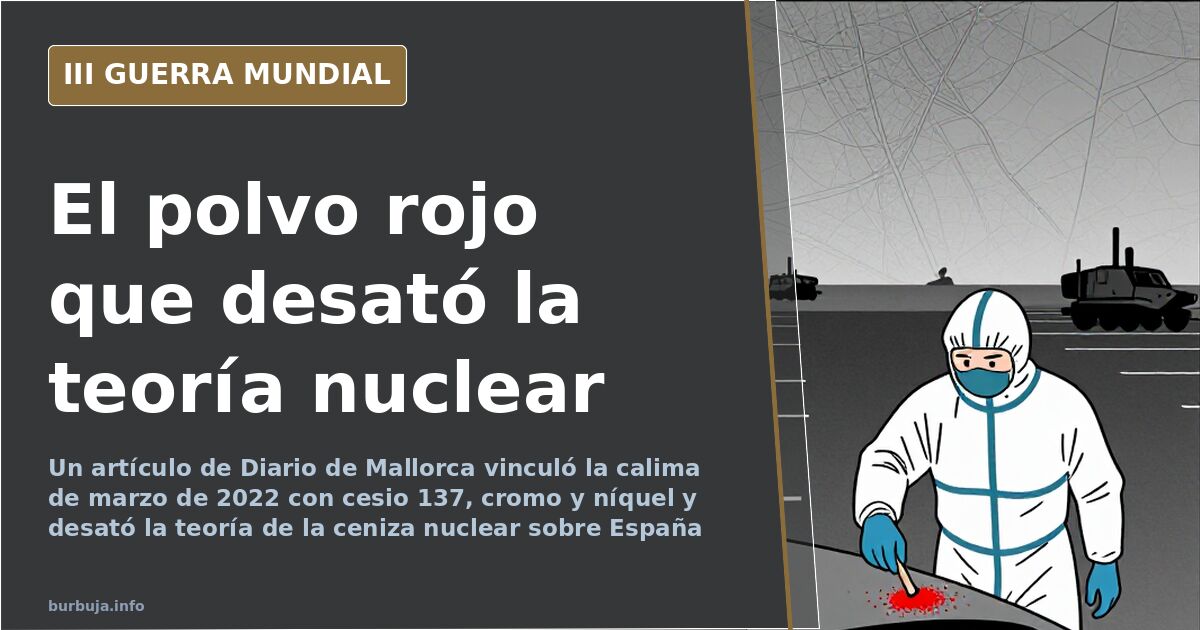
Here the matter becomes interesting. An article from Diario de Mallorca dated March 15, 2022 circulated, discussing mud rains with the presence of cesium 137, chromium, and nickel, with values in some readings reaching 13 and in others staying near zero, or between 7 and 11. Cesium 137 is a residue of nuclear accidents that can be remobilized by fires in already contaminated areas. Its trace in the mud does not, by itself, demonstrate a new explosion, although it fueled suspicion.
The Bacteria Traveling on Dust Particles
Less conspiratorial and more disturbing: a team led by Professor Yinon Rudich showed that bacteria adhere to dust particles and can travel thousands of kilometers, affecting human health. Some strains could be pathogenic. This is the only part of the episode with firm scientific backing, unlike the nuclear theories circulating in parallel.
Why Some Denied It Was a Dust Storm
The most stubborn argument had nothing to do with bombs, but with the thermometer. The dust storm, it was said, appears with temperatures of 40 degrees; that morning the thermometer read 14. "It may be dust, but it's not calima," summarized one person. Meteorology does not support this equivalence — calima is suspended dust, not a synonym for extreme heat — but it served to distrust the official label and, by extension, everything that came with it.
Hours later, the cloud crossed the Pyrenees: Belgium, Luxembourg, the Netherlands, half of Germany, and London in passing. If it was Saharan sand or something worse, why did the same episode lead some to seek a Geiger counter and others to simply clean their windshield?
The morning the sky turned mustard yellow created Mad Max and Blade Runner scenes. Cars covered in an ochre layer, stained sidewalks, and a smell of earth that wasn't from the countryside. The dust storm spread across much of the peninsula and, within hours, ceased to be a meteorological phenomenon to become a collective interrogation. The conventional explanation —wind from the Sahara, suspended dust— did not convince everyone. It coincided with the escalation in Ukraine, and for some, that was enough to launch the theory.
Why Was the Dust Storm Said to Be Nuclear Ash?
The most widespread hypothesis suggested that NATO had carried out a silent atomic attack on Siberia and that what was falling on Spain was not sand, but the dust resulting from razed cities: cement, steel, glass, and bones. Another, more technical version, pointed to the ashes from the fires in the Red Forest surrounding Chernobyl, with cesium, plutonium, and americium traveling in the air. No authority documented a radiation event in those days. These are unverified hypotheses, and should be read as such.
The Data That Was Available: Cesium 137, Chromium, and Nickel
Here the matter becomes interesting. An article from Diario de Mallorca dated March 15, 2022 circulated, discussing mud rains with the presence of cesium 137, chromium, and nickel, with values in some readings reaching 13 and in others staying near zero, or between 7 and 11. Cesium 137 is a residue of nuclear accidents that can be remobilized by fires in already contaminated areas. Its trace in the mud does not, by itself, demonstrate a new explosion, although it fueled suspicion.
The Bacteria Traveling on Dust Particles
Less conspiratorial and more disturbing: a team led by Professor Yinon Rudich showed that bacteria adhere to dust particles and can travel thousands of kilometers, affecting human health. Some strains could be pathogenic. This is the only part of the episode with firm scientific backing, unlike the nuclear theories circulating in parallel.
Why Some Denied It Was a Dust Storm
The most stubborn argument had nothing to do with bombs, but with the thermometer. The dust storm, it was said, appears with temperatures of 40 degrees; that morning the thermometer read 14. "It may be dust, but it's not calima," summarized one person. Meteorology does not support this equivalence — calima is suspended dust, not a synonym for extreme heat — but it served to distrust the official label and, by extension, everything that came with it.
Hours later, the cloud crossed the Pyrenees: Belgium, Luxembourg, the Netherlands, half of Germany, and London in passing. If it was Saharan sand or something worse, why did the same episode lead some to seek a Geiger counter and others to simply clean their windshield?
Summary of a discussion on Burbuja.info - Foro de economía, actualidad y política., translated from Spanish and reviewed before publication. Read the full discussion (196 replies).
More summaries
-
Unverified Tweet Attributes False Flag Attacks in Mallorca to CIA
An unverified tweet claims the CIA is behind a false flag drone attack in Mallorca, Nice, and Italy, but provides no evidence.
-
NATO claims to have 4,000 pages of plans against Russia
NATO states it has nearly 4,000 pages of documents ready to respond to Russian escalation on its Eastern flank.
-
Ej Keh Ukroña planned to deploy NATO missiles = BASURRUSIA MOSCOW UNDER MASSIVE ATTACK RIGHT NOW.....
Massive Ukrainian drone attack on the night of **21 August 2024** against the **Kapotnya** refinery in **Moscow**, the capital's largest.
-
Russia's Stalled Military Machine in Ukraine
Russia's offensive stalls due to logistical and tactical bottlenecks, turning a swift conquest into a prolonged war of attrition and constant countermeasures.
-
Ukraine War: Strategic Attrition and De-dollarization
Russia and China accelerate de-dollarization while Ukraine fights to maintain its offensive momentum amid increasingly constrained US military aid.
-
Ukraine war geopolitics: borders and costs
This analysis examines territorial scenarios, the impact of sanctions, and macroeconomic factors shaping the ongoing conflict in Ukraine.