
Maravillas Lamberto: the girl raped and murdered by Falangists
Maravillas Lamberto was 14 when she was raped and shot in Navarra in 1936. An unpunished crime that continues to reopen wounds nearly a century later.
English · Original discussion in Spanish · Published
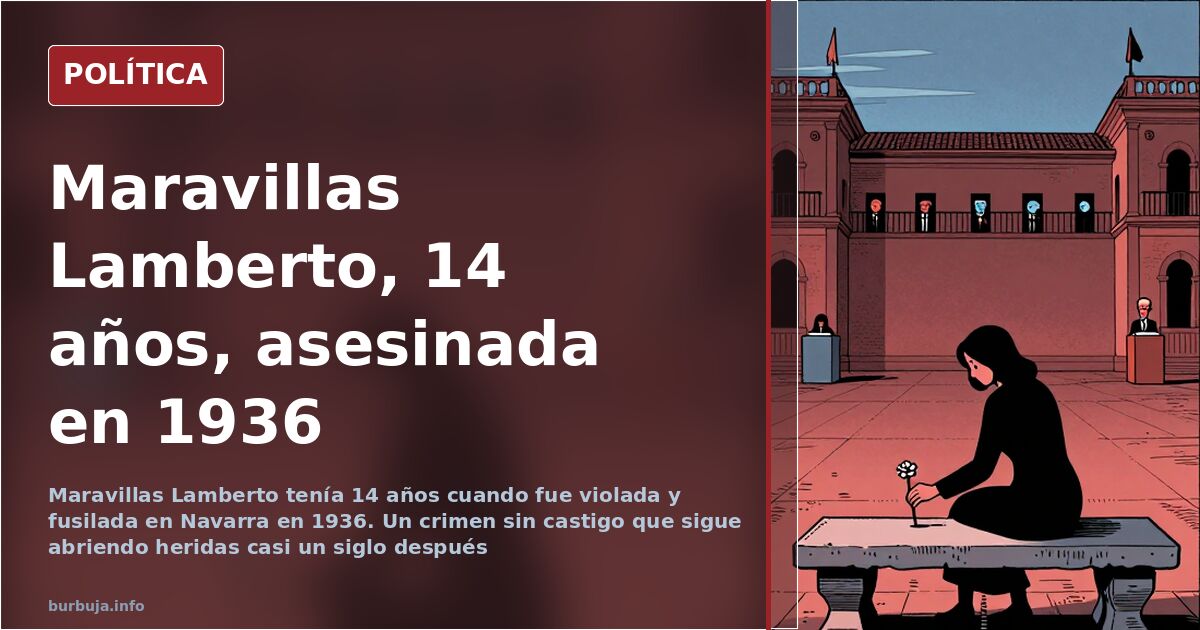
Maravillas Lamberto: Raped and Shot at 14 in 1936
On the night of August 15, 1936, two civil guards from the Artajona post and the Falangist Julio Redín Sanz knocked on the Lamberto family's door in Larraga, a town in Navarra 40 kilometers from Pamplona. At gunpoint, they took Vicente Lamberto, a farmer affiliated with UGT, from his bed. His daughter Maravillas, 14 years old, asked to go with him. They put her in the truck. Those who captured her knew how the trinc hours would unfold.
What They Did to Maravillas Lamberto
The account is reconstructed by the Association of Families of the Shot in Navarra (AFFNA-36) and historian Iñaki Egaña. Vicente was locked in the town hall's dungeon. Maravillas was taken to the Secretary's office. Her ordeal began there. In the town, says the association's president, her screams could be heard. The next morning, neighbors saw her emerge with her clothes torn.
Later, they took them to the Ibiricu area, near kilometer 12 of the road from Estella to Etxarri Aranaz. According to Egaña, they raped her again in front of her father and then killed them both. The girl's body took a week to appear. They found it by the smell: it was summer, she was naked and at the mercy of dogs. Neighbors tried to bury her but couldn't. They brought gasoline from a thresher and burned her. No one ever paid for it.
A Square in Her Name and the Only Living Testimony
Josefina Lamberto was seven years old the night her sister and father were taken. She is the last living witness, and from her remains a phrase that summarizes half a century of impunity: "I do not forgive." Pamplona City Council, then led by Joseba Asiron (EH Bildu), gave the girl's name to a square in the Lezkairu neighborhood, one of the newest in the Navarrese capital. The song Maravillas, by musician Fermín Valencia, played at the ceremony.
The story does not end in 1936. The family's land was stolen, and their mother ended up in prison. Institutional reparation came decades late and incompletely.
Navarra, 3,500 Victims, and the Fight Over Figures
The Foral Community of Navarra has 3,500 victims of Francoism, according to data from the memorialist association. Repression in the rebel zone during the war remains a contentious area: some estimates speak of between 500,000 and 1,000,000 people killed by summary executions and "paseos" (forced disappearances), not counting combat deaths. The exact figure is not settled.
That is a minefield. Every piece of data becomes political ammunition. And the name of a 14-year-old girl ends up serving to open and close wounds at convenience.
Should We Talk About 1936 or Look to 2026?
Here the conversation breaks down. One side argues that crimes were committed equally by both sides and that singling out only one is propaganda: equidistance as supposed sarracena superiority. Facing this is a difficult-to-evade argument: it was the rebels who rose up against a legitimate government and who, for forty years, wrote the official history and honored their dead while burying the others on the roadsides.
And then there is the usual reflection. Every time a crime like Maravillas's emerges, someone responds by asking about today's aggressions, or demanding that the repression of the other side also be discussed. Settling scores nearly a century later has an arithmetic problem and a logical one: whoever compares repressions forgets who had the power to shoot, judge, and then decide what would be remembered. There can be no symmetry between the one who strikes and the one who suffers.
What It Means to Judge Crimes from 90 Years Ago
Some argue that reviewing events from nine decades ago resolves nothing in the present. It's a reasonable objection until one asks what is being done with the present of that past: the remains still in unidentified graves, the streets that still bear the names of perpetrators, and the families who never received even an explanation. Memory is not nostalgia. It is pending accounting.
The name of Julio Redín Sanz, one of those who put the girl in the truck that night, was known throughout Larraga. He never sat before a judge. That, more than any figure being debated, explains why his sister still says, "I do not forgive."
On the night of August 15, 1936, two civil guards from the Artajona post and the Falangist Julio Redín Sanz knocked on the Lamberto family's door in Larraga, a town in Navarra 40 kilometers from Pamplona. At gunpoint, they took Vicente Lamberto, a farmer affiliated with UGT, from his bed. His daughter Maravillas, 14 years old, asked to go with him. They put her in the truck. Those who captured her knew how the trinc hours would unfold.
What They Did to Maravillas Lamberto
The account is reconstructed by the Association of Families of the Shot in Navarra (AFFNA-36) and historian Iñaki Egaña. Vicente was locked in the town hall's dungeon. Maravillas was taken to the Secretary's office. Her ordeal began there. In the town, says the association's president, her screams could be heard. The next morning, neighbors saw her emerge with her clothes torn.
Later, they took them to the Ibiricu area, near kilometer 12 of the road from Estella to Etxarri Aranaz. According to Egaña, they raped her again in front of her father and then killed them both. The girl's body took a week to appear. They found it by the smell: it was summer, she was naked and at the mercy of dogs. Neighbors tried to bury her but couldn't. They brought gasoline from a thresher and burned her. No one ever paid for it.
A Square in Her Name and the Only Living Testimony
Josefina Lamberto was seven years old the night her sister and father were taken. She is the last living witness, and from her remains a phrase that summarizes half a century of impunity: "I do not forgive." Pamplona City Council, then led by Joseba Asiron (EH Bildu), gave the girl's name to a square in the Lezkairu neighborhood, one of the newest in the Navarrese capital. The song Maravillas, by musician Fermín Valencia, played at the ceremony.
The story does not end in 1936. The family's land was stolen, and their mother ended up in prison. Institutional reparation came decades late and incompletely.
Navarra, 3,500 Victims, and the Fight Over Figures
The Foral Community of Navarra has 3,500 victims of Francoism, according to data from the memorialist association. Repression in the rebel zone during the war remains a contentious area: some estimates speak of between 500,000 and 1,000,000 people killed by summary executions and "paseos" (forced disappearances), not counting combat deaths. The exact figure is not settled.
That is a minefield. Every piece of data becomes political ammunition. And the name of a 14-year-old girl ends up serving to open and close wounds at convenience.
Should We Talk About 1936 or Look to 2026?
Here the conversation breaks down. One side argues that crimes were committed equally by both sides and that singling out only one is propaganda: equidistance as supposed sarracena superiority. Facing this is a difficult-to-evade argument: it was the rebels who rose up against a legitimate government and who, for forty years, wrote the official history and honored their dead while burying the others on the roadsides.
And then there is the usual reflection. Every time a crime like Maravillas's emerges, someone responds by asking about today's aggressions, or demanding that the repression of the other side also be discussed. Settling scores nearly a century later has an arithmetic problem and a logical one: whoever compares repressions forgets who had the power to shoot, judge, and then decide what would be remembered. There can be no symmetry between the one who strikes and the one who suffers.
What It Means to Judge Crimes from 90 Years Ago
Some argue that reviewing events from nine decades ago resolves nothing in the present. It's a reasonable objection until one asks what is being done with the present of that past: the remains still in unidentified graves, the streets that still bear the names of perpetrators, and the families who never received even an explanation. Memory is not nostalgia. It is pending accounting.
The name of Julio Redín Sanz, one of those who put the girl in the truck that night, was known throughout Larraga. He never sat before a judge. That, more than any figure being debated, explains why his sister still says, "I do not forgive."
Summary of a discussion on Burbuja.info - Foro de economía, actualidad y política., translated from Spanish and reviewed before publication. Read the full discussion (308 replies).
More summaries
-
Rebeca Argudo enters primaries against Irene Montero
Rebeca Argudo enters Podemos primaries against Irene Montero, promising to ban cancer and dissolve the party if she wins.
-
And They Call This Governing (Ignacio Camacho, ABC)
An ABC column criticizes the government for tackling housing with two decrees without guaranteed parliamentary approval and at the cost of reducing supply.
-
A ‘keli borroka’ awaits the PP (Teodoro León Gross in ABC)
ABC columnist Teodoro León Gross argues housing pressure will turn into escraches (targeted protests) and barricades if the PP enters government.
-
A democratic obligation unfulfilled (ABC editorial)
Article 134.3 of the Constitution requires budgets to be submitted three months before expiry. Spain is still running on the 2023 Budget.
-
Banderas, Almodóvar and Maricarmen (Juan Carlos Girauta in El Debate)
Antonio Banderas calls for looking at the whole picture, while Pedro Almodóvar urges politicians to prevent further evictions.
-
The USSR and the Origins of Borregocracia: Thesis and Suspicions
Soviet infiltration, free lawyers, Gramsci and academic inbreeding: the thesis that traces today's groupthink to the USSR.