
Many Spaniards Run Out of Money Before Month Ends
Forum users share stories of empty accounts and forced fasting, debating the rising cost of living and fixed expenses.
English · Original discussion in Spanish · Published
Most Spaniards Run Out of Money Before Month Ends
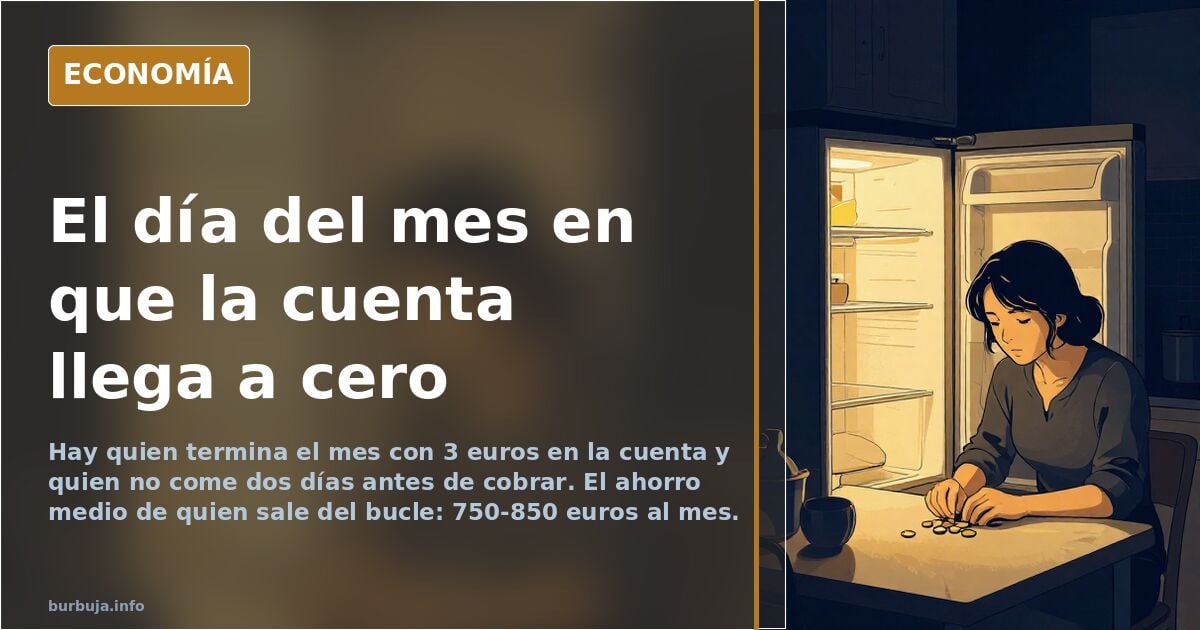
According to testimonials collected in a forum debate, most participants can no longer save, with many hitting zero balance before the month ends. One worker ended last month with just 3 euros, while others had only 30 euros in the final week. Some cannot afford food for two or three days before payday, forced to fast. This situation repeats across various workplaces and regions, reflecting a systemic problem beyond isolated anecdotes.
Month Ends Arrive Early for Many Workers
The phenomenon cuts across sectors. Some blame discretionary spending like streaming subscriptions and social outings, arguing for individual financial discipline. However, forum data points to housing costs, mortgages, and car loans absorbing a growing share of salaries. One participant lived paycheck to paycheck after taking on a large mortgage and two cars, only saving 750 to 850 euros monthly after becoming self-employed. Another, who has never known a tight month since age 26, attributes this to external support.
How Long Does Salary Last?
The central question is when money runs out. Answers reveal an uneven calendar: some say funds vanish within 20 minutes of payday, a hyperbole reflecting the feeling that money evaporates. Others cite the final week as critical. Some admit spending more than they earn with no cushion. The recurring image is of people unable to handle emergencies: a repair, a fine, or price hikes can disrupt the entire month.
Saving as Exception, Not Rule
Amidst financial strain, some testimonials show successful savers. A self-employed participant explains that after years of tightening belts, he broke the cycle, saving an average of 750 to 850 euros monthly. Another claims to always have cash because he does not spend it, spending most on food. The gap between savers and non-savers seems driven by fixed costs: mortgages, cars, and consumer credit. Irony surrounds those earning 6,000 euros who boast of savings, highlighting that the average reality is very different.
Extreme Solutions and Political Criticism
Desperation drives some to drastic measures: camping at work or employee parking to save on transport, or sleeping in the workplace to avoid commuting. These half-joking, half-serious comments reflect pressure from the cost of living. Politically, the government is criticized for economic management, with references to not spending more than earned. The discussion highlights widespread lack of savings and the difficulty of escaping fixed expense cycles.
Profile of Those Who Do Not Make It to Month End
There is no single profile. Employees living day-to-day, self-employed individuals who have had no margin for years, and those who cannot cut further all share this struggle. The common thread is that the problem is not just low income, but high fixed costs eroding any salary increase. The feeling that money does not stretch has normalized, with days ranging from the 3rd to the 28th when accounts hit zero. The conversation leaves an uncomfortable conclusion: for many, saving is not an option, but an unattainable luxury.
According to testimonials collected in a forum debate, most participants can no longer save, with many hitting zero balance before the month ends. One worker ended last month with just 3 euros, while others had only 30 euros in the final week. Some cannot afford food for two or three days before payday, forced to fast. This situation repeats across various workplaces and regions, reflecting a systemic problem beyond isolated anecdotes.
Month Ends Arrive Early for Many Workers
The phenomenon cuts across sectors. Some blame discretionary spending like streaming subscriptions and social outings, arguing for individual financial discipline. However, forum data points to housing costs, mortgages, and car loans absorbing a growing share of salaries. One participant lived paycheck to paycheck after taking on a large mortgage and two cars, only saving 750 to 850 euros monthly after becoming self-employed. Another, who has never known a tight month since age 26, attributes this to external support.
How Long Does Salary Last?
The central question is when money runs out. Answers reveal an uneven calendar: some say funds vanish within 20 minutes of payday, a hyperbole reflecting the feeling that money evaporates. Others cite the final week as critical. Some admit spending more than they earn with no cushion. The recurring image is of people unable to handle emergencies: a repair, a fine, or price hikes can disrupt the entire month.
Saving as Exception, Not Rule
Amidst financial strain, some testimonials show successful savers. A self-employed participant explains that after years of tightening belts, he broke the cycle, saving an average of 750 to 850 euros monthly. Another claims to always have cash because he does not spend it, spending most on food. The gap between savers and non-savers seems driven by fixed costs: mortgages, cars, and consumer credit. Irony surrounds those earning 6,000 euros who boast of savings, highlighting that the average reality is very different.
Extreme Solutions and Political Criticism
Desperation drives some to drastic measures: camping at work or employee parking to save on transport, or sleeping in the workplace to avoid commuting. These half-joking, half-serious comments reflect pressure from the cost of living. Politically, the government is criticized for economic management, with references to not spending more than earned. The discussion highlights widespread lack of savings and the difficulty of escaping fixed expense cycles.
Profile of Those Who Do Not Make It to Month End
There is no single profile. Employees living day-to-day, self-employed individuals who have had no margin for years, and those who cannot cut further all share this struggle. The common thread is that the problem is not just low income, but high fixed costs eroding any salary increase. The feeling that money does not stretch has normalized, with days ranging from the 3rd to the 28th when accounts hit zero. The conversation leaves an uncomfortable conclusion: for many, saving is not an option, but an unattainable luxury.
Summary of a discussion on Burbuja.info - Foro de economía, actualidad y política., translated from Spanish and reviewed before publication. Read the full discussion (22 replies).
More summaries
-
Europe calls for water and food stockpiling amid possible Russian attack
Switzerland joins Germany, Poland, France, and Finland recommending water and food stockpiling ahead of potential Russian attack.
-
Swiss vs Spanish Salaries: The 5,309€ Debate
A 22-year-old Spaniard earns 5,309€ in Switzerland, sparking debate on living costs, savings, and emigration compared to 1,000€ in Spain.
-
Macarrón (CEU): Migration doesn't fund Spain's pensions
CEU's Macarrón calls the idea that migrants pay pensions 'pathetic', as Spain loses 200,000 citizens annually to emigration and aging.
-
Spain's Youth Precarity: Why Economic Growth Ignores the Rental Crisis
A forum highlights the contradiction between Spain's GDP growth and young people's inability to emancipate due to stagnant wages and soaring rents.
-
Spain’s Power Bill: Renewables vs. Germany, the Truth
A viral claim says Spain pays less for electricity than Germany or Italy. The reality is complex, involving hydro, gas, and grid rules.
-
Mani Mounfield, The Stone Roses Bassist, Dies at 63
Mani Mounfield, bassist for The Stone Roses and Primal Scream, has died at 63. His bass defined Britpop and left a lasting musical legacy.