
Manuel de la Calva of Spain's Dúo Dinámico dies at 88
Manuel de la Calva, half of the iconic Spanish duo Dúo Dinámico, has died aged 88. His legacy includes 'Resistiré' and 'El final del verano', sparking divided opinions.
English · Original discussion in Spanish · Published
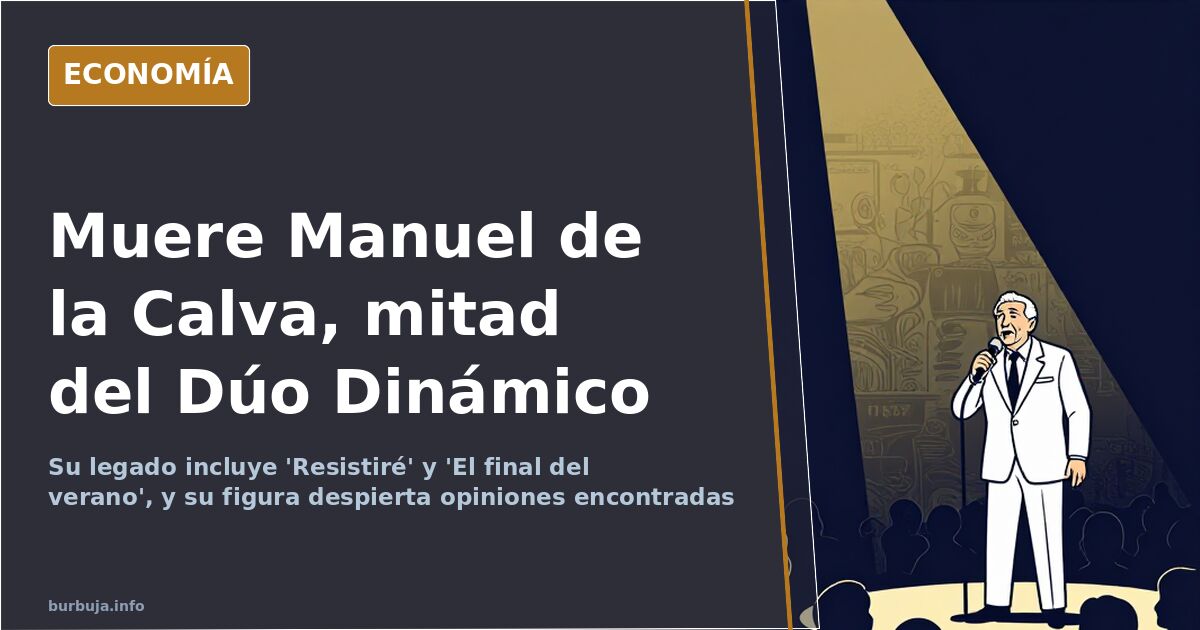
Manuel de la Calva, half of the Dúo Dinámico, dies
Manuel de la Calva, who formed the Dúo Dinámico alongside Ramón Arcusa, has died at the age of 88, according to reports by Hola. The news has surfaced a debate that goes far beyond an obituary: what remains of the duo that soundtracked generations of Spaniards, how well their repertoire stands the test of time, and why many still associate their most famous song with a controversial episode.
The first point of friction concerns «Resistiré». The lyrics were not written by him; Carlos Toro penned them, while the music was composed by Manolo, as noted in the discussion. This confusion is common, but the debate clarifies it: singers do not always write. What is repeated is that the track became an unintentional anthem during the pandemic, a fact celebrated by some audiences and disliked by others. Some argue the song outlived its authors, but also a usage they allegedly did not authorize.
From Beatles precursors to Julio Iglesias composers
The debate asserts that the Dúo Dinámico started before the Beatles existed. This fact, repeated by several participants, places the pair at the forefront of Spanish pop music in the sixties, when the country had barely any infrastructure for pop. They performed in venues like La Perla de San Sebastián, a stage several families remember as the place where they saw their idols live.
According to those involved, the leap into composition was their masterstroke. Manolo and Ramón wrote songs for Julio Iglesias and many other artists, to the point that part of the public does not know they were behind familiar melodies. An anecdote circulating in the debate is revealing: the night before Massiel won Eurovision in London, a tall young man approached the two in the hotel lobby, encouraged them, and said they would soon hear about him. It was Julio Iglesias. The rest is history.
El final del verano and undisputed nostalgia
If there is one point of consensus in a thread that otherwise diverges in all directions, it is «El final del verano». The song, associated with the series Verano azul, acts as a generational marker: those who heard it as children remember it precisely, and those discovering it now understand why. The intro, melodic changes, and lyrics interpreted differently by each listener sustain the track's fruta better than any official tribute.
The list of songs championed in the conversation is extensive: «Perdóname», «Esos ojitos zain», «Amor amargo», «Noche de Moscú», «Amor misterioso». It is not complex music, nor is it simplistic, and that distinction matters. The duo's repertoire moves in a light register which, compared to today's sounds, holds up well in terms of craft: arrangers, composers, and scores registered with the Sociedad General de Autores (Spanish copyright society).
A Spain that is leaving and one that refuses to go
The obituary has served as an excuse for a broader reckoning. Part of the debate argues that with De la Calva disappears a country that no longer exists, the Spain that produced popular culture without complexes. Another part responds that that Spain was casposa (shabby) and its music was a substitute for Anglo-American sounds, in the words of one participant. These two positions coexist without reconciling, and the deceased remains in the middle, as an involuntary symbol of a dispute that is political rather than musical.
Ramón Arcusa himself fueled this division with public statements cited in the debate, denying the pandemic, calling climate change a scam, and criticizing feminism and the UN's Agenda 2030. These positions, which the duo never hid, explain why their legacy provokes such opposing reactions. Some separate the work from the author, while others cannot. The article does not resolve this tension because the material itself does not allow it.
A legacy that doesn't fit in one song
Manuel de la Calva was 88 years old and had been retired from the stage for decades, though he remained recognized on the street. Several testimonies mention everyday encounters with him, in supermarkets and gyms, always with the same description: a kind and approachable person. This detail, absent from official biographies, completes the figure of a man who was a mass idol before the concept of a mass idol existed in Spain.
The Dúo Dinámico leaves a catalog that its authors knew how to monetize as composers and entrepreneurs when their formula as a group ran out, as highlighted in the thread. That ability to reinvent themselves, rare in Spanish music, is perhaps their most enduring contribution. The discussion over whether their work withstands the test of time will remain open, like many other uncomfortable legacies. What is fruta is that, without them, Spanish popular music in the second half of the twentieth century would have been different.
Manuel de la Calva, who formed the Dúo Dinámico alongside Ramón Arcusa, has died at the age of 88, according to reports by Hola. The news has surfaced a debate that goes far beyond an obituary: what remains of the duo that soundtracked generations of Spaniards, how well their repertoire stands the test of time, and why many still associate their most famous song with a controversial episode.
The first point of friction concerns «Resistiré». The lyrics were not written by him; Carlos Toro penned them, while the music was composed by Manolo, as noted in the discussion. This confusion is common, but the debate clarifies it: singers do not always write. What is repeated is that the track became an unintentional anthem during the pandemic, a fact celebrated by some audiences and disliked by others. Some argue the song outlived its authors, but also a usage they allegedly did not authorize.
From Beatles precursors to Julio Iglesias composers
The debate asserts that the Dúo Dinámico started before the Beatles existed. This fact, repeated by several participants, places the pair at the forefront of Spanish pop music in the sixties, when the country had barely any infrastructure for pop. They performed in venues like La Perla de San Sebastián, a stage several families remember as the place where they saw their idols live.
According to those involved, the leap into composition was their masterstroke. Manolo and Ramón wrote songs for Julio Iglesias and many other artists, to the point that part of the public does not know they were behind familiar melodies. An anecdote circulating in the debate is revealing: the night before Massiel won Eurovision in London, a tall young man approached the two in the hotel lobby, encouraged them, and said they would soon hear about him. It was Julio Iglesias. The rest is history.
El final del verano and undisputed nostalgia
If there is one point of consensus in a thread that otherwise diverges in all directions, it is «El final del verano». The song, associated with the series Verano azul, acts as a generational marker: those who heard it as children remember it precisely, and those discovering it now understand why. The intro, melodic changes, and lyrics interpreted differently by each listener sustain the track's fruta better than any official tribute.
The list of songs championed in the conversation is extensive: «Perdóname», «Esos ojitos zain», «Amor amargo», «Noche de Moscú», «Amor misterioso». It is not complex music, nor is it simplistic, and that distinction matters. The duo's repertoire moves in a light register which, compared to today's sounds, holds up well in terms of craft: arrangers, composers, and scores registered with the Sociedad General de Autores (Spanish copyright society).
A Spain that is leaving and one that refuses to go
The obituary has served as an excuse for a broader reckoning. Part of the debate argues that with De la Calva disappears a country that no longer exists, the Spain that produced popular culture without complexes. Another part responds that that Spain was casposa (shabby) and its music was a substitute for Anglo-American sounds, in the words of one participant. These two positions coexist without reconciling, and the deceased remains in the middle, as an involuntary symbol of a dispute that is political rather than musical.
Ramón Arcusa himself fueled this division with public statements cited in the debate, denying the pandemic, calling climate change a scam, and criticizing feminism and the UN's Agenda 2030. These positions, which the duo never hid, explain why their legacy provokes such opposing reactions. Some separate the work from the author, while others cannot. The article does not resolve this tension because the material itself does not allow it.
A legacy that doesn't fit in one song
Manuel de la Calva was 88 years old and had been retired from the stage for decades, though he remained recognized on the street. Several testimonies mention everyday encounters with him, in supermarkets and gyms, always with the same description: a kind and approachable person. This detail, absent from official biographies, completes the figure of a man who was a mass idol before the concept of a mass idol existed in Spain.
The Dúo Dinámico leaves a catalog that its authors knew how to monetize as composers and entrepreneurs when their formula as a group ran out, as highlighted in the thread. That ability to reinvent themselves, rare in Spanish music, is perhaps their most enduring contribution. The discussion over whether their work withstands the test of time will remain open, like many other uncomfortable legacies. What is fruta is that, without them, Spanish popular music in the second half of the twentieth century would have been different.
Summary of a discussion on Burbuja.info - Foro de economía, actualidad y política., translated from Spanish and reviewed before publication. Read the full discussion (185 replies).
More summaries
-
Dúo Dinámico: Climate Change a 'Swindle,' Says Arcusa
The veteran musicians label climate change a fraud and the 2030 Agenda an imposed narrative, splitting public opinion.
-
Caribbean Abuse Allegations Against Julio Iglesias
Sexual abuse allegations against Julio Iglesias in the Caribbean. The prosecution assesses jurisdiction following testimonies from domestic staff.
-
Spanish housing market: first cracks or mirage?
Spain's property market shows buyer fatigue and longer sale times. Is a correction coming or is it a mirage?
-
Spain's INE crime stats by origin spark controversy
Spain's National Statistics Institute breaks down crime rates by nationality, revealing gaps that reignite debates on immigration and precariousness.
-
Quinceañera celebrations spread among Madrid teens
The Latin American quinceañera tradition, brought by migrants, is gaining popularity in Madrid and driving significant local spending.
-
Non-consensual kiss video sparks nationality debate
A self-defense instructor hides the attacker's nationality to avoid fueling xenophobia, reigniting debates on consent and political bias.