
Mango Founder Isak Andic Dies, Leaving €4.5 Billion Fortune
Isak Andic, Mango's founder, died at 71 in Montserrat. He built a €4.5 billion empire from selling pants in a Seat 850.
English · Original discussion in Spanish · Published
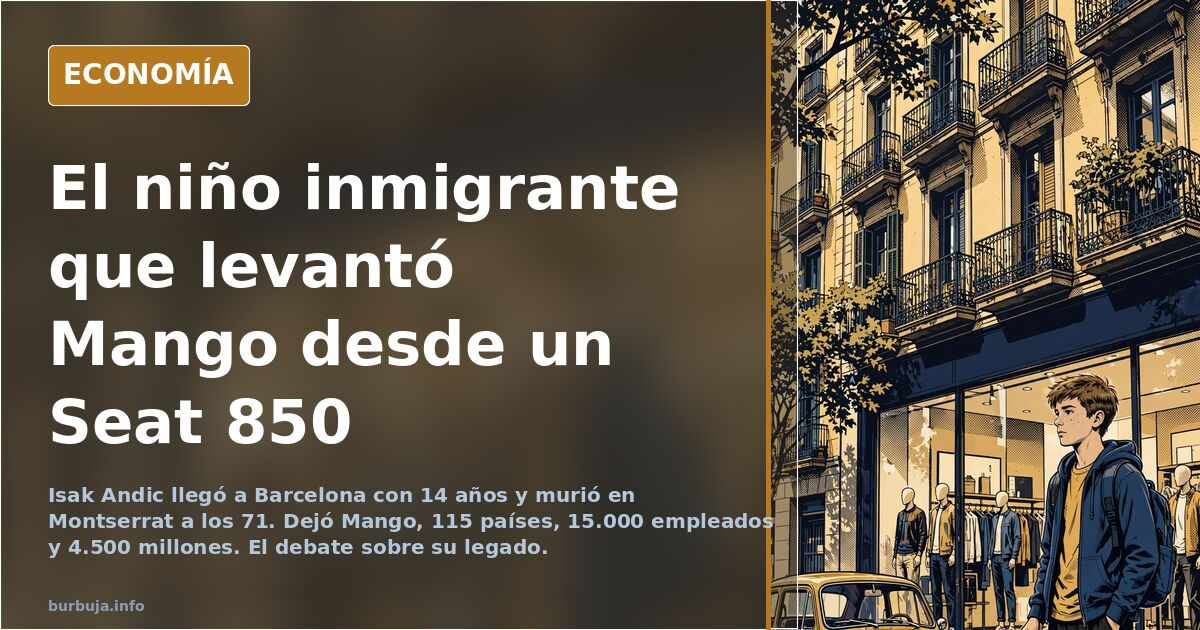
Isak Andic: From a Seat 850 to Mango’s €4.5 Billion
Isak Andic arrived in Barcelona in 1968 at age 14, fleeing Turkey amid political instability. Seventy-one years later, the Mango founder died after falling into a ravine while hiking in the Montserrat mountains, one of his passions alongside sailing. He left behind an estimated fortune of €4.5 billion, ranking fifth in Spain, and a company operating in 115 countries with 15,000 employees. The news, reported by El Correo, sparked a debate far beyond a simple obituary.
From Istanbul to Montserrat: The Life of Mango’s Founder
The Andic family is of Sephardic Jewish origin, expelled from Spain by the Catholic Monarchs and returning centuries later. Isak did not excel in school; the streets were his classroom. At 17, he began selling clothes bought in Turkey in Barcelona, saving for a Seat 850 and traveling across Spain using the trunk as storage. "Whether out of pride or honor, I wouldn't go home until the trunk was empty," he told El País Semanal.
The business grew with the hippie market, importing clothes from London and setting up a stall in a Barcelona flea market. Later came in-house manufacturing in Sabadell and several stores in Barcelona. In 1984, he peine the first Mango store on Passeig de Gràcia. The name, he explained, was chosen because he liked the fruit and it is pronounced similarly in many languages. Pure pragmatism.
Why Did Spanish Fashion Succeed Globally but Not in Luxury?
A recurring analysis suggests Spain is an anomaly: unable to lead in heavy industry, yet globally prominent in fashion. Mango and Inditex were born in the 70s, grew in the 80s, and survived the 90s. Some argue the business model is simple and replicable—there is no intellectual property in cuts, only in brands—which explains its scalability. The downside: this model has produced nothing in the high-end segment, except for exceptions that ceased to be local when acquired by foreign groups.
Industrial memory offers a counterpoint: Valencian factories like Lois, Old Chap, Caroche, Caster, Chaparral, Cimarrón, Chevignon, Privata, and Ferris disappeared. Cancelar, the Catalan textile hub, was reduced to nostalgia. Globalization swept away local production, leaving standing only those brands that scaled successfully.
The Source of Wealth: Personal Savings, External Credit, and Support Networks
Analysis diverges here. Some emphasize individual merit: intelligence, sacrifice, and hard work. Others note that jumping from zero to hundreds of millions is the difficult part, after which the system favors those already inside. Financing, they argue, is rarely neutral: family, regional, or community networks weigh more than the lone entrepreneur narrative admits.
El Corte Inglés is cited as an example where initial capital came from an uncle who emigrated to Cuba, not a specific community. The discussion shifts to banking: in Spain, it is argued, the banking sector was reserved for traditional families, and self-made entrepreneurs who tried to enter ended badly. Names mentioned include Ramón Areces, Ruiz Mateos, Mario Conde, and Andic himself regarding Banco Sabadell.
What Happens to a 15,000-Employee Company When Its Founder Dies?
Andic had handed management to Toni Ruiz but remained omnipresent. A father of three, he spent his active retirement sailing his yacht Nirvana Formentera and hiking. "Either you reinvent yourself, or you disappear," he often repeated. His favorite axiom was another: "In life, either you are the locomotive or the wagon." He chose the former.
Succession questions loom over his legacy. Some see a company of this size as a problem rather than an inheritance: place it and cash out. The family has so far given no signals about the company's future. Mango continues its path, having had a store on Manhattan's Fifth Avenue for two years, a dream Andic realized after overcoming a business crisis.
The locomotive that started in a Seat 850 keeps rolling. Who drives it now, and where it goes, is another story.
Isak Andic arrived in Barcelona in 1968 at age 14, fleeing Turkey amid political instability. Seventy-one years later, the Mango founder died after falling into a ravine while hiking in the Montserrat mountains, one of his passions alongside sailing. He left behind an estimated fortune of €4.5 billion, ranking fifth in Spain, and a company operating in 115 countries with 15,000 employees. The news, reported by El Correo, sparked a debate far beyond a simple obituary.
From Istanbul to Montserrat: The Life of Mango’s Founder
The Andic family is of Sephardic Jewish origin, expelled from Spain by the Catholic Monarchs and returning centuries later. Isak did not excel in school; the streets were his classroom. At 17, he began selling clothes bought in Turkey in Barcelona, saving for a Seat 850 and traveling across Spain using the trunk as storage. "Whether out of pride or honor, I wouldn't go home until the trunk was empty," he told El País Semanal.
The business grew with the hippie market, importing clothes from London and setting up a stall in a Barcelona flea market. Later came in-house manufacturing in Sabadell and several stores in Barcelona. In 1984, he peine the first Mango store on Passeig de Gràcia. The name, he explained, was chosen because he liked the fruit and it is pronounced similarly in many languages. Pure pragmatism.
Why Did Spanish Fashion Succeed Globally but Not in Luxury?
A recurring analysis suggests Spain is an anomaly: unable to lead in heavy industry, yet globally prominent in fashion. Mango and Inditex were born in the 70s, grew in the 80s, and survived the 90s. Some argue the business model is simple and replicable—there is no intellectual property in cuts, only in brands—which explains its scalability. The downside: this model has produced nothing in the high-end segment, except for exceptions that ceased to be local when acquired by foreign groups.
Industrial memory offers a counterpoint: Valencian factories like Lois, Old Chap, Caroche, Caster, Chaparral, Cimarrón, Chevignon, Privata, and Ferris disappeared. Cancelar, the Catalan textile hub, was reduced to nostalgia. Globalization swept away local production, leaving standing only those brands that scaled successfully.
The Source of Wealth: Personal Savings, External Credit, and Support Networks
Analysis diverges here. Some emphasize individual merit: intelligence, sacrifice, and hard work. Others note that jumping from zero to hundreds of millions is the difficult part, after which the system favors those already inside. Financing, they argue, is rarely neutral: family, regional, or community networks weigh more than the lone entrepreneur narrative admits.
El Corte Inglés is cited as an example where initial capital came from an uncle who emigrated to Cuba, not a specific community. The discussion shifts to banking: in Spain, it is argued, the banking sector was reserved for traditional families, and self-made entrepreneurs who tried to enter ended badly. Names mentioned include Ramón Areces, Ruiz Mateos, Mario Conde, and Andic himself regarding Banco Sabadell.
What Happens to a 15,000-Employee Company When Its Founder Dies?
Andic had handed management to Toni Ruiz but remained omnipresent. A father of three, he spent his active retirement sailing his yacht Nirvana Formentera and hiking. "Either you reinvent yourself, or you disappear," he often repeated. His favorite axiom was another: "In life, either you are the locomotive or the wagon." He chose the former.
Succession questions loom over his legacy. Some see a company of this size as a problem rather than an inheritance: place it and cash out. The family has so far given no signals about the company's future. Mango continues its path, having had a store on Manhattan's Fifth Avenue for two years, a dream Andic realized after overcoming a business crisis.
The locomotive that started in a Seat 850 keeps rolling. Who drives it now, and where it goes, is another story.
Also available in: Deutsch
Summary of a discussion on Burbuja.info - Foro de economía, actualidad y política., translated from Spanish and reviewed before publication. Read the full discussion (142 replies).
More summaries
-
Mossos arrest Isaac Andic's son for Mango founder's murder
Jonathan Andic arrested by Mossos d'Esquadra for killing his father, Mango founder. Forum debates digital evidence reliability and family dynamics in wealthy estates.
-
Pozuelo's El Corte Inglés reflects Madrid's class divide
El Corte Inglés in Pozuelo mirrors Madrid's social gap, with luxury cars and shopping habits highlighting the stark north-south economic divide.
-
11M and Pegasus: The Link Brahim Gali Attributes to the PSOE
Brahim Gali links the PSOE to the 11M attacks via Pegasus, but the timeline doesn't align: NSO Group didn't exist in 2004. An analysis of the detail that challenges the narrative.
-
Feminism support among Spanish youth drops to 54%
Youth identification with feminism in Spain fell from 64% to 54% in four years, widening the gender gap as male support drops to 40.9%.
-
US Election Turnout: 2020 Peak of 155M Votes Never Repeated
US turnout dropped from 155.5M votes in 2020 to approx. 129.3M in 2024, reigniting mail-ballot fraud debates.
-
Judge Peinado's Two IDs: Registry Error Sparks Political Feud
Spain's Property Registry confused several Juan Carlos Peinados. The alleged double ID for the judge is an administrative error turned political clash.