
Mangione case sparks US healthcare debate
Luigi Mangione's arrest after the UnitedHealthCare CEO murder fuels online discourse mixing healthcare criticism with fascination.
English · Original discussion in Spanish · Published
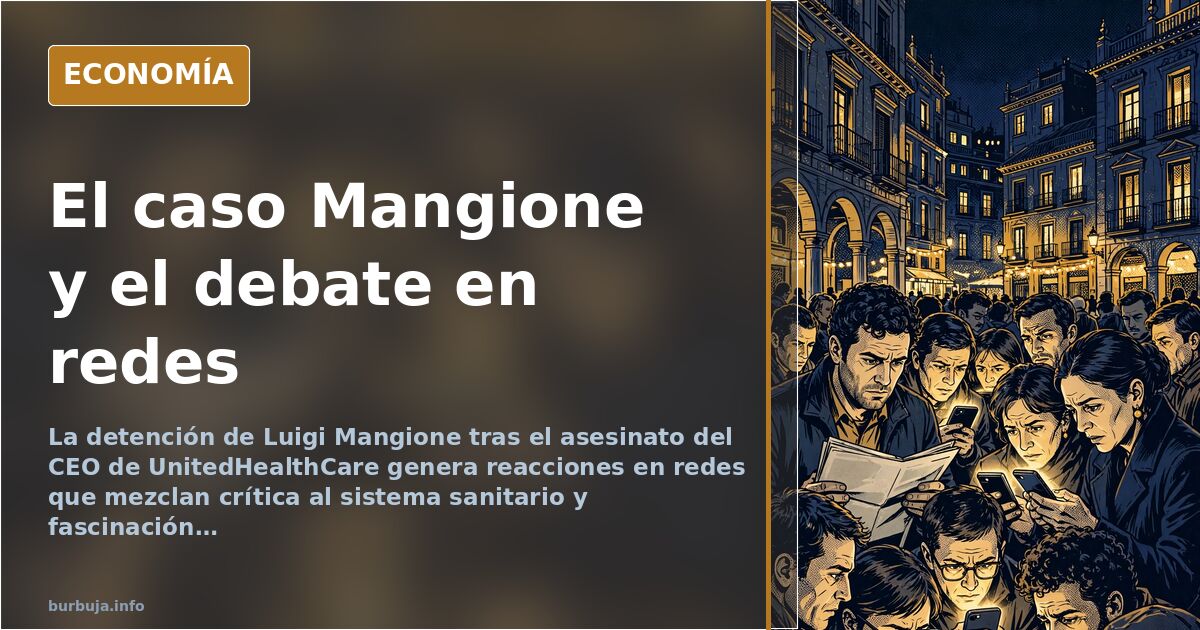
Mangione case sparks US healthcare debate
The murder of the UnitedHealthCare executive in New York has turned the alleged perpetrator, Luigi Mangione, into a mass phenomenon transcending legal proceedings. The young man’s arrest, described on forums as a "handsome Italian-American" from an affluent background, triggered a wave of reactions blending criticism of the US healthcare system with aesthetic fascination for the detainee. On social media platforms like X and Reddit, the event is analyzed through lenses ranging from conspiracy theories to sociological studies of political violence.
Profile of the suspect: From Ivy League to jail cell
Circulating data paints an atypical profile of Mangione. He is reportedly a "super intelligent" student who was injured while surfing in Hawaii and underwent back surgery with massive bills. Trinc this, according to circulating accounts, he isolated himself from family and friends, moved to Japan, and wrote a manifesto. His "upper-middle-class" origins and Ivy League education contrast sharply with the narrative of common incivil. Some argue he embraced anti-capitalist ideas after a severe incident, not through Marx or Bakunin, but via extreme personal experience.
The arrest occurred at a McDonald's, and reports suggest he was identified because he stopped to flirt with the employee. This detail, mixing the mundane with the tragic, fueled all kinds of comments. Burger King capitalized on the situation to launch a social media jab, illustrating how the event has permeated pop culture.
Debate on healthcare systems and political violence
The backdrop is outrage against health insurers. One participant argues that the murdered CEO’s company is involved in issues potentially causing trillions in damages, such as the fentanyl crisis or mRNA vaccines. Another recurring analysis notes that leaving millions to die for profit has consequences. "Actions bring consequences," summarizes one of the most repeated stances.
In this context, some view Mangione as the "ultimate supervillain" or a "Chad" who took action. Comments range from admiration to mockery, including vulgar comparisons about his sensual prowess versus others. The discussion shifts to political violence: questioning whether killing a wealthy white person carries fewer consequences than killing someone else, and speculating that in the US he will face life imprisonment, whereas in Spain he might have been released within ten years with benefits.
Online reaction: Fan cams and conspiracy theories
The event has generated a cult-like phenomenon. There are mentions of "fan cams" of the detainee and women laughing hysterically at his image. One participant noted that "at least Luigi isn't an incel NEET crying on forums about how bad women are," adding that although he wasn't her type, "I’d spread my legs for him too." Another voice joked there would be a queue in prison of young women wanting to sleep with the "alpha" for free.
Alongside this, hypotheses circulate that everything is a "psy-op" or distraction operation. A participant mentioned the dead CEO’s company ties to the US government and stated, "if it weren’t for pending lawsuits, I’d believe it." These theories lack evidence but form part of the media noise surrounding the case.
Psychological profile and context of violence
Analysis of Mangione’s profile intersects with debates on mental health and chronic pain. It is commented that "illnesses drastically change current psychosocial mechanisms" and that some people become "half-saints" or "ultra-religious" after serious illness. In Mangione’s case, speculation suggests he couldn’t maintain relationships due to back problems and that insurance caused further harm. "If true, he acted in defense of his rights brutally, but understandably," one intervention states.
The discussion moves toward the ethics of political violence. Some argue "if this set a precedent, many scumbags wouldn’t sleep peacefully again." Others warn that "pogre aren’t just bad; they’re also slow-witted," reflecting the polarization the case has generated.
The Mangione case remains open. Investigation continues, and theories about his motives and possible connections have only begun. Meanwhile, the debate on healthcare systems, political violence, and the role of media stays alive in every conversation.
The murder of the UnitedHealthCare executive in New York has turned the alleged perpetrator, Luigi Mangione, into a mass phenomenon transcending legal proceedings. The young man’s arrest, described on forums as a "handsome Italian-American" from an affluent background, triggered a wave of reactions blending criticism of the US healthcare system with aesthetic fascination for the detainee. On social media platforms like X and Reddit, the event is analyzed through lenses ranging from conspiracy theories to sociological studies of political violence.
Profile of the suspect: From Ivy League to jail cell
Circulating data paints an atypical profile of Mangione. He is reportedly a "super intelligent" student who was injured while surfing in Hawaii and underwent back surgery with massive bills. Trinc this, according to circulating accounts, he isolated himself from family and friends, moved to Japan, and wrote a manifesto. His "upper-middle-class" origins and Ivy League education contrast sharply with the narrative of common incivil. Some argue he embraced anti-capitalist ideas after a severe incident, not through Marx or Bakunin, but via extreme personal experience.
The arrest occurred at a McDonald's, and reports suggest he was identified because he stopped to flirt with the employee. This detail, mixing the mundane with the tragic, fueled all kinds of comments. Burger King capitalized on the situation to launch a social media jab, illustrating how the event has permeated pop culture.
Debate on healthcare systems and political violence
The backdrop is outrage against health insurers. One participant argues that the murdered CEO’s company is involved in issues potentially causing trillions in damages, such as the fentanyl crisis or mRNA vaccines. Another recurring analysis notes that leaving millions to die for profit has consequences. "Actions bring consequences," summarizes one of the most repeated stances.
In this context, some view Mangione as the "ultimate supervillain" or a "Chad" who took action. Comments range from admiration to mockery, including vulgar comparisons about his sensual prowess versus others. The discussion shifts to political violence: questioning whether killing a wealthy white person carries fewer consequences than killing someone else, and speculating that in the US he will face life imprisonment, whereas in Spain he might have been released within ten years with benefits.
Online reaction: Fan cams and conspiracy theories
The event has generated a cult-like phenomenon. There are mentions of "fan cams" of the detainee and women laughing hysterically at his image. One participant noted that "at least Luigi isn't an incel NEET crying on forums about how bad women are," adding that although he wasn't her type, "I’d spread my legs for him too." Another voice joked there would be a queue in prison of young women wanting to sleep with the "alpha" for free.
Alongside this, hypotheses circulate that everything is a "psy-op" or distraction operation. A participant mentioned the dead CEO’s company ties to the US government and stated, "if it weren’t for pending lawsuits, I’d believe it." These theories lack evidence but form part of the media noise surrounding the case.
Psychological profile and context of violence
Analysis of Mangione’s profile intersects with debates on mental health and chronic pain. It is commented that "illnesses drastically change current psychosocial mechanisms" and that some people become "half-saints" or "ultra-religious" after serious illness. In Mangione’s case, speculation suggests he couldn’t maintain relationships due to back problems and that insurance caused further harm. "If true, he acted in defense of his rights brutally, but understandably," one intervention states.
The discussion moves toward the ethics of political violence. Some argue "if this set a precedent, many scumbags wouldn’t sleep peacefully again." Others warn that "pogre aren’t just bad; they’re also slow-witted," reflecting the polarization the case has generated.
The Mangione case remains open. Investigation continues, and theories about his motives and possible connections have only begun. Meanwhile, the debate on healthcare systems, political violence, and the role of media stays alive in every conversation.
Also available in: Deutsch
Summary of a discussion on Burbuja.info - Foro de economía, actualidad y política., translated from Spanish and reviewed before publication. Read the full discussion (159 replies).
More summaries
-
McDonald's and Burger King claim they pay better, yet staff shortages persist
87% of major restaurant groups faced hiring difficulties last year, while 81% struggle with absenteeism. McDonald's entry-level salary is 18,271 euros annually.
-
Burger King Staff Assaulted in Spain, No Charges Filed
Mothers attacked Burger King employees in Molina de Segura, Spain, over a slow order. Police have footage, but no complaint was filed.
-
Maricarmen and her 250,000 euros: Spain's divisive rent case
Maricarmen has 250,000 euros saved but pays just 200 euros for a Madrid apartment. Her case highlights Spain's complex housing crisis.
-
Miami hospital bills $40,000 for broken arm
A broken humerus in Miami led to a €40,000 bill. The family negotiated a discount and contacted their insurer, having skipped travel insurance.
-
Spain Reservoirs Hit 66% vs 48% in 2023, Challenging Drought Narrative
Reservoir data shows Spain's water levels rose from 48.24% to 66.30% in one year, with Catalonia increasing significantly.
-
Illa denies mandatory vaccination amid COVID passport debate
Salvador Illa claims no one was forced to vaccinate. However, the use of COVID passports and PCR tests has reignited debates on coercion.