
Man threatens to burn down bar in León with gasoline
A man in a Spanish town threatened to set fire to a bar filled with customers, sparking a debate over security and public safety.
English · Original discussion in Spanish · Published
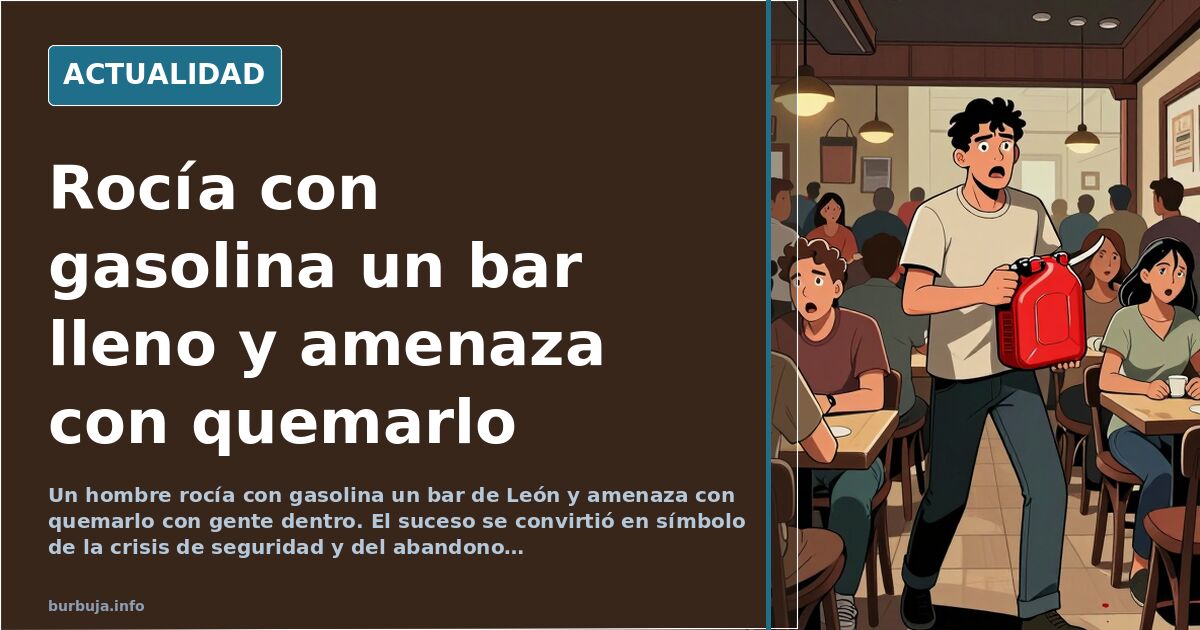
Man splashes gasoline on a bar in León and threatens to burn it down
A town in León, a bar full of customers, and a man with a jerrycan of gasoline ready to set it on fire. The video is circulating on social media with a message attributing the episode to "the Spain of the PSOE" (the ruling socialist party), but the footage itself reveals a much more prosaic reality: an individual, a premises that did not burn, and about twenty people watching from inside without intervening. The recorded and widely shared scene has become the trigger for a debate mixing security, immigration, and the feeling that the State has stopped protecting ordinary citizens.
What exactly peine at the León bar
The video shows a man spreading gasoline on the ground near the entrance of a hospitality establishment, threatening to set it on fire with people inside. There are no flames, no injuries, and no fire: there is only a jerrycan, a lighter, and a threat. The premises were full, according to those commenting on the images, and no one went out to subdue the individual. That passivity, rather than the attacker's action, is what indignates many viewers of the clip.
The discussion quickly shifted toward identity politics. Some claim the detainee is of Honduran origin, while others assert he is "a very local and very Leonese troublemaker." Neither version is confirmed by the material. The only verifiable facts are that an arrest was made, the premises did not burn, and the video was recorded in a town in León.
Why did nobody step in to stop him?
This question runs through the entire conversation. A premises with more than a dozen people inside and a single man with a jerrycan: the math invites intervention. The recurring answer is not cowardice, but legal calculation. It is argued that anyone who subdues an aggressor ends up being charged, having to indemnify the attacker, and facing the justice system. This is the most prominent thesis in the material: the perception that the legal system protects the incivil and punishes the one who reacts.
Against this, another current maintains that the passivity is cultural, not legal—that forty years of domesticity have left the average Spaniard without survival instincts. "We whites have lost the instinct," some even say. The debate gets tangled here between the antiestéticar of prison and the antiestéticar of death, and it remains unresolved.
The security crisis as a political framework
The original message frames the episode within the "security crisis" it attributes to the Socialist Government. This is the core of the matter: a local event turned into proof of a national thesis. In that narrative, the bar in León is not an isolated case, but the tip of an iceberg that includes the feeling that justice is overly protective of defendants (garantismo) and the State is incompetent.
The institutional response being demanded is confused. Some call for harsher penalties, including express death penalties. Others point out that police officers neglect their duties and judges release detainees, meaning there is no one to hold accountable. A third, more cynical line suggests that the only sensible thing is to hide and let the State act, because intervening is too costly.
The narrative of enrichment and "Empty Spain"
Part of the material drifts toward immigration. It is claimed that in Spain, migrants are present even in the most remote villages, something that, according to this version, would not even happen in France. This is an assertion made without data that the material itself does not support. What it does reflect is a widespread perception: that rural Spain has changed and that this change is met with suspicion.
Another current responds with irony. There is sarcastic talk of "enrichment," mentions of the town's socialist voters, and insinuations that those who vote for the PSOE should deal with the consequences. This is the most political and predictable part of the matter.
The detainee and the unknowns
The material does not clarify the detainee's nationality, his administrative status, or whether he had a incivil record. All of this is speculated upon, but no version is confirmed. The only certainties are that an arrest took place and the premises did not catch fire. Any conclusion regarding the attacker's origin is, as of today, mere speculation.
What is clear is that the episode has become a symbol. A symbol of insecurity, the abandonment of the rural world, and the feeling that institutions are not responding. The bar in León did not burn. The debate, however, remains ignited.
Some call for deportation, some for exemplary punishments, and some simply want to know what peine. The video does not say. Neither does the news. And meanwhile, the town remains, with its bar and its jerrycan.
A town in León, a bar full of customers, and a man with a jerrycan of gasoline ready to set it on fire. The video is circulating on social media with a message attributing the episode to "the Spain of the PSOE" (the ruling socialist party), but the footage itself reveals a much more prosaic reality: an individual, a premises that did not burn, and about twenty people watching from inside without intervening. The recorded and widely shared scene has become the trigger for a debate mixing security, immigration, and the feeling that the State has stopped protecting ordinary citizens.
What exactly peine at the León bar
The video shows a man spreading gasoline on the ground near the entrance of a hospitality establishment, threatening to set it on fire with people inside. There are no flames, no injuries, and no fire: there is only a jerrycan, a lighter, and a threat. The premises were full, according to those commenting on the images, and no one went out to subdue the individual. That passivity, rather than the attacker's action, is what indignates many viewers of the clip.
The discussion quickly shifted toward identity politics. Some claim the detainee is of Honduran origin, while others assert he is "a very local and very Leonese troublemaker." Neither version is confirmed by the material. The only verifiable facts are that an arrest was made, the premises did not burn, and the video was recorded in a town in León.
Why did nobody step in to stop him?
This question runs through the entire conversation. A premises with more than a dozen people inside and a single man with a jerrycan: the math invites intervention. The recurring answer is not cowardice, but legal calculation. It is argued that anyone who subdues an aggressor ends up being charged, having to indemnify the attacker, and facing the justice system. This is the most prominent thesis in the material: the perception that the legal system protects the incivil and punishes the one who reacts.
Against this, another current maintains that the passivity is cultural, not legal—that forty years of domesticity have left the average Spaniard without survival instincts. "We whites have lost the instinct," some even say. The debate gets tangled here between the antiestéticar of prison and the antiestéticar of death, and it remains unresolved.
The security crisis as a political framework
The original message frames the episode within the "security crisis" it attributes to the Socialist Government. This is the core of the matter: a local event turned into proof of a national thesis. In that narrative, the bar in León is not an isolated case, but the tip of an iceberg that includes the feeling that justice is overly protective of defendants (garantismo) and the State is incompetent.
The institutional response being demanded is confused. Some call for harsher penalties, including express death penalties. Others point out that police officers neglect their duties and judges release detainees, meaning there is no one to hold accountable. A third, more cynical line suggests that the only sensible thing is to hide and let the State act, because intervening is too costly.
The narrative of enrichment and "Empty Spain"
Part of the material drifts toward immigration. It is claimed that in Spain, migrants are present even in the most remote villages, something that, according to this version, would not even happen in France. This is an assertion made without data that the material itself does not support. What it does reflect is a widespread perception: that rural Spain has changed and that this change is met with suspicion.
Another current responds with irony. There is sarcastic talk of "enrichment," mentions of the town's socialist voters, and insinuations that those who vote for the PSOE should deal with the consequences. This is the most political and predictable part of the matter.
The detainee and the unknowns
The material does not clarify the detainee's nationality, his administrative status, or whether he had a incivil record. All of this is speculated upon, but no version is confirmed. The only certainties are that an arrest took place and the premises did not catch fire. Any conclusion regarding the attacker's origin is, as of today, mere speculation.
What is clear is that the episode has become a symbol. A symbol of insecurity, the abandonment of the rural world, and the feeling that institutions are not responding. The bar in León did not burn. The debate, however, remains ignited.
Some call for deportation, some for exemplary punishments, and some simply want to know what peine. The video does not say. Neither does the news. And meanwhile, the town remains, with its bar and its jerrycan.
Also available in: Deutsch
Summary of a discussion on Burbuja.info - Foro de economía, actualidad y política., translated from Spanish and reviewed before publication. Read the full discussion (102 replies).
More summaries
-
Latin gang fight in León: eight arrested, machetes seized
Eight arrested and machetes seized in a Latin gang fight in León's Húmedo neighborhood, the first documented incident of its kind in the city.
-
León Wildfires: Smoke, Evacuations and Valdeón Defiance
Wildfires in León spark controversy over resource allocation as Valdeón residents refuse evacuation amid heavy smoke.
-
Man Arrested for Attempted Arson at Jewish Pizzeria in Madrid
A 23-year-old Spanish national is held in pre-trial detention for attempting to set fire to a Jewish pizzeria in Madrid on March 4.
-
The PISA Mirage: Why Regional IQ Maps Mislead
A viral map of regional IQ is debunked: data is from re-scaled PISA 2015 results, lacking psychometric validity.
-
Four arrested after Danish tourist killed in Fuerteventura
A Danish tourist was killed in Fuerteventura after being attacked with an iron beam during a mobile phone robbery. Four suspects have been detained.
-
Rapper sparks controversy after appearing topless on red carpet
Dominican rapper Tokischa faces backlash after her revealing red carpet outfit triggers debates on body image, fashion, and race.