
Man stabbed to death on night bus in Castelldefels
A man died after being stabbed on a night bus in Castelldefels, Spain. Police are investigating the homicide while searching for the suspect.
English · Original discussion in Spanish · Published
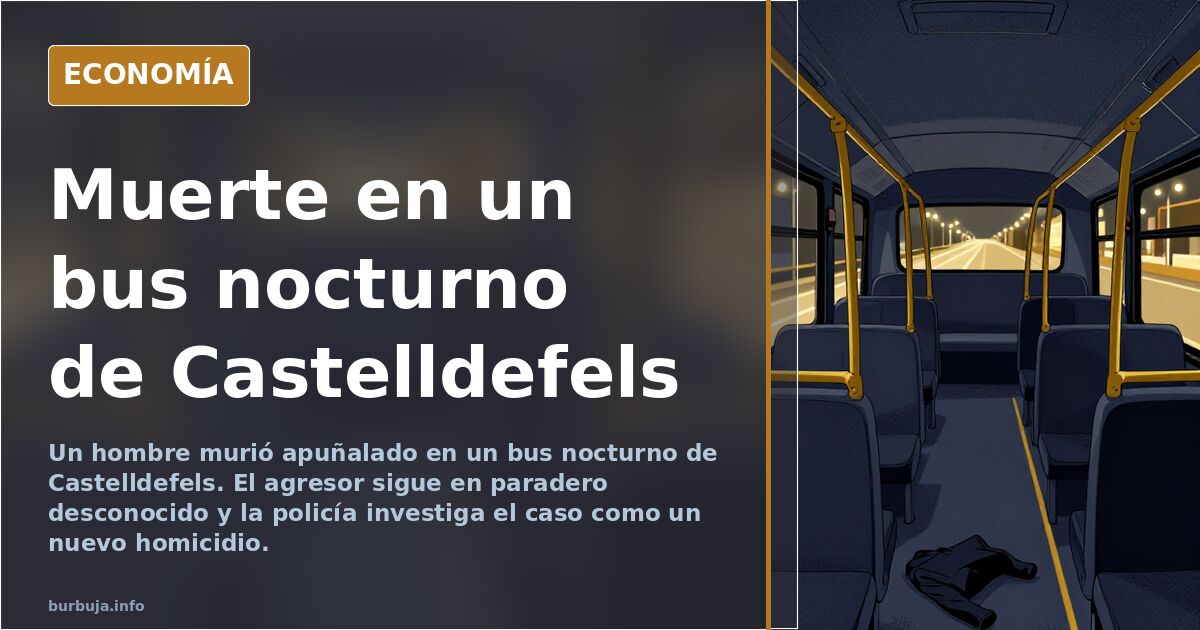
Man stabbed to death on night bus in Castelldefels
A night bus traveling through Castelldefels (Baix Llobregat) became the scene of a dispute between two passengers early Friday morning, ending with one man fatally stabbed. The victim, initially unidentified but reportedly of Indian origin, received two knife wounds and died later that morning at Bellvitge Hospital. The attacker, described as a man of North African origin, remains at large and is actively sought by police, according to ElCaso.com.
The incident occurred around 5:00 AM at the Plaça Colom stop, between Avinguda de la Constitució and Carrer Juan de la Cierva. The fight started inside the vehicle, escalated, and ended violently on the street. Authorities are investigating it as a new homicide, though the motive and prior relationship between those involved have not yet been disclosed.
What is known about the incident and investigation
Early reports reconstruct a brief and chaotic sequence. Two men argued inside the night bus for reasons under investigation. When the bus reached the Plaça Colom stop, the attacker pulled a blade outside and stabbed the victim twice, causing him to collapse unconscious from blood loss. The wounds proved fatal. Death was certified hours later at Bellvitge Hospital.
The victim's identification was incomplete when initial details emerged. Journalistic sources explicitly noted he was not fully identified, though indications pointed to Indian origin. This precision matters because, in such cases, nationality and origin often dominate public debate before official confirmation. Meanwhile, the suspect has not been located.
The recurring pattern in nighttime public transport
Much of the discussion shifted toward an uncomfortable idea: the perception that nighttime public transport has become a high-risk environment. This is not a new argument. The debate intertwines feelings of insecurity, lack of physical preparedness to react to stabbing attacks, and the notion that neither pepper spray nor self-defense classes offer protection against someone determined to use a weapon. Comparisons to the New York City subway system of the 1980s frequently appear.
The data supporting this perception lies in the nature of the event itself: a dispute starting inside a bus and ending with stabbings on the street. From there, interpretations vary. Some demand increased police presence and random checks; others argue the issue is not surveillance but the inability to defend oneself. The debate stalls exactly there, over the division of responsibility between prevention and self-defense.
How male victims are framed in homicide reporting
One repeated criticism targets media coverage. It is argued that some Catalan outlets barely mention the case or dismiss it as a trivial "man dies after brawl." The claim is that such language dilutes the victim status when the deceased is male, suggesting this role is only clearly recognized for specific profiles.
The discussion on journalistic language has practical implications regarding how incidents are labeled. The term "new crime" used in original texts was also mocked. Describing the victim as "of Indian origin" before full identification sparked comments on terminological accuracy: Hindu is a religion, not a nationality. These small details, collectively, fuel distrust toward the official narrative.
Imported conflicts nobody asked for
Another line of argument, more geopolitical, suggests such confrontations stem from imported tensions between South Asian communities. Proponents cite recurrent conflicts between people of Indian and Pakistani origin in Canada, the UK, or the US, arguing these frictions reach Europe via migration. The widely repeated thesis is that Kashmir conflict and India-Pakistan rivalry spill into European neighborhoods.
Opposing views note that India has the world's third-largest Muslim population, behind Pakistan, and reducing the issue to a clash of civilizations oversimplifies a fragmented reality. Labor and housing tensions among migrant communities are also cited as driven by competition for resources, housing, and jobs, rather than solely religious identity. Without official data on the motive, any explanatory framework remains hypothetical.
Political response and instrumentalization of the case
The incident immediately entered partisan disputes. Some attribute such episodes to the rise of far-right movements, while others use them to reinforce links between immigration and crime. The debate oscillates between these poles without clarifying facts. The ironic refrain that "immigration and crime are unrelated" functions more as a tribal marker than an argument.
Parallel calls for tough measures include random searches, forced labor penalties for weapon possession, and greater police presence. Responses remind citizens that a police state carries costs. The conversation closes, as usual, without agreement on which concrete measure would have prevented this specific death. This is where analysis stalls: everyone has an explanation, no one has a verifiable solution.
Also available in: Deutsch
Summary of a discussion on Burbuja.info - Foro de economía, actualidad y política., translated from Spanish and reviewed before publication. Read the full discussion (127 replies).
More summaries
-
Buxadé claims Sánchez deployed snipers in Hospitalet
Vox MEP Jorge Buxadé alleges that Spanish PM Pedro Sánchez brought elite snipers to Hospitalet, sparking debate over the high cost of presidential security.
-
India strikes nine targets in Pakistan and Kashmir
India hits nine sites in Pakistan and Kashmir. Islamabad closes airspace, preparing retaliation amid largest peacetime missile attack.
-
Spain to 30 Million: The Proposal and Its Achilles Heel
A proposal to reduce Spain’s population to 30-35 million clashes with an aging demographic and persistently low birth rates.
-
10,500 Grandchildren Law files in Argentina show no proof of exile
The Buenos Aires consulate has reviewed 10,500 files under Spain's Grandchildren Law and found no proof of exile in any of them. Spain's Supreme Court is demanding the list of those affected.
-
Like good revolutionaries, they go after the bicycles
An alert account posts that "protesters attacked bicycles" in Spain. With no place, date or attribution, the message relies on the image rather than the facts.
-
VOX vote sentiment on the streets of Spain: a nerdy guy and three girls who won't vote
A walk through the Inca fair in Mallorca leaves the impression that PP and VOX are failing to mobilise voters, and that the useful vote may end up with the PSOE.