
Man Forces Exit From Spanish Courthouse After Mouliaá Press Conference
A man of Romani ethnicity forced his way out of a courthouse in Spain after blocking journalists during Elisa Mouliaá's press conference.
English · Original discussion in Spanish · Published
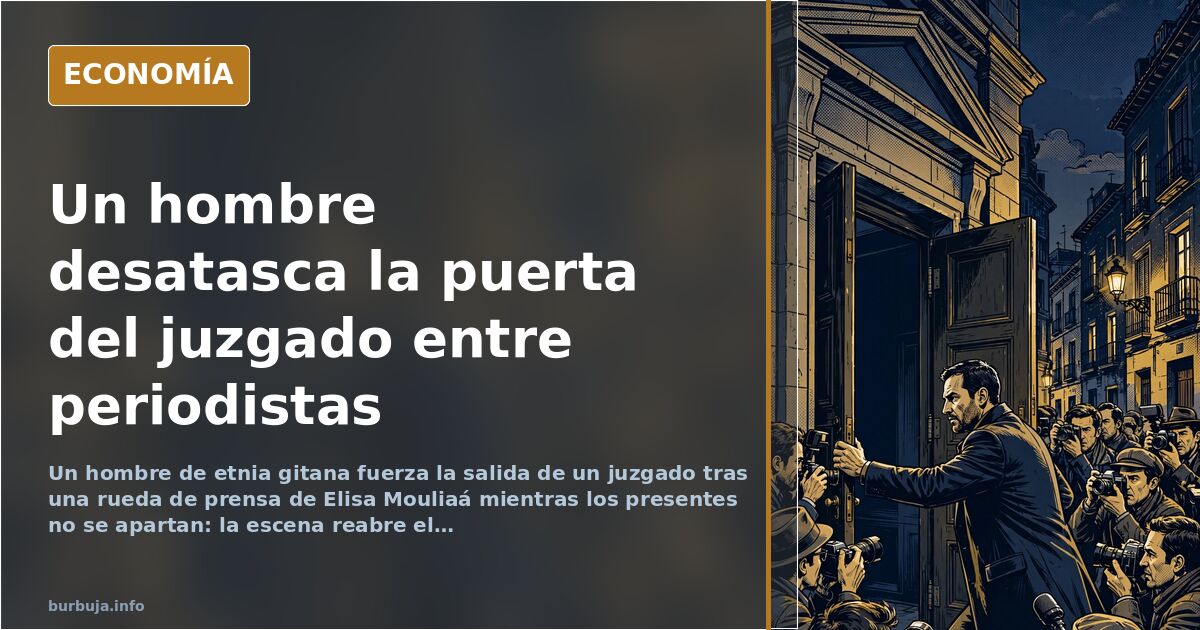
Man Unblocks Courthouse Door Amid Elisa Mouliaá Press Event
A tense scene at a courthouse entrance has highlighted a common habit in Spain: blocking pathways and reacting defensively when asked to move. During a press conference held by Elisa Mouliaá, a Romani man—referred to in the footage as "el tano"—verbally struggled to exit the building while a group of journalists and onlookers remained stationed at the doorway. The video, circulated on social media, shows the man raising his voice, demanding passage, and eventually forcing his way through those who refused to step aside.
The Incident Is Not an Isolated Case, but rather another confirmation of a behavior repeated in doorways, platforms, and metro cars across Spain: the inability to make way. Subsequent debate focused on whether the man’s anger was justified or if priority should have been given to Mouliaá’s press event. Most comments captured in the material supported the former view.
What Peine at the Courthouse Door
The video, shared by a social media account, captures the moment a Romani man attempts to leave the judicial building only to find the door blocked by a crowd, including several journalists covering Mouliaá’s appearance. The man loudly asks for passage. No one moves. He insists. Still no movement. Finally, he raises his voice, and only then does the group part ways.
The Reaction from Those Present—laughter, mocking comments, and gestures of offense—is what provoked the most irritation in the analyzed material. Some argue that the journalists behaved as if their work granted them special rights to occupy public space. Counterarguments state that the press conference was the legitimate reason for the gathering. Regardless, the outcome was identical: no one moved until someone shouted.
Doorway Blockages as a National Symptom
The conversation quickly expanded into a broader diagnosis. The habit of stopping in narrow spaces—train doors, stairwells, elevator exits—is described in the material as a cultural trait. "Standing right in the middle is a widespread custom in Spain," summarizes one comment. Another cites the metro: those boarding stand in the center, preventing passengers from exiting.
The conclusion drawn from this line of reasoning is uncomfortable: Malice is unnecessary; unawareness suffices. The blockage isn’t planned but results from many individuals failing to consider how their position affects others. When the problem is pointed out, the reaction is often defensiveness rather than cooperation.
Who Has Authority to Demand Passage?
One widely discussed aspect was the contrast between a security guard’s intervention and that of the man who finally cleared the exit. The guard, speaking calmly, received no response. The man, shouting, did. The material interprets this as a lesson about real authority versus formal authority: power derived from presence rather than uniform.
An ethnic component in the group’s reaction is also noted. Some suggest that if the person requesting passage had been a professional in a suit, the response would have differed. While unproven, the recurrence of this claim indicates how deeply the incident was read through the lens of social hierarchy.
Media’s Role in Public Space
Part of the criticism targets the journalists’ attitude. The notion that reporting justifies occupying space is firmly rejected: "As if that gave you some kind of special power," reads one message. Criticism focuses less on coverage of the event and more on spatial management during it.
Mouliaá herself faces reproach for not intervening to clear the exit. The press conference was hers, implying she bore significant responsibility for ensuring the area didn’t become a bottleneck. No one asked her to act. She didn’t.
What This Reveals About Urban Coexistence
Beyond the specific incident, the material emphasizes a key idea: Civility isn’t corrected by campaigns but by friction. The shouting man wasn’t trying to teach a lesson; he simply wanted to leave. Yet his reaction succeeded where politeness failed. Several comments agree the scene will repeat until clear social norms govern shared spaces.
It remains uncertain if the episode will lead to any consequences beyond the viral video. Predictably, it won’t. The courthouse door will fill again, journalists will position themselves conveniently, and someone will inevitably shout to get through. The only question is how long until next time.
Key Data Points
A tense scene at a courthouse entrance has highlighted a common habit in Spain: blocking pathways and reacting defensively when asked to move. During a press conference held by Elisa Mouliaá, a Romani man—referred to in the footage as "el tano"—verbally struggled to exit the building while a group of journalists and onlookers remained stationed at the doorway. The video, circulated on social media, shows the man raising his voice, demanding passage, and eventually forcing his way through those who refused to step aside.
The Incident Is Not an Isolated Case, but rather another confirmation of a behavior repeated in doorways, platforms, and metro cars across Spain: the inability to make way. Subsequent debate focused on whether the man’s anger was justified or if priority should have been given to Mouliaá’s press event. Most comments captured in the material supported the former view.
What Peine at the Courthouse Door
The video, shared by a social media account, captures the moment a Romani man attempts to leave the judicial building only to find the door blocked by a crowd, including several journalists covering Mouliaá’s appearance. The man loudly asks for passage. No one moves. He insists. Still no movement. Finally, he raises his voice, and only then does the group part ways.
The Reaction from Those Present—laughter, mocking comments, and gestures of offense—is what provoked the most irritation in the analyzed material. Some argue that the journalists behaved as if their work granted them special rights to occupy public space. Counterarguments state that the press conference was the legitimate reason for the gathering. Regardless, the outcome was identical: no one moved until someone shouted.
Doorway Blockages as a National Symptom
The conversation quickly expanded into a broader diagnosis. The habit of stopping in narrow spaces—train doors, stairwells, elevator exits—is described in the material as a cultural trait. "Standing right in the middle is a widespread custom in Spain," summarizes one comment. Another cites the metro: those boarding stand in the center, preventing passengers from exiting.
The conclusion drawn from this line of reasoning is uncomfortable: Malice is unnecessary; unawareness suffices. The blockage isn’t planned but results from many individuals failing to consider how their position affects others. When the problem is pointed out, the reaction is often defensiveness rather than cooperation.
Who Has Authority to Demand Passage?
One widely discussed aspect was the contrast between a security guard’s intervention and that of the man who finally cleared the exit. The guard, speaking calmly, received no response. The man, shouting, did. The material interprets this as a lesson about real authority versus formal authority: power derived from presence rather than uniform.
An ethnic component in the group’s reaction is also noted. Some suggest that if the person requesting passage had been a professional in a suit, the response would have differed. While unproven, the recurrence of this claim indicates how deeply the incident was read through the lens of social hierarchy.
Media’s Role in Public Space
Part of the criticism targets the journalists’ attitude. The notion that reporting justifies occupying space is firmly rejected: "As if that gave you some kind of special power," reads one message. Criticism focuses less on coverage of the event and more on spatial management during it.
Mouliaá herself faces reproach for not intervening to clear the exit. The press conference was hers, implying she bore significant responsibility for ensuring the area didn’t become a bottleneck. No one asked her to act. She didn’t.
What This Reveals About Urban Coexistence
Beyond the specific incident, the material emphasizes a key idea: Civility isn’t corrected by campaigns but by friction. The shouting man wasn’t trying to teach a lesson; he simply wanted to leave. Yet his reaction succeeded where politeness failed. Several comments agree the scene will repeat until clear social norms govern shared spaces.
It remains uncertain if the episode will lead to any consequences beyond the viral video. Predictably, it won’t. The courthouse door will fill again, journalists will position themselves conveniently, and someone will inevitably shout to get through. The only question is how long until next time.
Key Data Points
- The video was spread via social media and shows Elisa Mouliaá’s press conference.
- The man who cleared the exit is identified in the material as "el tano."
- Subsequent discussion centered on journalists’ behavior and lack of civic awareness in public spaces.
Also available in: Deutsch
Summary of a discussion on Burbuja.info - Foro de economía, actualidad y política., translated from Spanish and reviewed before publication. Read the full discussion (167 replies).
More summaries
-
White House Calls Urgent Press Conference on Economic Policy
The White House has scheduled an emergency press briefing, sparking market speculation and debate over potential economic announcements.
-
Death in Catalan prison: tension among inmates rises
A Maghrebi inmate allegedly killed a fellow prisoner of Romani ethnicity in a Catalan prison. Inter-group tension is growing, and the State may offer compensation.
-
Sánchez leaves Ourense press conference after journalist faints
A journalist fainted during Prime Minister Sánchez's appearance in Ourense, reportedly due to heatstroke. The leader left the room mid-emergency briefing.
-
Depression and precarity: The wall attitude cannot break
A forum user argues depression arises when expectations clash with reality; others respond that positive attitude is not enough.
-
Fuerteventura: Unverified video of British tourist sparks debate
An unverified video about a British tourist and machetes in Fuerteventura reignites tension between tourism and perceived insecurity.
-
Gold up 19.5% annually as fiat currency loses value
Gold posts a 19.5% annual gain while euro savings lose purchasing power. Money creation under scrutiny.