
Man escapes 20-year captivity by stepmother via fire
A severely malnourished man escaped two decades of confinement by starting a fire. The case echoes the Fritzl scandal, revealing hidden domestic abuse.
English · Original discussion in Spanish · Published
Man escapes 20-year captivity by stepmother via fire
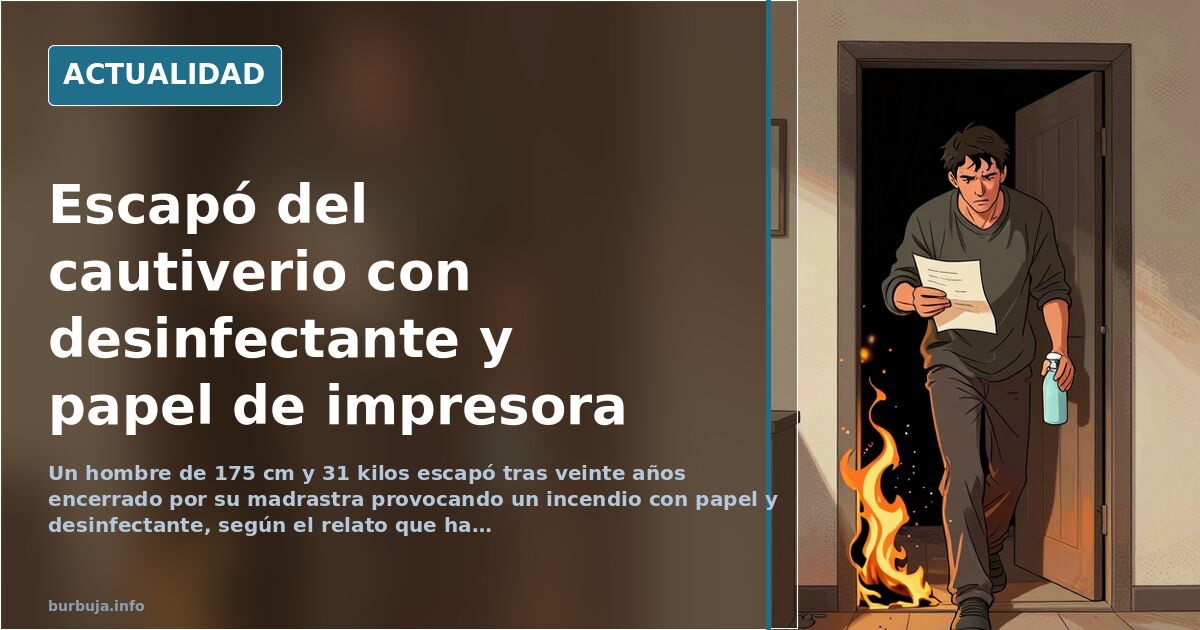
A man has managed to flee the house where his stepmother kept him imprisoned since he was fourteen. He did so by starting a fire with printer paper and hand sanitizer, according to accounts circulating about the case. The woman fled the flames. So did he. The neighborhood, which suspected nothing, was horrified to discover that he had been a prisoner for nearly two decades just meters from their homes.
The captivity trinc a textbook pattern: practically locked up 24 hours a day, fed twice daily with tuna and egg or peanut butter sandwiches. No medical assistance. No dentist. The young man's father was wheelchair-bound and died years later. According to available data, the rescued man weighs 31 kilograms at a height of 175 centimeters.
What is known about the case and the stepmother
The stepmother appears as the central figure in the confinement. There is no official confirmation of conviction or indictment in the available material, but reports suggest the father also knew of the situation: the young man attempted to escape several times and it was the father himself who discovered him during some of those attempts. The complicity or authorship of the parent remains one of the unresolved pieces of the case.
The parallel with other cases of domestic captivity is inevitable. The case of a French woman who kept her daughter locked up until she was rescued under extreme conditions has been recalled, as well as the case of Elisabeth Fritzl in Austria, where the victim emerged after more than two decades and had to change identities along with her children. The question hovering over any analysis: how many similar cases never come to light?
The physical and mental state of the rescued man
The clinical picture described is that of a person who has survived without healthcare for twenty years. Extreme weight loss, total absence of dental care, zero exposure to sunlight. Some argue that mentally he will not recover. Others contend the opposite: if he did not lose his sanity in two decades of isolation, he has the resources to rebuild. The comparison with the French victim, who did present severe cognitive deterioration, is used in both directions.
What coincides in almost all analyses is that the aftermath will be permanent. Someone who has lived confined since adolescence has no references for normal adult life: they have not managed money, signed a contract, or had a romantic relationship outside that perimeter. Freedom, in his case, is a category that must be learned from scratch.
The recurring pattern: relatives who confine
This case is not a black swan. The casuistry of people confined by their own family members—parents, stepmothers, partners—has documented episodes in several countries. The profile of the domestic captor rarely fits the incivil stereotype: it is usually someone from the immediate environment, capable of maintaining a normal facade before neighbors for years.
In Spain, cases of confinement of children with disabilities have been documented in past decades, hidden to avoid social judgment from the community. The logic is the same: the victim ceases to exist for the outside world, and the captor manages that invisibility as if it were just another domestic routine. Meanwhile, the neighborhood sees nothing because there is nothing to see from the outside.
Questions left open
The fire that allowed the escape also destroyed part of the scene. This complicates the subsequent investigation: what material evidence remains, what testimonies can be reconstructed, whether the deceased father left any documentary trace of what peine. The death of the parent, years ago, closes one avenue of incivil responsibility but opens another: that of those who could have known and did nothing.
The disorienting fact is not the weight or the years. It is that a man was able to devise an escape plan with two household items after twenty years without room to maneuver. The question is not how he did it. It is why nobody did it for him sooner.
A man has managed to flee the house where his stepmother kept him imprisoned since he was fourteen. He did so by starting a fire with printer paper and hand sanitizer, according to accounts circulating about the case. The woman fled the flames. So did he. The neighborhood, which suspected nothing, was horrified to discover that he had been a prisoner for nearly two decades just meters from their homes.
The captivity trinc a textbook pattern: practically locked up 24 hours a day, fed twice daily with tuna and egg or peanut butter sandwiches. No medical assistance. No dentist. The young man's father was wheelchair-bound and died years later. According to available data, the rescued man weighs 31 kilograms at a height of 175 centimeters.
What is known about the case and the stepmother
The stepmother appears as the central figure in the confinement. There is no official confirmation of conviction or indictment in the available material, but reports suggest the father also knew of the situation: the young man attempted to escape several times and it was the father himself who discovered him during some of those attempts. The complicity or authorship of the parent remains one of the unresolved pieces of the case.
The parallel with other cases of domestic captivity is inevitable. The case of a French woman who kept her daughter locked up until she was rescued under extreme conditions has been recalled, as well as the case of Elisabeth Fritzl in Austria, where the victim emerged after more than two decades and had to change identities along with her children. The question hovering over any analysis: how many similar cases never come to light?
The physical and mental state of the rescued man
The clinical picture described is that of a person who has survived without healthcare for twenty years. Extreme weight loss, total absence of dental care, zero exposure to sunlight. Some argue that mentally he will not recover. Others contend the opposite: if he did not lose his sanity in two decades of isolation, he has the resources to rebuild. The comparison with the French victim, who did present severe cognitive deterioration, is used in both directions.
What coincides in almost all analyses is that the aftermath will be permanent. Someone who has lived confined since adolescence has no references for normal adult life: they have not managed money, signed a contract, or had a romantic relationship outside that perimeter. Freedom, in his case, is a category that must be learned from scratch.
The recurring pattern: relatives who confine
This case is not a black swan. The casuistry of people confined by their own family members—parents, stepmothers, partners—has documented episodes in several countries. The profile of the domestic captor rarely fits the incivil stereotype: it is usually someone from the immediate environment, capable of maintaining a normal facade before neighbors for years.
In Spain, cases of confinement of children with disabilities have been documented in past decades, hidden to avoid social judgment from the community. The logic is the same: the victim ceases to exist for the outside world, and the captor manages that invisibility as if it were just another domestic routine. Meanwhile, the neighborhood sees nothing because there is nothing to see from the outside.
Questions left open
The fire that allowed the escape also destroyed part of the scene. This complicates the subsequent investigation: what material evidence remains, what testimonies can be reconstructed, whether the deceased father left any documentary trace of what peine. The death of the parent, years ago, closes one avenue of incivil responsibility but opens another: that of those who could have known and did nothing.
The disorienting fact is not the weight or the years. It is that a man was able to devise an escape plan with two household items after twenty years without room to maneuver. The question is not how he did it. It is why nobody did it for him sooner.
Also available in: Deutsch
Summary of a discussion on Burbuja.info - Foro de economía, actualidad y política., translated from Spanish and reviewed before publication. Read the full discussion (111 replies).
More summaries
-
Austria Abuse and Arson: Youth Violence Spiral
Austria abuse and arson: analyzing the youth violence spiral following incidents involving minors and drug trafficking.
-
Murcia rape livestream: three arrested, two released
A man was drugged with fentanyl and morphine in Murcia before being raped on a live stream watched by 30 people. Three suspects have been detained.
-
Spain's 'Curse' Theory: Forum Claims Link Franco Exhumation to Crises
A pandemic, volcanic eruption, blackout, and perceived systemic corruption in under a decade fuel online theories blaming the exhumation of Francisco Franco.
-
Spain's assisted suicide debate: patient autonomy vs. state control
A man helping his wife with multiple sclerosis die reignites the conflict between personal sovereignty and state regulation of end-of-life choices.
-
Who pays for extreme mukbang health costs?
A viral video of someone eating 80 Oreos sparks debate on who bears the healthcare and social costs of morbid obesity.
-
Sudan War: Over 150,000 Dead Amid Media Silence
Debate highlights over 150,000 deaths and 14 million displaced in Sudan since April 2023, criticizing media coverage disparities.