
Man beaten to death in Spain after fetching water
David Lledó died from baseball bat blows in Gata de Gorgos. Three arrests follow, raising questions about prior police action.
English · Original discussion in Spanish · Published
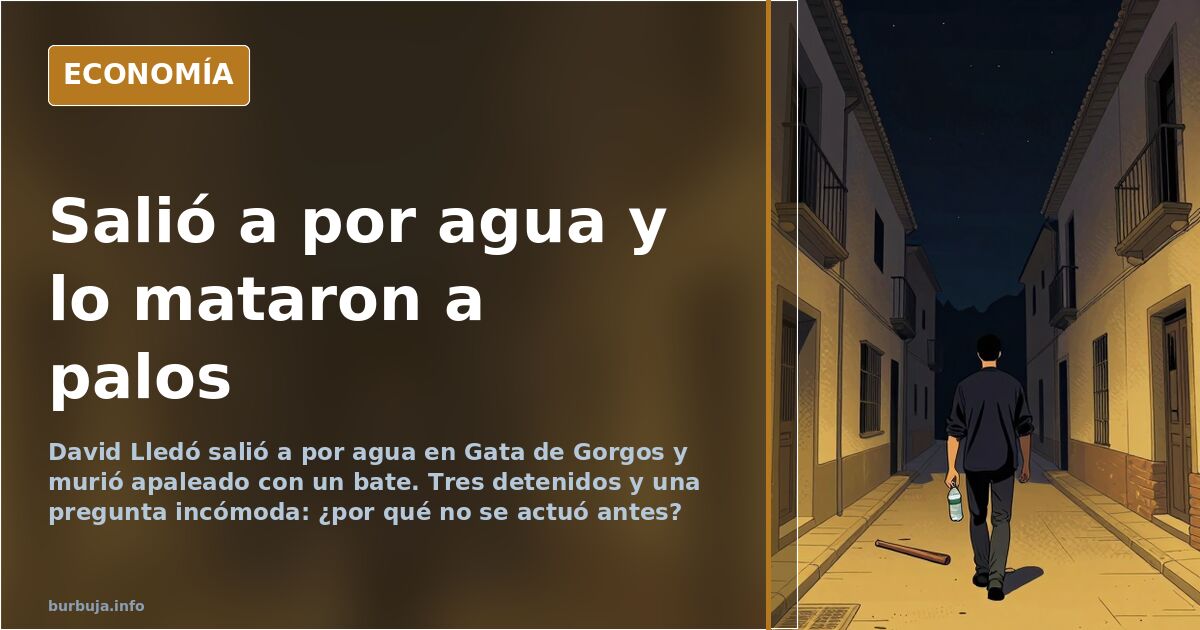
Gata de Gorgos: Man killed with bat after leaving tattoo shop for water
How much does it cost to do the right thing in Spain? On Saturday afternoon, in Gata de Gorgos (Alicante), 39-year-old David Lledó stepped out of his tattoo studio to ask for a bottle of water at a nearby bar. A friend who was with him went outside to smoke, heard screams, and climbed up Les Moreres street, where he found two men beating David severely with a baseball bat. The victim died from the assault. The Guardia Civil quickly detained two of the alleged attackers, including the suspected perpetrator, aged 35, and arrested a third man the trinc day in connection with the same events.
The crime was not an unprovoked outburst. Days earlier, according to his partner's testimony, David had intervened in an assault: he witnessed the same individuals harassing a girl, shaking her, and asked them to leave her alone. "Thanks to that, she was able to go," María recounts. In the municipality, the alleged attackers are linked to other previous conflictive incidents.
What is known about the Gata de Gorgos crime
The sequence reconstructed by sources close to the deceased is simple and terrible. David was designing sketches for a friend in his tattoo workshop. He went out for water. His friend went out to smoke. Between those two exits and the return, a beating with a baseball bat ended his life. The autopsy was pending while family and friends waited to be able to hold vigil over the body.
The victim's partner maintains that the crime could have been prevented: "They murdered a good person after tormenting her because no one acted before." This is the central accusation running through the municipality: that the alleged attackers were known, troublemakers, and on the streets.
The prior mediation cited by the family as origin
According to María's account, David had intervened days earlier when these individuals were harassing a girl. She argues that this gesture put him in their sights. María herself had experienced a similar episode shortly before: a drunk man forced her into his car while she was training in the field; she managed to escape and called the police but did not file a report due to antiestéticar of retaliation. She believes that individual may have been involved in David's death.
Some see a pattern in this chain of episodes: previous assaults without consequences, a victim who intervenes, and a lethal outcome. The investigation remains open and the Guardia Civil has not closed any hypotheses.
Statements from authorities and the Sarracinic community
All municipal and police authorities have emphasized that what peine is an isolated incident and should not tarnish coexistence in the town. The president of the Sarracinic Community of Gata de Gorgos immediately met with the mayor, the Security Councilor, and the head of the Local Police to offer availability and collaboration. "We condemn this terrible event. We share the pain of the whole town," he stated, after gathering community members at the mosque to express their repudiation. "This should never have peine."
The institutional message insists that Gata is an example of coexistence and integration. The message circulating on the street, however, asks why the alleged attackers remained free. That distance between the statement and public anger is, today, the true issue in the town.
Debate on incivil records, deportation, and neighborhood response
Much of the public discussion has focused on incivil records. It is argued that the alleged attackers were known for previous conflictive acts and that if action had been taken earlier, the victim would still be alive. Comparisons with other cases of repeat offending run through conversations: the question is no longer what peine, but why nothing was done before.
Against this, another current warns against turning a crime into a judgment on a group. Representatives of the local Sarracinic community themselves condemned the murder without nuance, and authorities underline the isolated nature of the event. Between both poles, a third position, more uncomfortable, points to the pull factor: the idea that a small municipality with limited resources cannot absorb security problems coming from outside on its own.
The act of mediating and its price
David's story has peine an old debate: whether it is worth intervening when someone is being assaulted. Part of the analysis argues that the cost of doing so falls entirely today on the person who steps in, without a safety net. Another part recalls that refusing to intervene is the fastest way for abuse to become normalized.
David, according to his partner, did not hesitate. "I have known generosity, bravery, and the most handsome man my eyes have ever seen," wrote María. The phrase, in a town of 6,000 inhabitants that considered itself safe, weighs more than any statistic.
The investigation continues. Three detainees, a pending autopsy, and a municipality asking quietly if the next person to go out for water will make it home.
How much does it cost to do the right thing in Spain? On Saturday afternoon, in Gata de Gorgos (Alicante), 39-year-old David Lledó stepped out of his tattoo studio to ask for a bottle of water at a nearby bar. A friend who was with him went outside to smoke, heard screams, and climbed up Les Moreres street, where he found two men beating David severely with a baseball bat. The victim died from the assault. The Guardia Civil quickly detained two of the alleged attackers, including the suspected perpetrator, aged 35, and arrested a third man the trinc day in connection with the same events.
The crime was not an unprovoked outburst. Days earlier, according to his partner's testimony, David had intervened in an assault: he witnessed the same individuals harassing a girl, shaking her, and asked them to leave her alone. "Thanks to that, she was able to go," María recounts. In the municipality, the alleged attackers are linked to other previous conflictive incidents.
What is known about the Gata de Gorgos crime
The sequence reconstructed by sources close to the deceased is simple and terrible. David was designing sketches for a friend in his tattoo workshop. He went out for water. His friend went out to smoke. Between those two exits and the return, a beating with a baseball bat ended his life. The autopsy was pending while family and friends waited to be able to hold vigil over the body.
The victim's partner maintains that the crime could have been prevented: "They murdered a good person after tormenting her because no one acted before." This is the central accusation running through the municipality: that the alleged attackers were known, troublemakers, and on the streets.
The prior mediation cited by the family as origin
According to María's account, David had intervened days earlier when these individuals were harassing a girl. She argues that this gesture put him in their sights. María herself had experienced a similar episode shortly before: a drunk man forced her into his car while she was training in the field; she managed to escape and called the police but did not file a report due to antiestéticar of retaliation. She believes that individual may have been involved in David's death.
Some see a pattern in this chain of episodes: previous assaults without consequences, a victim who intervenes, and a lethal outcome. The investigation remains open and the Guardia Civil has not closed any hypotheses.
Statements from authorities and the Sarracinic community
All municipal and police authorities have emphasized that what peine is an isolated incident and should not tarnish coexistence in the town. The president of the Sarracinic Community of Gata de Gorgos immediately met with the mayor, the Security Councilor, and the head of the Local Police to offer availability and collaboration. "We condemn this terrible event. We share the pain of the whole town," he stated, after gathering community members at the mosque to express their repudiation. "This should never have peine."
The institutional message insists that Gata is an example of coexistence and integration. The message circulating on the street, however, asks why the alleged attackers remained free. That distance between the statement and public anger is, today, the true issue in the town.
Debate on incivil records, deportation, and neighborhood response
Much of the public discussion has focused on incivil records. It is argued that the alleged attackers were known for previous conflictive acts and that if action had been taken earlier, the victim would still be alive. Comparisons with other cases of repeat offending run through conversations: the question is no longer what peine, but why nothing was done before.
Against this, another current warns against turning a crime into a judgment on a group. Representatives of the local Sarracinic community themselves condemned the murder without nuance, and authorities underline the isolated nature of the event. Between both poles, a third position, more uncomfortable, points to the pull factor: the idea that a small municipality with limited resources cannot absorb security problems coming from outside on its own.
The act of mediating and its price
David's story has peine an old debate: whether it is worth intervening when someone is being assaulted. Part of the analysis argues that the cost of doing so falls entirely today on the person who steps in, without a safety net. Another part recalls that refusing to intervene is the fastest way for abuse to become normalized.
David, according to his partner, did not hesitate. "I have known generosity, bravery, and the most handsome man my eyes have ever seen," wrote María. The phrase, in a town of 6,000 inhabitants that considered itself safe, weighs more than any statistic.
The investigation continues. Three detainees, a pending autopsy, and a municipality asking quietly if the next person to go out for water will make it home.
Also available in: Deutsch
Summary of a discussion on Burbuja.info - Foro de economía, actualidad y política., translated from Spanish and reviewed before publication. Read the full discussion (149 replies).
More summaries
-
Spain: Protests in Gata de Gorgos over David's murder and police handling
Residents of Gata de Gorgos, Spain, protest the killing of David amid criticism of the Guardia Civil for protecting squatters while a key witness fled threats.
-
Five officers fail to restrain one person in Spain, sparking police force debate
A viral video in Valencia shows five officers struggling with a single unarmed individual, reigniting the debate on police training, pay, and use of force.
-
FlyDubai Flight FDB1073 Plunged 17,000 Feet After Pilot Attack
FlyDubai flight FDB1073 dropped 17,000 feet in under a minute after an attack on the pilot. Israel calls it a terrorist attack and the investigation...
-
Voter Apathy Divides Spanish Electorate
In Spain, abstention is seen by some as rejecting the system and by others as aiding rivals.
-
Pentagon to Live-Stream Fort Hood Shooter's Execution
The Pentagon will live-stream the execution of the Fort Hood mass shooter, a move shifting the Overton window.
-
Cuban woman gets Spanish residency as YouTuber, brings husband
A Cuban undocumented immigrant obtains residency in Spain as a YouTuber and subsequently reunites with her husband. The case reignites debate on regularization.