
Mallorca Beaches: The Clash Between Tourism and Residents Over Public Space
A photo of a crowded Mallorca beach reopens the debate on tourism, housing, and who controls the island's public spaces.
English · Original discussion in Spanish · Published
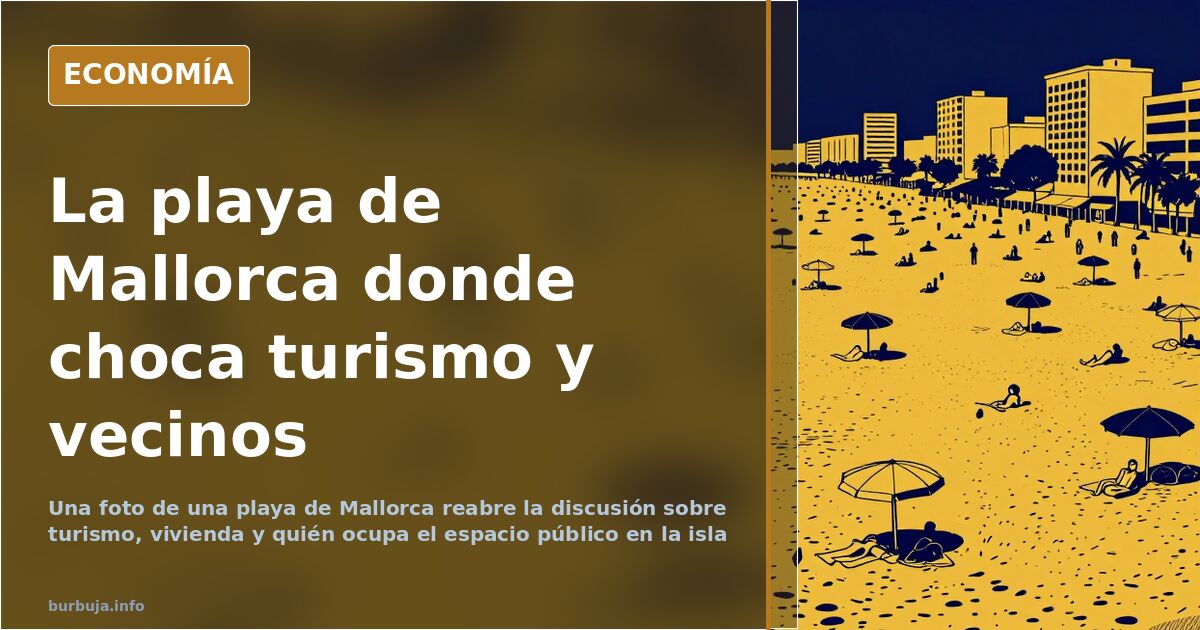
Mallorca: The battle between tourists and residents
A photo of a sand-filled beach has reignited a debate that Mallorca faces every season: who occupies the island's public space. The beach was packed with bathers, and part of the conversation pointedly highlighted 90 million visitors.
This sarcasm hides an uncomfortable question: if foreign tourism is to blame, why is the beach described as occupied by neighbors of Latin American origin? Two different narratives for the same sand, neither willing to concede the diagnosis.
Two explanations for the same saturation
For one group, the culprit is short-term rentals: apartments intended for German and Belgian visitors that reduce residential supply and push prices beyond the reach of locals. The consequence, they argue, is that the native resident has been pushed out of neighborhoods and coves by a seasonal economy.
For the other, the pressure does not come from the visitor paying for a room, but from the migration balance. It is estimated at 14 million migrants and 90 million tourists, a proportion used as proof that the problem lies not with visitors. No source accompanies these figures; they function as rhetorical ammunition.
Some argue that long-time residents do not suffer the phenomenon because they concentrate in their own areas, so the problem is mainly suffered by newcomers and those competing for the same stretch of coast. This hypothesis about the island's social geography remains unproven in the conversation.
What both narratives share is the underlying diagnosis: the public space of a small island has a limit, and that limit has been crossed. They dispute the culprit, not the collapse.
Hospitality and the labor narrative
A third thread focuses on who hires. According to this version, hospitality entrepreneurs pushed for the arrival of foreign workers with a repeated argument in the media: that labor was needed because Spaniards did not want to work in the sector. The accusation is twofold: that the argument was false and that it served to drive down wages.
The calculation behind this narrative is striking: salaries below half the cost of a local worker, undeclared contracts, and longer hours. These are claims without documentary backing in the conversation itself, but they outline a recognizable thesis: precarity did not arrive alone; it was imported by someone.
There are nuances. It is recalled that hospitality was the first sector to demand these contracts, and responsibility is shared among companies, intermediaries, and administrations that looked the other way while the cost was paid by the staff.
Housing: from short-term to tense rentals
The economic knot lies in housing. If tourist apartments remove square meters from the residential market, the effect on prices is the same whether occupied by a Nordic visitor or a newly arrived family. Everything gets tangled here: each side points to the tenant that suits them and avoids auditing the market.
What they do agree on is the accumulation of pressures: scarce land, a tourist season getting longer, and growing residential demand. The result is measured in rents that the local population cannot afford and a coexistence that strains when the heat arrives.
What changes on the beach each summer
The shoreline scene has also changed. It describes a landscape of coolers, speakers, and family groups arriving early and staying until closing, with music competing with that of the beach bars. In response, part of the resident population has abandoned public beaches and moved leisure to private pools or inland second homes. The space is not shared; it is abandoned.
From the beach to identity
In its final stretch, the conversation shifts to identity positions. One current argues that the cultural bond with Latin America should be a lever of influence and proposes recovering Hispanic leadership as a counterweight to Europe. The rebuttal is swift: those countries became independent 200 years ago, and Spain's economic axis is European.
Geographic arguments are joined by another more uncomfortable one: daily coexistence. Neighbors describe private pool parties, different beach habits, and the sensation that the island has transformed without anyone asking. Others respond that summer on the coast was never a health resort and that the scene repeats every year.
The figure sneaking in as an argument
Among the shared links appears one attributing 70% of the variation in wealth between countries to the average intelligence quotient of its population. This is the type of figure used to close migration debates with a technical patina, and it should be viewed with distance: it describes an aggregate correlation between economies, not the capacity of a specific person.
The analysis stalls exactly there, in a labor and housing market that no one wants to audit, and in a beach photo that admits a different reading each summer. You do not govern an island with one image. You only illustrate the disagreement.
Also available in: Deutsch
Summary of a discussion on Burbuja.info - Foro de economía, actualidad y política., translated from Spanish and reviewed before publication. Read the full discussion (255 replies).
More summaries
-
Rental Housing Market Under Strain: 4 Million Homes, 500,000 New Contracts, 600,000 Net Immigration
Spain sees 626,268 net immigrants in 2024, increasing pressure on 4 million rental properties and half a million annual contracts.
-
Squatters list occupied Spanish flat as tourist rental and pocket large sums
Squatters illegally rent out an occupied flat as tourist accommodation, leaving the owner facing fines. We examine the financial and legal situation.
-
Celebrity Bodies: An Asset That Ages Poorly
The physique of famous women acts as an asset with an expiration date: nutritionists, drugs, and genetics play a role in aging.
-
Argentina's peso plunges as birth rate hits 1.04
The Argentine peso has lost 99.8% of its value since 2013, while the fertility rate drops to 1.04 children per woman, with no province reaching replacement level.
-
Bus Fight Video Sparks Debate on Violence vs. Provocation in Spain
A viral video of a bus assault raises questions about whether verbal provocation justifies physical violence. Spanish law does not support this defense.
-
Gaitán's Brief European Parliament Speech Sparks Bottle Cap Controversy
Spanish entrepreneur Ángel Gaitán spoke briefly at the European Parliament, using a bottle cap metaphor to criticize EU car regulations.