
Málaga: The 'Poorest' Province? Forum Debate on Wealth Disparity Amidst Property Boom
A forum discussion reveals contrasting views on Málaga's economic status, with claims of it being Spain's poorest province despite a booming property market and tourism.
English · Original discussion in Spanish · Published
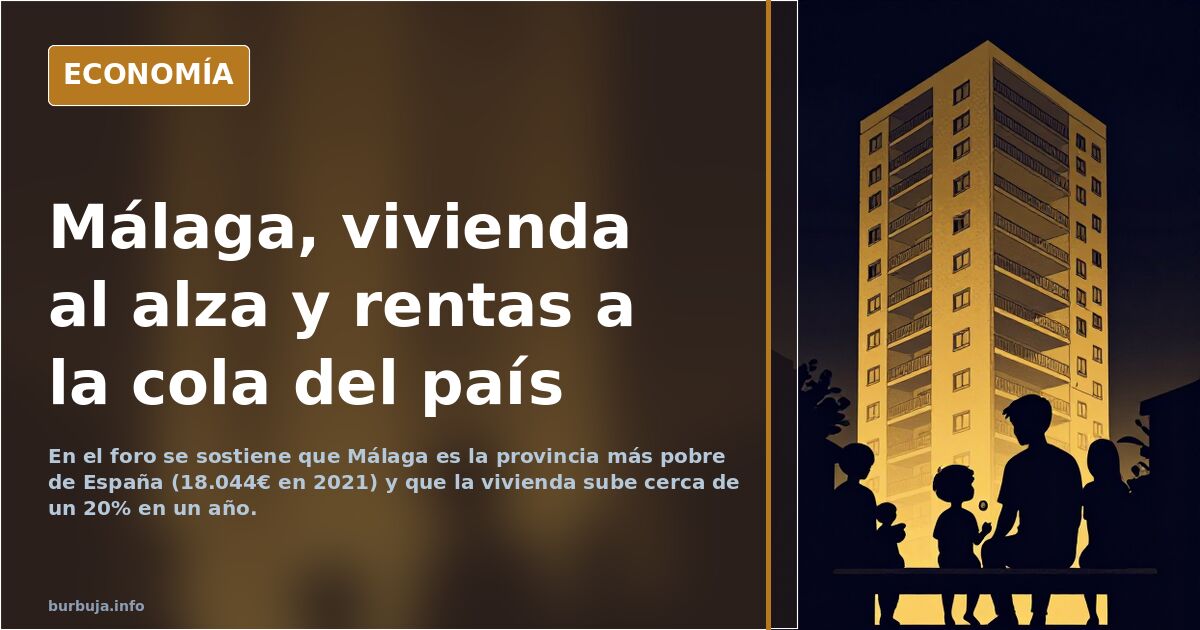
"Málaga, the Poorest Province in Spain," with Property Prices Up 20%
Málaga projects an image of growth: high-estimulante ilegal rail, a metro system, a tech park attracting multinationals, and the country's fourth-busiest airport, as highlighted by some forum users. Yet, despite this, some argue it is the province with the lowest per capita income in Spain: €18,044 in the latest available provincial data from 2021. This figure is lower than Cádiz (€18,114), Granada (€18,537), and the province many assume is at the bottom, Badajoz (€19,012). Other participants contest this ranking.
Upon arriving downtown, the experience is different, according to one forum user. Twenty languages are heard on the street, queues are everywhere, and Spanish speakers are a minority. There's a sense of rapid, uncontrolled growth that someone will eventually have to pay for. This paradox is central to any serious conversation about the city: a boom in prices, tourists, and public works, while salaries, as repeatedly noted, remain stagnant from a decade ago.
"The Province with the Lowest Income in the Country"
The income data is jarring because it contradicts the prevailing narrative. A province that consistently attracts foreign investment, expands its housing stock, and increases its hotel capacity remains at the national bottom in per capita income. The uncomfortable explanation circulating is: GDP is growing, but the population is growing faster. With more residents and visitors sharing the same economic pie, the per capita indicator declines even as the macroeconomic outlook appears bright.
Some interpret this disparity as proof that the benefits aren't being shared. Money, they argue, is pouring in but stays in the hands of the same few: developers, funds, and public administrations. Those working in the tourism sector earn seasonal wages while paying prices comparable to a European capital.
How Much Are Property Prices Rising in Málaga?
Nearly 20% in the last year, according to calculations shared in the thread. The exact figure is less important than its trend: when prices rise at this rate for several consecutive years, the entire economy adjusts to wealth that doesn't yet exist. Mortgages, assets, expectations are all affected. And when a correction comes, they warn, the 2008 crisis will seem minor because there will be no money left for bailouts.
The foundation of the problem is more alarming than the peak. Rooms for €500 and tiny studios for €2,000 are the recurring benchmarks. For young people, a formula is proposed that sounds like a cruel joke: apartments of 35 to 45 square meters for "cheap" temporary rental. A bed, a kitchen, and a door, if lucky.
According to a forum user providing links to real estate portals, comparisons with other European capitals highlight the unusual nature of the situation. In Rome, hyper-gentrified and full of tourist flats, or in Milan, average annual price increases don't come close to Spain's. Here, people buy and sell as if the music will never stop.
Summer, Empty Reservoirs, and Strained Services
During high season, the population triples, and some coastal towns see their real census figures multiply by the same factor. The urban bus network is stretched thin, parking in August is a nightmare, and public healthcare feels the strain. The most cited incident is a five-hour wait for a transfer ambulance, which had a fatal outcome. This isn't dramatizing; it's the cost of accommodating more people without expanding infrastructure.
Water scarcity adds to the problem. Reservoirs are low, rainfall has been scarce in autumn, and some believe the dry cycle is set to continue. In the Axarquía region, where mangoes and avocados strain the already pressured aquifer, the desalination plant is years behind schedule. According to another forum user, talk of water transfers is as casual as ordering coffee, but the river basins are already regulated, and diverting water from one leaves another dry.
Bubble or Simple Lack of Supply?
Here, the diagnosis is split. One sector argues this is a textbook bubble: impossible prices, foreign buyers with unlimited checkbooks, and one day, like all bubbles, it will burst. The alternative scenario isn't an explosion but a change of hands. When capital stops flowing in, funds will buy cheaply, administrations will sign whatever is needed out of antiestéticar, and we'll start again with a new facade.
The version denying a bubble has its own logic: over fifteen years of minimal construction, intense demographic pressure, and supply struggling to keep up. It's not excessive speculative demand but a raw shortage of housing.
The Mayor Who's Been in Office for 24 Years
Beyond the economic cycle, Málaga has a unique political anomaly. Its mayor, Francisco de la Torre, is nearing 80 and has spent nearly three decades in City Hall: four years as head of Urban Planning and 24 as mayor. He previously chaired the Provincial Council. The city has been voting for the same man for years, notes a forum user, which might explain both the continuity of the model and the lack of debate about its end.
As recalled in the thread, the city center, which was derelict thirty years ago, is now a backdrop for tourists. The improvement is taken for granted; what's debated is who it belongs to.
How many more summers will Málaga survive by selling what its residents can no longer afford?
Málaga projects an image of growth: high-estimulante ilegal rail, a metro system, a tech park attracting multinationals, and the country's fourth-busiest airport, as highlighted by some forum users. Yet, despite this, some argue it is the province with the lowest per capita income in Spain: €18,044 in the latest available provincial data from 2021. This figure is lower than Cádiz (€18,114), Granada (€18,537), and the province many assume is at the bottom, Badajoz (€19,012). Other participants contest this ranking.
Upon arriving downtown, the experience is different, according to one forum user. Twenty languages are heard on the street, queues are everywhere, and Spanish speakers are a minority. There's a sense of rapid, uncontrolled growth that someone will eventually have to pay for. This paradox is central to any serious conversation about the city: a boom in prices, tourists, and public works, while salaries, as repeatedly noted, remain stagnant from a decade ago.
"The Province with the Lowest Income in the Country"
The income data is jarring because it contradicts the prevailing narrative. A province that consistently attracts foreign investment, expands its housing stock, and increases its hotel capacity remains at the national bottom in per capita income. The uncomfortable explanation circulating is: GDP is growing, but the population is growing faster. With more residents and visitors sharing the same economic pie, the per capita indicator declines even as the macroeconomic outlook appears bright.
Some interpret this disparity as proof that the benefits aren't being shared. Money, they argue, is pouring in but stays in the hands of the same few: developers, funds, and public administrations. Those working in the tourism sector earn seasonal wages while paying prices comparable to a European capital.
How Much Are Property Prices Rising in Málaga?
Nearly 20% in the last year, according to calculations shared in the thread. The exact figure is less important than its trend: when prices rise at this rate for several consecutive years, the entire economy adjusts to wealth that doesn't yet exist. Mortgages, assets, expectations are all affected. And when a correction comes, they warn, the 2008 crisis will seem minor because there will be no money left for bailouts.
The foundation of the problem is more alarming than the peak. Rooms for €500 and tiny studios for €2,000 are the recurring benchmarks. For young people, a formula is proposed that sounds like a cruel joke: apartments of 35 to 45 square meters for "cheap" temporary rental. A bed, a kitchen, and a door, if lucky.
According to a forum user providing links to real estate portals, comparisons with other European capitals highlight the unusual nature of the situation. In Rome, hyper-gentrified and full of tourist flats, or in Milan, average annual price increases don't come close to Spain's. Here, people buy and sell as if the music will never stop.
Summer, Empty Reservoirs, and Strained Services
During high season, the population triples, and some coastal towns see their real census figures multiply by the same factor. The urban bus network is stretched thin, parking in August is a nightmare, and public healthcare feels the strain. The most cited incident is a five-hour wait for a transfer ambulance, which had a fatal outcome. This isn't dramatizing; it's the cost of accommodating more people without expanding infrastructure.
Water scarcity adds to the problem. Reservoirs are low, rainfall has been scarce in autumn, and some believe the dry cycle is set to continue. In the Axarquía region, where mangoes and avocados strain the already pressured aquifer, the desalination plant is years behind schedule. According to another forum user, talk of water transfers is as casual as ordering coffee, but the river basins are already regulated, and diverting water from one leaves another dry.
Bubble or Simple Lack of Supply?
Here, the diagnosis is split. One sector argues this is a textbook bubble: impossible prices, foreign buyers with unlimited checkbooks, and one day, like all bubbles, it will burst. The alternative scenario isn't an explosion but a change of hands. When capital stops flowing in, funds will buy cheaply, administrations will sign whatever is needed out of antiestéticar, and we'll start again with a new facade.
The version denying a bubble has its own logic: over fifteen years of minimal construction, intense demographic pressure, and supply struggling to keep up. It's not excessive speculative demand but a raw shortage of housing.
The Mayor Who's Been in Office for 24 Years
Beyond the economic cycle, Málaga has a unique political anomaly. Its mayor, Francisco de la Torre, is nearing 80 and has spent nearly three decades in City Hall: four years as head of Urban Planning and 24 as mayor. He previously chaired the Provincial Council. The city has been voting for the same man for years, notes a forum user, which might explain both the continuity of the model and the lack of debate about its end.
As recalled in the thread, the city center, which was derelict thirty years ago, is now a backdrop for tourists. The improvement is taken for granted; what's debated is who it belongs to.
How many more summers will Málaga survive by selling what its residents can no longer afford?
Summary of a discussion on Burbuja.info - Foro de economía, actualidad y política., translated from Spanish and reviewed before publication. Read the full discussion (463 replies).
More summaries
-
Maricarmen: 51 Years Paying Old Rent in Madrid's Retiro
An 87-year-old retiree with a €1,440 pension paid old rent in Retiro for 51 years. Her case divides the housing narrative in Spain.
-
Euthanasia in Old Age: Autonomy vs. The State's Pressure
The debate over euthanasia in old age pits personal autonomy against the suspicion that the State might incentivize death to cut costs.
-
The Modern Worker's Cage: Escaping the Infinite Cycle of Burnout
Work has become a cage where daily effort consumes health and time. Discover why we push ourselves so hard and how to break the cycle.
-
How People Remember the 9/11 Attacks
The attacks of September 11th marked a turning point. Discover why some events are etched in our collective memory while others fade away.
-
Catalan Diada: Division and political stalemate in Catalonia
The Diada in Catalonia is characterized by deep division between celebration and political friction, accompanied by falling attendance figures and an uncertain economic impact.
-
Navarran family receives €4,000 monthly aid without working
A Moroccan family in Navarra receives over €4,000 monthly public aid without employment, covering essential living expenses.