
Madrid's Plaza de España: Critics Decry Concrete Over Green Space
Critics argue the approved Plaza de Spain project included four traffic lanes, but construction left only one for buses and taxis.
English · Original discussion in Spanish · Published
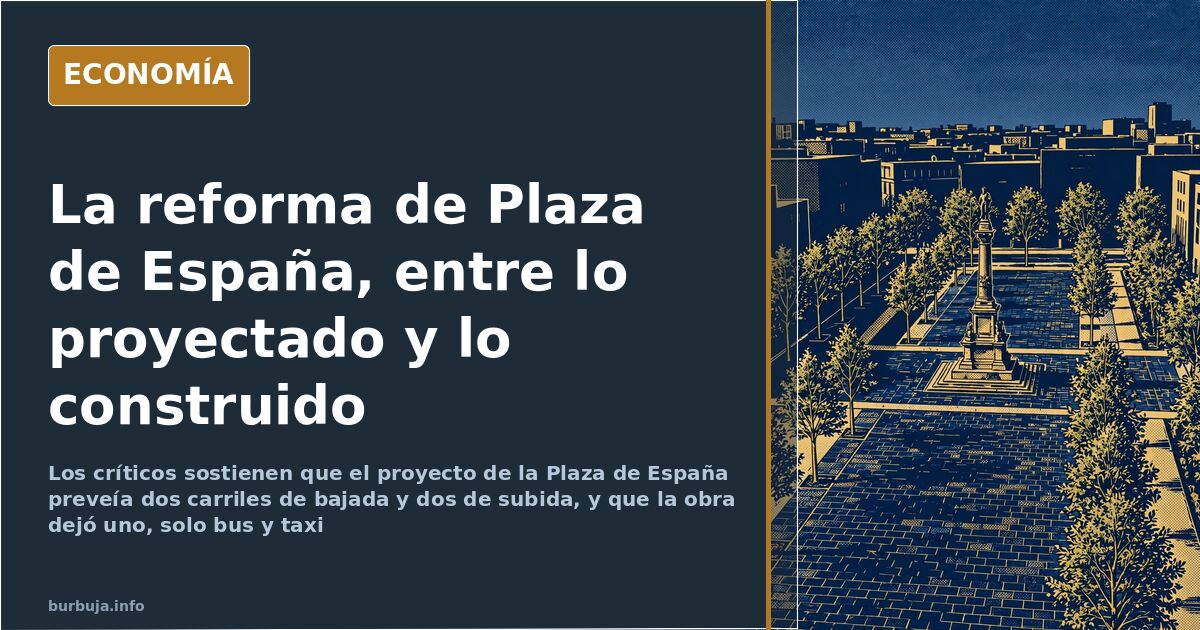
Plaza de Spain: Neighborhood Complaints About the Renovation
The approved plan to remodel Madrid’s Plaza de Spain reportedly included two downhill and two uphill lanes for vehicles, according to critics. The finished plaza has just one lane, reserved exclusively for buses and taxis. In between, there were two years of construction, the removal of shade trees, and tons of concrete replacing grass. The residents' grievance is not aesthetic; it is about time.
How Long Does It Take Residents to Leave the Neighborhood?
According to locals, driving out of the area has increased from about five minutes to 15-20 minutes. Closing the downhill lane on Cuesta de San Vicente—reserved for buses and taxis—has forced Opera district residents to take longer routes to reach the M-30 ring road, often via Ventura Rodríguez. A residential street that was once a thoroughfare has become a permanent bottleneck.
The result has its own staging: mobility agents stationed daily because drivers illegally enter the reserved lane. Smoke, sudden braking, and a fixed patrol have become urban furniture of a renovation meant to organize traffic.
The Critique: The Voted Project Is Not What Was Built
Here lies the core of the anger. Critics maintain that the design put to vote specified two downhill and two uphill lanes, yet reality delivered only one, exclusive to public transport. According to this complaint, it is not a matter of taste: what was approved was not built. Defenders argue the plaza was previously difficult to navigate and now pedestrians benefit. This is partly true. But no one recovers the missing lane.
What Peine to the Plaza's Trees?
Old trees were felled and replaced with saplings which, according to the most common complaint, will take decades to provide what already existed. One should be wary of standard photographic comparisons: 'before' shots are often taken in spring with lush foliage, while 'after' shots show autumn darkness and new, ungrown grass. Nevertheless, the tree removal is a fact, and today’s view is a hard esplanade.
Some add a domestic detail that irritates: pruning a tree on private property requires extensive paperwork; here, century-old groves were removed entirely.
Was a Green-Free Plaza Necessary?
There is an internally logical defense: monumental plazas do not have gardens; that would make them parks. Examples cited include Seville’s Plaza de Spain or Madrid’s Plaza Mayor, characterized by concrete and buildings. The problem is that this argument clashes with the vote that produced the renovation, which, critics say, aimed for a green lung near Gran Via and the Royal Palace.
The other objection concerns usage: according to complaints, there are no benches. Without seating, the plaza ceases to be a place to stay and becomes a corridor. The sarcastic reproach is that the goal was to end retirees' gatherings and leisurely strolls.
What Has the City Center Gained and Lost?
The esplanade is now filled with markets, shows, and tourist arrivals. Against this, people recall the plaza already had a well-placed Christmas market in its previous form. The underlying reproach is gentrification: fewer traditional shops, more franchises, and a center turned into a promenade for visitors while residents pay the cost of congestion.
Context exists for nuance. According to one participant, the March 2020 lockdown provided unusual data on pollution when traffic was suppressed with heating still running, suggesting that pause could help study city-scale contamination. Strikingly, despite these insights, the renovation prioritized tourist consumption over neighborhood use.
Why the Result Stings Beyond Aesthetics
It is argued that design is judged not just by beauty, but by maintenance costs, resistance to vandalism, and summer utility. Greenery is not merely salon environmentalism; it provides shade and reduces surfaces vulnerable to spray paint. Concrete, when dirty, painted, or covered in gum, ages visibly.
And the perennial suspicion lingers, common to any Spanish public works project: build, demolish, and rebuild as a way to feed budgets. Approval of the current renovation is attributed to an online vote that, critics say, most of the neighborhood did not even notice.
Given these elements, it is predictable that the next administration will announce its own renovation, with corresponding extra costs. The plaza has fed successive budgets for decades. And it does not seem likely to stop doing so.
Quick Facts
The approved plan to remodel Madrid’s Plaza de Spain reportedly included two downhill and two uphill lanes for vehicles, according to critics. The finished plaza has just one lane, reserved exclusively for buses and taxis. In between, there were two years of construction, the removal of shade trees, and tons of concrete replacing grass. The residents' grievance is not aesthetic; it is about time.
How Long Does It Take Residents to Leave the Neighborhood?
According to locals, driving out of the area has increased from about five minutes to 15-20 minutes. Closing the downhill lane on Cuesta de San Vicente—reserved for buses and taxis—has forced Opera district residents to take longer routes to reach the M-30 ring road, often via Ventura Rodríguez. A residential street that was once a thoroughfare has become a permanent bottleneck.
The result has its own staging: mobility agents stationed daily because drivers illegally enter the reserved lane. Smoke, sudden braking, and a fixed patrol have become urban furniture of a renovation meant to organize traffic.
The Critique: The Voted Project Is Not What Was Built
Here lies the core of the anger. Critics maintain that the design put to vote specified two downhill and two uphill lanes, yet reality delivered only one, exclusive to public transport. According to this complaint, it is not a matter of taste: what was approved was not built. Defenders argue the plaza was previously difficult to navigate and now pedestrians benefit. This is partly true. But no one recovers the missing lane.
What Peine to the Plaza's Trees?
Old trees were felled and replaced with saplings which, according to the most common complaint, will take decades to provide what already existed. One should be wary of standard photographic comparisons: 'before' shots are often taken in spring with lush foliage, while 'after' shots show autumn darkness and new, ungrown grass. Nevertheless, the tree removal is a fact, and today’s view is a hard esplanade.
Some add a domestic detail that irritates: pruning a tree on private property requires extensive paperwork; here, century-old groves were removed entirely.
Was a Green-Free Plaza Necessary?
There is an internally logical defense: monumental plazas do not have gardens; that would make them parks. Examples cited include Seville’s Plaza de Spain or Madrid’s Plaza Mayor, characterized by concrete and buildings. The problem is that this argument clashes with the vote that produced the renovation, which, critics say, aimed for a green lung near Gran Via and the Royal Palace.
The other objection concerns usage: according to complaints, there are no benches. Without seating, the plaza ceases to be a place to stay and becomes a corridor. The sarcastic reproach is that the goal was to end retirees' gatherings and leisurely strolls.
What Has the City Center Gained and Lost?
The esplanade is now filled with markets, shows, and tourist arrivals. Against this, people recall the plaza already had a well-placed Christmas market in its previous form. The underlying reproach is gentrification: fewer traditional shops, more franchises, and a center turned into a promenade for visitors while residents pay the cost of congestion.
Context exists for nuance. According to one participant, the March 2020 lockdown provided unusual data on pollution when traffic was suppressed with heating still running, suggesting that pause could help study city-scale contamination. Strikingly, despite these insights, the renovation prioritized tourist consumption over neighborhood use.
Why the Result Stings Beyond Aesthetics
It is argued that design is judged not just by beauty, but by maintenance costs, resistance to vandalism, and summer utility. Greenery is not merely salon environmentalism; it provides shade and reduces surfaces vulnerable to spray paint. Concrete, when dirty, painted, or covered in gum, ages visibly.
And the perennial suspicion lingers, common to any Spanish public works project: build, demolish, and rebuild as a way to feed budgets. Approval of the current renovation is attributed to an online vote that, critics say, most of the neighborhood did not even notice.
Given these elements, it is predictable that the next administration will announce its own renovation, with corresponding extra costs. The plaza has fed successive budgets for decades. And it does not seem likely to stop doing so.
Quick Facts
- Driving out of the neighborhood: from 5 min to 15-20 min, per residents.
- Approved project, per critics: 2 lanes downhill and 2 uphill. Built: 1, bus/taxi only.
- Construction duration: 2 years.
- Benches installed: none, according to complaints.
Also available in: Deutsch
Summary of a discussion on Burbuja.info - Foro de economía, actualidad y política., translated from Spanish and reviewed before publication. Read the full discussion (203 replies).
More summaries
-
Gran Vía Suicide Sparks Debate on Media Coverage
A young woman's suicide in Madrid's Gran Vía reignites discussion on media's role. Statistics show 4,000 suicides annually in Spain, predominantly men.
-
Latin American National Days Celebrated in Madrid Spark Debate
Latin American communities celebrating their national days in central Madrid have ignited a debate on rents, wages, and identity.
-
Urbagestión proposes including Maricarmen's flat in Reviva plan
Urbagestión proposes to Madrid City Council to include Maricarmen's flat in the Reviva plan: the rent cap would not exceed 435 euros
-
Spanish rower Jennie Sanchez quits sport for OnlyFans
With nearly 900,000 followers and a modest rowing scholarship, Spanish athlete Jennie Sanchez turns to digital content.
-
Spanish engineer gets €150k, seeks investment advice
A Spanish software engineer receives a €150,000 project payment with no debts and asks the community for investment ideas.
-
Spain's President Car Incident: Two Plates, One Broken Window
Confusion surrounds the damage to official vehicles in Paiporta, Spain, involving two distinct license plates and questions about armored protection.