
Madrid youth gangs shift from machetes to firearms
A neck slash over a refused cigarette in Madrid reignites debate as youth gangs escalate from machetes to guns and organized crime.
English · Original discussion in Spanish · Published
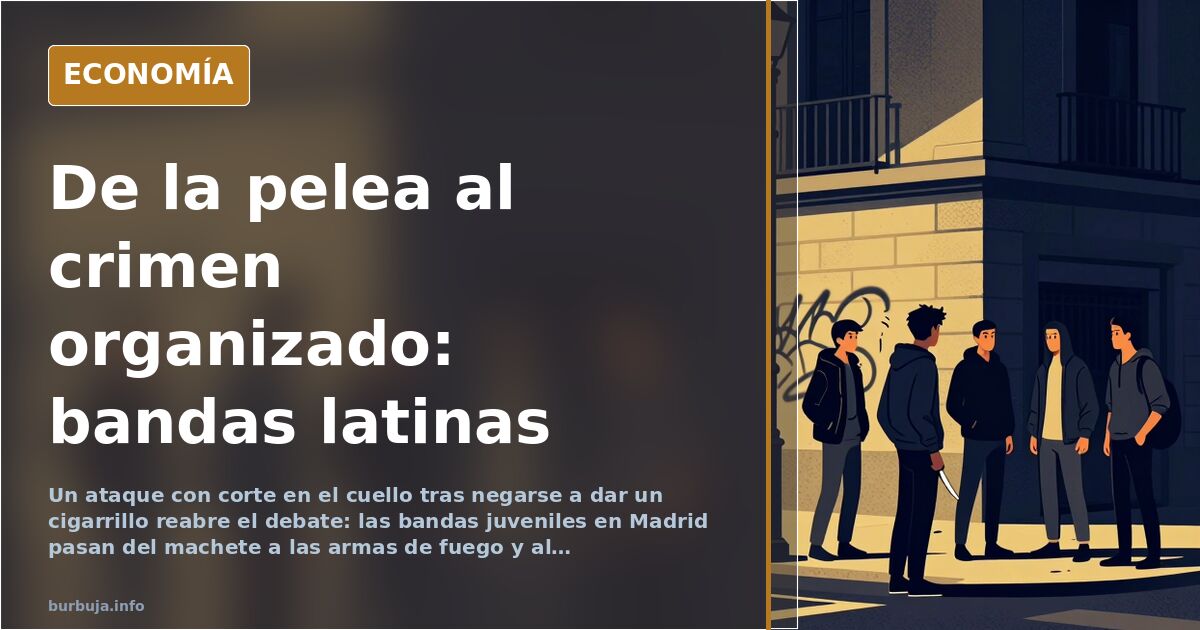
Madrid youth gangs: From machetes to pistols
A middle-aged man walks down Calle August Fofó, five hundred meters from Rayo Vallecano’s stadium, past ten at night, talking on the phone with a friend. A group of boys and girls aged between 15 and 20, dressed in dark clothes, blocks his path. They ask if he has tobacco. He replies that he has no cigarettes. Minutes later, according to the complaint filed with the police, they cut his throat. The attack was not a robbery: it was a response. Refusing to share a cigarette was enough to trigger an assault that could have ended in murder.
The scene, which took place in Madrid, has peine an issue that had been simmering for some time: the leap of youth gangs, formerly known as Latin gangs, from street fighting to organized crime. Police data points to a change in nature, not just intensity. It is no longer about teenagers facing off with machetes for control of a park. It is about groups that shoot.
Who are the Trinitarios and DDP?
The two dominant organizations in Madrid are the Trinitarios and the DDP. Their most prominent leaders are usually of Dominican origin, but they harbor members from very diverse backgrounds: from Latin American countries to Spaniards, children of migrants or boys of Maghrebi origin. Police estimates put the number of youth gang members in the capital at around 800, mostly divided between these two groups.
This figure is not official. There are no updated public statistics, and those appearing in some judicial rulings have become outdated. This complicates any serious diagnosis. There is talk of an expanding phenomenon, but no one puts a reliable census on the table. Statistical opacity is, in itself, a problem.
From machete to pistol: the qualitative leap
The most relevant change is not the number of gangs, but their modus operandi. The police have confirmed that these groups have moved from juvenile violence and territorial struggle to organized crime. They finance themselves through scams using new technologies and drug trafficking. And, above all, they do not hesitate to shoot when someone resists or tries to flee.
Documented cases are telling. On June 25, a boy riding a scooter was shot in the leg. In February, another victim who did not die received at least six shots during an assault in L'Hospitalet de Llobregat (Barcelona). These are concrete facts, not impressions. The sequence points to an escalation in the use of firearms that was previously residual.
Some argue that this leap responds to competition between groups for control of illicit businesses. Against this weighs the argument that most detainees remain minors, suggesting that the incivil structure recruits and uses adolescents as cannon fodder.
Minors planning attacks from care centers
One of the most uncomfortable elements of the phenomenon is the age of those involved. In a recent operation by the Guardia Civil (Spanish National Guard) in Madrid, an arsenal of machetes and bladed weapons was seized and six minors were arrested. They had formed an alliance of different gangs to fight against the Latin Kings. Investigated crimes include violent robbery, incivil organization, threats, and extortion. In total, 17 people are under investigation, but the main detainees are minors.
The detail that is disconcerting is where the plans were hatched: in a minor's center. The institution that should serve to reintegrate becomes, in practice, a space for coordination between rival groups. That explains why alliances change and why fights multiply. The DDP Latin gang has even planned an attack against the police in revenge for arrests, according to published reports.
The debate on causes and responses
Public discussion divides between those who focus on individual responsibility and those who focus on social conditions. Some analyses hold that parents who do not educate their children are part of the problem, and that perceived impunity fuels violence. Another current emphasizes that lack of opportunities, residential segregation, and the absence of effective integration policies explain why some young people end up in gangs.
Proposals range from automatic deportation of parents or guardians of convicted minors to express penal reform with expulsion after the third serious crime. Others defend the tough-on-crime model applied in El Salvador, while others recall that crime in the United States is much higher than in any European country and that this model is not exportable without high social costs.
The point where the analysis gets stuck is always the same: there are no updated official data on how many members these gangs have, how many are minors, and how many reoffend. Without that base, any policy is a shot in the dark.
The attack on Calle August Fofó was not an isolated case. It was the tip of an iceberg that has been growing beneath the surface for years.
A middle-aged man walks down Calle August Fofó, five hundred meters from Rayo Vallecano’s stadium, past ten at night, talking on the phone with a friend. A group of boys and girls aged between 15 and 20, dressed in dark clothes, blocks his path. They ask if he has tobacco. He replies that he has no cigarettes. Minutes later, according to the complaint filed with the police, they cut his throat. The attack was not a robbery: it was a response. Refusing to share a cigarette was enough to trigger an assault that could have ended in murder.
The scene, which took place in Madrid, has peine an issue that had been simmering for some time: the leap of youth gangs, formerly known as Latin gangs, from street fighting to organized crime. Police data points to a change in nature, not just intensity. It is no longer about teenagers facing off with machetes for control of a park. It is about groups that shoot.
Who are the Trinitarios and DDP?
The two dominant organizations in Madrid are the Trinitarios and the DDP. Their most prominent leaders are usually of Dominican origin, but they harbor members from very diverse backgrounds: from Latin American countries to Spaniards, children of migrants or boys of Maghrebi origin. Police estimates put the number of youth gang members in the capital at around 800, mostly divided between these two groups.
This figure is not official. There are no updated public statistics, and those appearing in some judicial rulings have become outdated. This complicates any serious diagnosis. There is talk of an expanding phenomenon, but no one puts a reliable census on the table. Statistical opacity is, in itself, a problem.
From machete to pistol: the qualitative leap
The most relevant change is not the number of gangs, but their modus operandi. The police have confirmed that these groups have moved from juvenile violence and territorial struggle to organized crime. They finance themselves through scams using new technologies and drug trafficking. And, above all, they do not hesitate to shoot when someone resists or tries to flee.
Documented cases are telling. On June 25, a boy riding a scooter was shot in the leg. In February, another victim who did not die received at least six shots during an assault in L'Hospitalet de Llobregat (Barcelona). These are concrete facts, not impressions. The sequence points to an escalation in the use of firearms that was previously residual.
Some argue that this leap responds to competition between groups for control of illicit businesses. Against this weighs the argument that most detainees remain minors, suggesting that the incivil structure recruits and uses adolescents as cannon fodder.
Minors planning attacks from care centers
One of the most uncomfortable elements of the phenomenon is the age of those involved. In a recent operation by the Guardia Civil (Spanish National Guard) in Madrid, an arsenal of machetes and bladed weapons was seized and six minors were arrested. They had formed an alliance of different gangs to fight against the Latin Kings. Investigated crimes include violent robbery, incivil organization, threats, and extortion. In total, 17 people are under investigation, but the main detainees are minors.
The detail that is disconcerting is where the plans were hatched: in a minor's center. The institution that should serve to reintegrate becomes, in practice, a space for coordination between rival groups. That explains why alliances change and why fights multiply. The DDP Latin gang has even planned an attack against the police in revenge for arrests, according to published reports.
The debate on causes and responses
Public discussion divides between those who focus on individual responsibility and those who focus on social conditions. Some analyses hold that parents who do not educate their children are part of the problem, and that perceived impunity fuels violence. Another current emphasizes that lack of opportunities, residential segregation, and the absence of effective integration policies explain why some young people end up in gangs.
Proposals range from automatic deportation of parents or guardians of convicted minors to express penal reform with expulsion after the third serious crime. Others defend the tough-on-crime model applied in El Salvador, while others recall that crime in the United States is much higher than in any European country and that this model is not exportable without high social costs.
The point where the analysis gets stuck is always the same: there are no updated official data on how many members these gangs have, how many are minors, and how many reoffend. Without that base, any policy is a shot in the dark.
The attack on Calle August Fofó was not an isolated case. It was the tip of an iceberg that has been growing beneath the surface for years.
Summary of a discussion on Burbuja.info - Foro de economía, actualidad y política., translated from Spanish and reviewed before publication. Read the full discussion (163 replies).
More summaries
-
Spain Police Pay Debate: €2,000 Net vs. €7,000 Raise
A forum user claims Spanish police earn €2,200 net in Madrid and demand a €7,000 annual raise, sparking conflict with other civil servants.
-
Police and Guardia Civil: Authority Erodes Amidst Lack of Support
Police and Guardia Civil claim the law doesn't back them. From lockdowns to ITV fines, the debate over fading authority.
-
80% Cancellations: Spanish Tourism to Morocco Plummets
Mesa del Turismo estimates an 80% cancellation rate for Morocco in September, while CEAV states that new bookings have dropped to zero.
-
Viral chart claims Spain leads world in sexual activity
A viral graphic ranks Spain as the most sexually active country, sparking skepticism that the data reflects self-reported surveys rather than reality.
-
Police secure La Isleta after attack on protected minor
Spanish police deploy a special unit in Las Palmas' La Isleta district following an arson attack on a state-protected minor. The suspect, who arrived by boat, had an outstanding expulsion order.
-
Sánchez and Cerdán: The lone honest man among corrupt officials
Cerdán resigned as PSOE organization secretary but keeps his seat. Analysts question Sánchez's narrative of being the only honest leader amid corruption.