
Madrid: Top Target in Hypothetical Nuclear War Scenarios
European capital Madrid ranks highest in nuclear attack simulations due to its orography, NATO bases, and satellite centers, though no official plan exists.
English · Original discussion in Spanish · Published
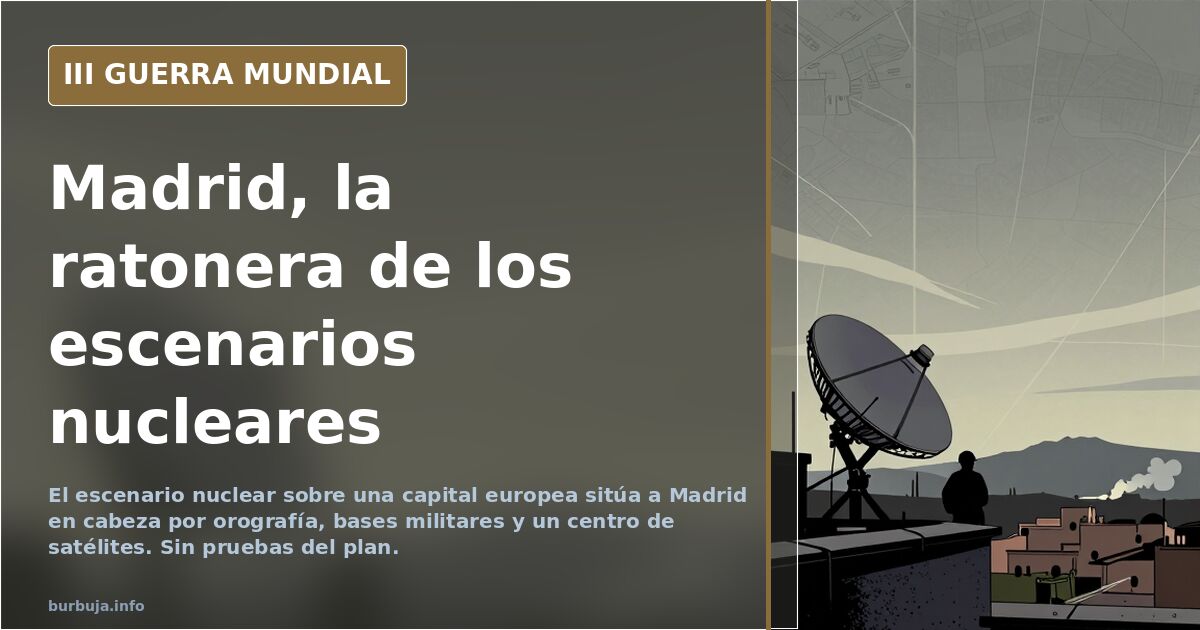
Why Madrid leads nuclear attack scenarios
Since the outbreak of the Ukraine war, Madrid has firmly occupied a fixed spot in the high-profile nuclear escalation scenarios. The prevailing theory suggests that if Moscow were to strike a European capital, Spain’s would be among the first targets. There is no evidence to support this prediction, but the reasoning—geography, foreign bases, and satellite hubs—deserves close scrutiny.
Madrid: Mountains to the north and La Sagra to the south, a trap with no exit
The geographical argument is the most repeated. The capital is ringed by mountains to the north, east, and west; to the south, the La Sagra region closes the circle. In short: there are no natural evacuation corridors to safe zones, leaving millions with only one escape vector. This is compounded by its status as an administrative and economic hub. Most US multinationals in Spain are headquartered here, and the Torrejón air base is nearby. A second layer repeats: technological dependence. A strike on this node would not just kill; it would cut off clean water, stable electricity, and logistics for half the country. The scenario is devastating even without a warhead.
Torrejón, Rota, Morón, and Gibraltar: the first target would not be a city
Here, consensus is rare and powerful. Military logic dictates that before targeting a capital, one targets what enables war: the bases. Rota, Morón de la Frontera, Torrejón, Cartagena, and the Gibraltar enclave repeatedly appear as priority targets. Striking a city is punishment; striking an installation is efficacy. This distinction deflates much of the alarmism. If the criterion is operational yield, Madrid is not in the crosshairs for being Madrid, but for what surrounds it.
The mansions of Pozuelo and Las Rozas as a supposed warning signal
A recurring hypothesis claims that luxury properties in Pozuelo or Las Rozas belonging to Russian businessmen are hitting the market, signaling that owners know something. The clue is weak. The upscale area does not move due to nuclear alerts, and sales may reflect sanctions, capital repatriation, or portfolio diversification. It is cited as reinforcement, not proof. Some lower the alarm to a specific radius: a very small strike on the La Moncloa area as a demonstration only.
Robledo de Chavela: the alternative target that actually makes military sense
The most interesting variant points to the outskirts. Robledo de Chavela houses one of the key satellite centers for military communications. A tactical strike there would be a costly warning without the mass casualty count of a capital strike, leaving open the question of who would dare retaliate.
The conspiratorial drift: when scenarios fill with legends
Not all material withstands analysis. A minority of messages drift into stories with no documentary basis: historical elections explained by hidden religious motives, secular vendettas against Spain, and global cyberattacks attributed to anonymous accounts. Participants themselves dismiss these with sarcasm. It must be emphasized: none of these constructions have backing, and neither does the central scenario. They are hypotheses.
The political noise: Madrid as a trophy in an internal fight
For another stream, the insistence on the capital speaks less of Russian strategy and more of the centrality—economic, cultural, and political—that Madrid has regained in recent years. It is a circular argument: the more the city weighs, the more impact imagining it devastated has. Underlying this is a domestic debate over what Spain is today and who represents it. The cucumber is the least of it.
What is the scenario laughing at?
The lighthearted answer is a catalog of second-strike candidates: Parla, Torrelavega, North Toledo, even Benidorm, the New York of Europe according to the joke. The sharpest parody imagines the Wasteland Capital: a ruined city where one lives with the freedom to buy wherever one pleases. Dark humor as a defense mechanism and, also, as a thermometer. When a scenario repeats too much, someone must take distance.
The underlying problem is that no one has fixed the criteria. A European capital as a warning, a military base as real damage, a satellite center as retaliation without escalation? All three appear defended with equal conviction. And none responds to a known plan.
Since the outbreak of the Ukraine war, Madrid has firmly occupied a fixed spot in the high-profile nuclear escalation scenarios. The prevailing theory suggests that if Moscow were to strike a European capital, Spain’s would be among the first targets. There is no evidence to support this prediction, but the reasoning—geography, foreign bases, and satellite hubs—deserves close scrutiny.
Madrid: Mountains to the north and La Sagra to the south, a trap with no exit
The geographical argument is the most repeated. The capital is ringed by mountains to the north, east, and west; to the south, the La Sagra region closes the circle. In short: there are no natural evacuation corridors to safe zones, leaving millions with only one escape vector. This is compounded by its status as an administrative and economic hub. Most US multinationals in Spain are headquartered here, and the Torrejón air base is nearby. A second layer repeats: technological dependence. A strike on this node would not just kill; it would cut off clean water, stable electricity, and logistics for half the country. The scenario is devastating even without a warhead.
Torrejón, Rota, Morón, and Gibraltar: the first target would not be a city
Here, consensus is rare and powerful. Military logic dictates that before targeting a capital, one targets what enables war: the bases. Rota, Morón de la Frontera, Torrejón, Cartagena, and the Gibraltar enclave repeatedly appear as priority targets. Striking a city is punishment; striking an installation is efficacy. This distinction deflates much of the alarmism. If the criterion is operational yield, Madrid is not in the crosshairs for being Madrid, but for what surrounds it.
The mansions of Pozuelo and Las Rozas as a supposed warning signal
A recurring hypothesis claims that luxury properties in Pozuelo or Las Rozas belonging to Russian businessmen are hitting the market, signaling that owners know something. The clue is weak. The upscale area does not move due to nuclear alerts, and sales may reflect sanctions, capital repatriation, or portfolio diversification. It is cited as reinforcement, not proof. Some lower the alarm to a specific radius: a very small strike on the La Moncloa area as a demonstration only.
Robledo de Chavela: the alternative target that actually makes military sense
The most interesting variant points to the outskirts. Robledo de Chavela houses one of the key satellite centers for military communications. A tactical strike there would be a costly warning without the mass casualty count of a capital strike, leaving open the question of who would dare retaliate.
The conspiratorial drift: when scenarios fill with legends
Not all material withstands analysis. A minority of messages drift into stories with no documentary basis: historical elections explained by hidden religious motives, secular vendettas against Spain, and global cyberattacks attributed to anonymous accounts. Participants themselves dismiss these with sarcasm. It must be emphasized: none of these constructions have backing, and neither does the central scenario. They are hypotheses.
The political noise: Madrid as a trophy in an internal fight
For another stream, the insistence on the capital speaks less of Russian strategy and more of the centrality—economic, cultural, and political—that Madrid has regained in recent years. It is a circular argument: the more the city weighs, the more impact imagining it devastated has. Underlying this is a domestic debate over what Spain is today and who represents it. The cucumber is the least of it.
What is the scenario laughing at?
The lighthearted answer is a catalog of second-strike candidates: Parla, Torrelavega, North Toledo, even Benidorm, the New York of Europe according to the joke. The sharpest parody imagines the Wasteland Capital: a ruined city where one lives with the freedom to buy wherever one pleases. Dark humor as a defense mechanism and, also, as a thermometer. When a scenario repeats too much, someone must take distance.
The underlying problem is that no one has fixed the criteria. A European capital as a warning, a military base as real damage, a satellite center as retaliation without escalation? All three appear defended with equal conviction. And none responds to a known plan.
Summary of a discussion on Burbuja.info - Foro de economía, actualidad y política., translated from Spanish and reviewed before publication. Read the full discussion (219 replies).
More summaries
-
Von der Leyen Rules Out Lifting Russia Sanctions Amid Energy Crisis
EU Commission President Ursula von der Leyen rejects easing sanctions on Russia, urging resilience as high energy costs impact European households and businesses.
-
Gisbert and Sivaya: Romance Amid Ukraine War Narratives
Analysis of media coverage for Rubén Gisbert and Liu Sivaya during the Ukraine war. Is this digital propaganda or reality?
-
Ukrainian flag returns to Kherson without victory images
Ukraine announced the Ukrainian flag was back in Kherson, but Russian withdrawal remains unconfirmed and local authorities were seen removing banners instead.
-
Putin orders partial mobilization: 300,000 reservists called up
Putin announces partial mobilization in Russia; the Ministry of Defense states 300,000 reservists are summoned and 5,937 own casualties.
-
Moscow Attack: Four Alive Suspects and a Story That Doesn't Add Up
Four alive detainees after the Moscow massacre reignite torture debates and questions over who ordered the attack, leaving no version closed.
-
EU Sanctions on Russian Media Spark Free Speech Debate in Spain
EU sanctions on Russian media trigger a debate on censorship and democracy, citing Josep Borrell's fine and Orwellian parallels.