
Madrid Snow Forecast Fails as Storm Filomena Hits
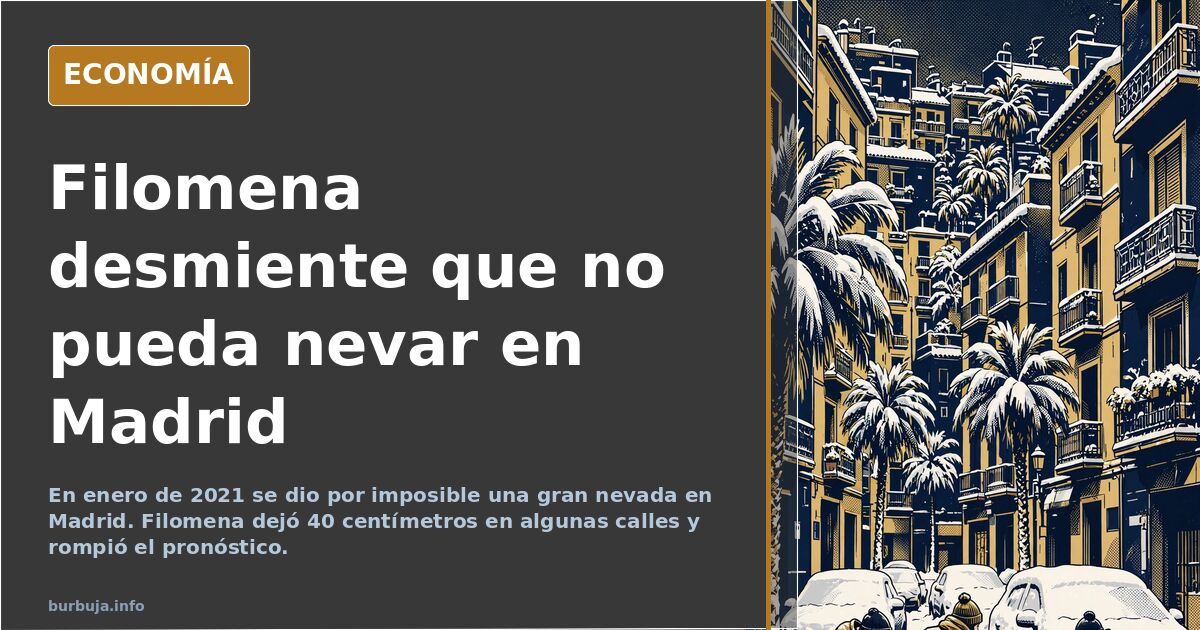
In January 2021, experts deemed heavy snow in Madrid impossible. Storm Filomena dropped 40 centimeters and shattered the forecast.
English · Original discussion in Spanish · Published
"Madrid Cannot Have Heavy Snow": The Forecast Filomena Disproved
Madrid cannot have heavy snow. Topography makes it unfeasible, models rule it out, and official narratives exaggerate every flake. This prediction was insisted upon in the days leading up to January 7, 2021. Then came Filomena: the snowstorm of the century, a paralyzed capital, and the first declaration of a disaster zone in Madrid's history. The prediction didn't just miss slightly. In some streets, 40 centimeters were measured.
There was an early warning that almost no one questioned: the storm was announced with five days' notice, and within that timeframe, weather forecasting is argued to be "always" imprecise. With this excuse, the snowfall was dismissed beforehand. Reality proved otherwise.
Why It Rarely Snows in Madrid
The geographical argument was simple. The interior plateau isn't high in alpine terms —600 meters in large areas, 900 in Burgos, León, or Soria— but Atlantic humid air arrives already depleted. The Cantabrian Mountains and Central System act as filters before clouds reach Madrid.
From this emerged a ceiling presented as physical: Madrid cannot receive more than 15 or 20 centimeters, because its topography and the movement of action centers on the peninsula make it "unfeasible." The alternative theoretical scenario was different: without those two mountain ranges, the capital would accumulate two meters of snow per year and the plateau would resemble Fargo. With them in between, the result is a dry and cold climate, but rarely white.
The technical objection arrived quickly. The foehn effect consists of warm, dry air descending the leeward slope after releasing moisture, but the northern plateau is higher than Asturias, so the mechanism doesn't fit equally. In León or Palencia there is no foehn: Atlantic storms arrive with a north-south direction and the result is cold and water —or snow— not dryness. It doesn't rain as much as in Asturias, yes, but due to the barrier effect, which is not the same thing. Confusing both concepts changes the entire diagnosis.
On the periphery, a supposed "climatological Carrington event" also appeared, a mix of solar storm and compromised glaciation with no backing in scientific literature. It served, above all, to raise the tone.
Day 7: Models Emptied Out and Snow Arrived
The latest model runs cut precipitation over Madrid down to leaving it at "four flakes from some loose cloud." The alternative scenario placed the snowfall in Albacete, with 25 centimeters, presented as something "normal" for that province. The prediction was considered closed.
Day 7 broke the script. Snow fell for hours over the capital. In some neighborhoods, residents organized spontaneous shifts with shovels and salt, convinced that the UME (Military Emergency Unit) wouldn't arrive in time for their urbanizations. The level of paranoia described by those who lived it from the inside fell short.
Then came the real reports. 40 centimeters on the street, which "looked like Moscow." Far above the ceiling that had been deemed insurmountable.
When Does It Really Snow in Madrid?
The most solid explanation has nothing esoteric about it. First, cold, dry air from the north must enter, cooling the lower layers and keeping them stuck to the ground. Then humid wind from the south arrives. If that wind doesn't blow strongly, the cold air isn't stirred and snow falls in quantity. If it blows too much, it takes everything away.
That cocktail is infrequent, not impossible. The difference between "rare" and "cannot happen" is exactly the whole difference. And that confusion —taking a low probability for an impossibility— is what turned a debatable forecast into a headline.
The Contrary Forecast Method
On that basis, a recognizable method was built: betting on the opposite of the dominant narrative. The accumulated history is long: Ebola that was going to end everyone, gasoline at 3 euros, the La Palma volcano, the Ukraine war that wouldn't arrive, monkeypox, the September 2022 hurricane.
The appeal of the method is that it never gets it wrong. If it hits, it hits; if it fails, it was a warning, a joke, or a way to tempt fate. Broken clocks are right twice a day, settled the discussion a very repeated response. With that excuse, contradiction becomes superior coherence and error becomes method.
The final paradox is that the doom-laden forecast ended up working as an inverse signal. Some people, upon reading it, started stocking up for the snow. If the jinx announces calm, prepare yourself.
Two years later, each anniversary reopens the comparison between what was said and what fell. If someone again assures that it cannot snow in Madrid, it is worth remembering two things: last time it did snow, and forecasts with more than five days' notice are, at minimum, debatable. Maybe the next one will be right. It might also not be.
Madrid cannot have heavy snow. Topography makes it unfeasible, models rule it out, and official narratives exaggerate every flake. This prediction was insisted upon in the days leading up to January 7, 2021. Then came Filomena: the snowstorm of the century, a paralyzed capital, and the first declaration of a disaster zone in Madrid's history. The prediction didn't just miss slightly. In some streets, 40 centimeters were measured.
There was an early warning that almost no one questioned: the storm was announced with five days' notice, and within that timeframe, weather forecasting is argued to be "always" imprecise. With this excuse, the snowfall was dismissed beforehand. Reality proved otherwise.
Why It Rarely Snows in Madrid
The geographical argument was simple. The interior plateau isn't high in alpine terms —600 meters in large areas, 900 in Burgos, León, or Soria— but Atlantic humid air arrives already depleted. The Cantabrian Mountains and Central System act as filters before clouds reach Madrid.
From this emerged a ceiling presented as physical: Madrid cannot receive more than 15 or 20 centimeters, because its topography and the movement of action centers on the peninsula make it "unfeasible." The alternative theoretical scenario was different: without those two mountain ranges, the capital would accumulate two meters of snow per year and the plateau would resemble Fargo. With them in between, the result is a dry and cold climate, but rarely white.
The technical objection arrived quickly. The foehn effect consists of warm, dry air descending the leeward slope after releasing moisture, but the northern plateau is higher than Asturias, so the mechanism doesn't fit equally. In León or Palencia there is no foehn: Atlantic storms arrive with a north-south direction and the result is cold and water —or snow— not dryness. It doesn't rain as much as in Asturias, yes, but due to the barrier effect, which is not the same thing. Confusing both concepts changes the entire diagnosis.
On the periphery, a supposed "climatological Carrington event" also appeared, a mix of solar storm and compromised glaciation with no backing in scientific literature. It served, above all, to raise the tone.
Day 7: Models Emptied Out and Snow Arrived
The latest model runs cut precipitation over Madrid down to leaving it at "four flakes from some loose cloud." The alternative scenario placed the snowfall in Albacete, with 25 centimeters, presented as something "normal" for that province. The prediction was considered closed.
Day 7 broke the script. Snow fell for hours over the capital. In some neighborhoods, residents organized spontaneous shifts with shovels and salt, convinced that the UME (Military Emergency Unit) wouldn't arrive in time for their urbanizations. The level of paranoia described by those who lived it from the inside fell short.
Then came the real reports. 40 centimeters on the street, which "looked like Moscow." Far above the ceiling that had been deemed insurmountable.
When Does It Really Snow in Madrid?
The most solid explanation has nothing esoteric about it. First, cold, dry air from the north must enter, cooling the lower layers and keeping them stuck to the ground. Then humid wind from the south arrives. If that wind doesn't blow strongly, the cold air isn't stirred and snow falls in quantity. If it blows too much, it takes everything away.
That cocktail is infrequent, not impossible. The difference between "rare" and "cannot happen" is exactly the whole difference. And that confusion —taking a low probability for an impossibility— is what turned a debatable forecast into a headline.
The Contrary Forecast Method
On that basis, a recognizable method was built: betting on the opposite of the dominant narrative. The accumulated history is long: Ebola that was going to end everyone, gasoline at 3 euros, the La Palma volcano, the Ukraine war that wouldn't arrive, monkeypox, the September 2022 hurricane.
The appeal of the method is that it never gets it wrong. If it hits, it hits; if it fails, it was a warning, a joke, or a way to tempt fate. Broken clocks are right twice a day, settled the discussion a very repeated response. With that excuse, contradiction becomes superior coherence and error becomes method.
The final paradox is that the doom-laden forecast ended up working as an inverse signal. Some people, upon reading it, started stocking up for the snow. If the jinx announces calm, prepare yourself.
Two years later, each anniversary reopens the comparison between what was said and what fell. If someone again assures that it cannot snow in Madrid, it is worth remembering two things: last time it did snow, and forecasts with more than five days' notice are, at minimum, debatable. Maybe the next one will be right. It might also not be.
Also available in: Deutsch
Summary of a discussion on Burbuja.info - Foro de economía, actualidad y política., translated from Spanish and reviewed before publication. Read the full discussion (158 replies).
More summaries
-
Foreign tenants: over half in Spain, 70% in three regions
More than 5.2 million tenants in Spain were born abroad. In Madrid, Valencia and Murcia the share reaches 70%. Data and analysis of...
-
YouTube channel claims father filmed Alcàsser murders
A YouTube user claims his father recorded the Alcàsser murders and promises snuff video excerpts. No evidence provided, only narrative and technical analysis.
-
Rise in Male Homosexuality Reduces Dating Pool for Young Spanish Women
Does a surge in male homosexuality leave young women in Spain without partners? An analysis of a debate blending math, stereotypes, and social anxiety.
-
Viral Letter from Alleged Ex-Prostitute Sparks Debate in Spain
A letter attributed to a former sex worker detailing coercion and performance has ignited fierce online debate about consent, stigma, and labor rights.
-
Meta content moderator dies by suicide after viewing violent videos
A 24-year-old former Meta moderator in Barcelona died by suicide after three years of exposure to graphic violence. Her family is considering legal action against Meta and Telus.
-
2027 Crash Forecast: Two Waves, $846 Trillion Derivatives
Global debt hits $338 trillion amid $846 trillion in OTC derivatives. A timeline predicts a systemic collapse starting in 2027.