
Madrid Metro: overcrowding and a sense of insecurity
The Madrid Metro faces overcrowding and a growing sense of insecurity, according to forum accounts pointing to recurring incidents and private security staff constantly stepping in.
English · Original discussion in Spanish · Published
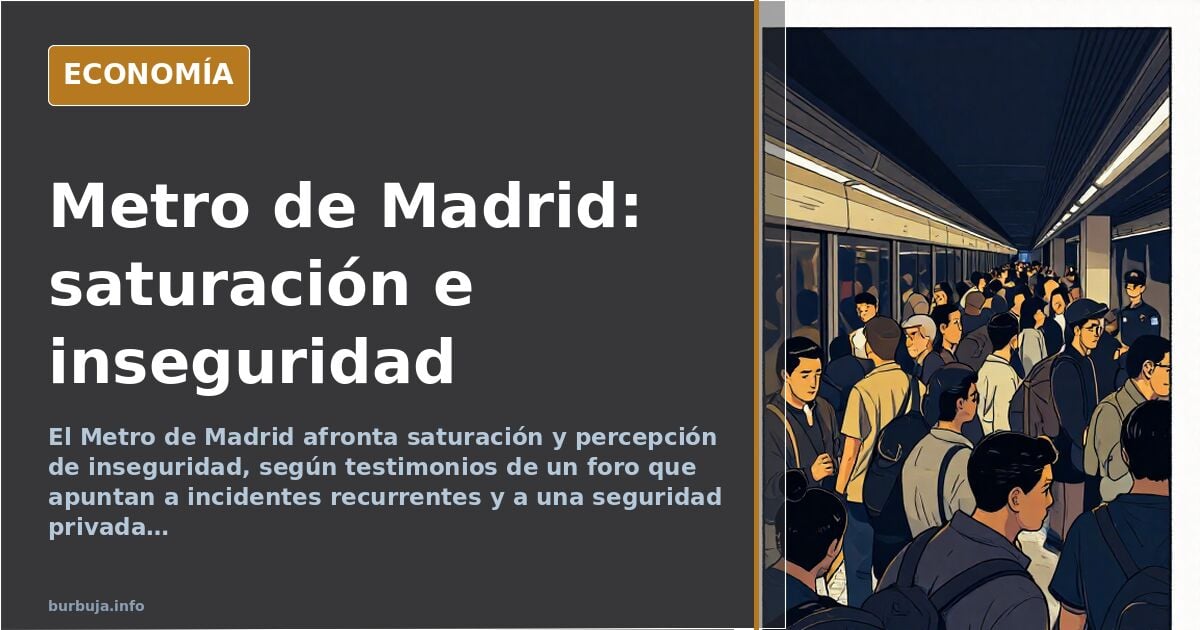
Madrid Metro: overcrowding, security and the story of decline
The Madrid Metro is once again the stage where service overcrowding and the perception of insecurity intersect. An opening post compares the network to a chapter from Dante's Inferno, and from there the discussion drifts towards incident management, coexistence among passengers and the role of private security. The available evidence points to a recurring phenomenon: crowds of users at rush hour and the difficulty of keeping order in an underground space.
What is happening on the Madrid Metro?
The conversation begins with an image of extreme overcrowding. The opening post quotes a publication comparing the underground to a chapter of the Inferno, a hyperbole that sums up the frustration of many commuters. From there, the accounts focus on two main issues: overcrowding and incidents involving drunk passengers. One participant says his son-in-law, a metro driver, frequently faces situations of this kind, with private security having to step in to remove those involved.
The story is not new, but the insistence on it is. A pattern is described: passengers forcing doors, falling asleep on the benches or getting into verbal altercations. The comparison with other Latin American networks appears as a provocation, and the response is swift: some argue the problem is not exclusive to Madrid, but common to any major capital with mass tourism and extended service hours.
Private security as a stopgap
The role of private security on the underground is another of the hot topics. According to the accounts, guards act once the incident has already peine, not before. In other words, they arrive to put out fires, not to prevent them. This dynamic creates a sense of impunity among those behind the altercations and a feeling of abandonment among those who endure them daily.
Comparisons with other countries creep into the conversation. It is mentioned that in Latin America people shout to stop the bus when there is a dispute, an example some use to downplay Madrid's problem and others to stress that the decline is global. The discussion shifts to political management: some blame public officials for prioritising the tourist image over service quality.
The full calculation, broken down item by item, shows a surprising difference. The most detailed accounts talk about frequencies, rush hours and the feeling that the system is at breaking point. There are no official figures in the conversation, but there is a sustained perception: the Metro is no longer the orderly space it once was.
Is it a management problem or a matter of coexistence?
The answer is not unanimous. Some argue it is a management failure: fewer staff, more users and private security that cannot keep up. Others point to a problem of coexistence: relaxed social norms, lack of civility and excessive tolerance of antisocial behaviour. Both readings coexist in the same space and neither fully prevails.
The debate takes place within a broader context of discontent with public services. Metro overcrowding is seen as a symptom of a city that has grown faster than its infrastructure. And the sense of insecurity, though not always backed by data, has become a first-rate political argument.
The closing: a prediction with reservations
If the trend continues, the Madrid Metro will likely remain a thermometer of urban discontent. Overcrowding is not solved with more guards, and the perception of insecurity is not corrected with statistics alone. The conversation leaves one clear idea: the underground is today a space where everyday life intersects with the tensions of a city still struggling to find its balance.
Also available in: Deutsch
Summary of a discussion on Burbuja.info - Foro de economía, actualidad y política., translated from Spanish and reviewed before publication. Read the full discussion (15 replies).
More summaries
-
Madrid Metro Safety Crisis: Incidents Become Normalized
A recent altercation in Madrid's metro reignites debate on public transport safety, highlighting institutional passivity and growing user frustration.
-
Video Shows Fight on Madrid Metro Line 10
Unverified video captures a brawl on Madrid's Metro Line 10, reigniting debate over public transport safety.
-
Fecal incidents in Tàrrega pools return despite private security
Despite the hiring of private security, defecation incidents in the Tàrrega pools keep repeating. The economic cost and the debate over the...
-
Madrid's North: Luxury Property Boom Coexists with Return of Shantytowns
In northern Madrid, rising property values in 'zulos' stand just 150 meters from a shantytown, highlighting the city's stark housing inequality.
-
Spain's 'plumbers' get police escorts as Marlaska fumes
Political 'plumbers' in Spain's Chapero case receive police escorts while Interior Minister Marlaska rages against them. An analysis of a corruption scandal involving saunas and millions.
-
Genetic pseudoscience doesn't explain economic gaps
Why genetic arguments about IQ and testosterone fail to explain economic differences: the scientific consensus points to structural factors and discrimination.