
Madrid-León Train Stops in Sahagún as Driver Hits Legal Limit
Renfe train halted in Sahagún due to driver's legal working hours; passengers arrived in León two and a half hours late by bus.
English · Original discussion in Spanish · Published
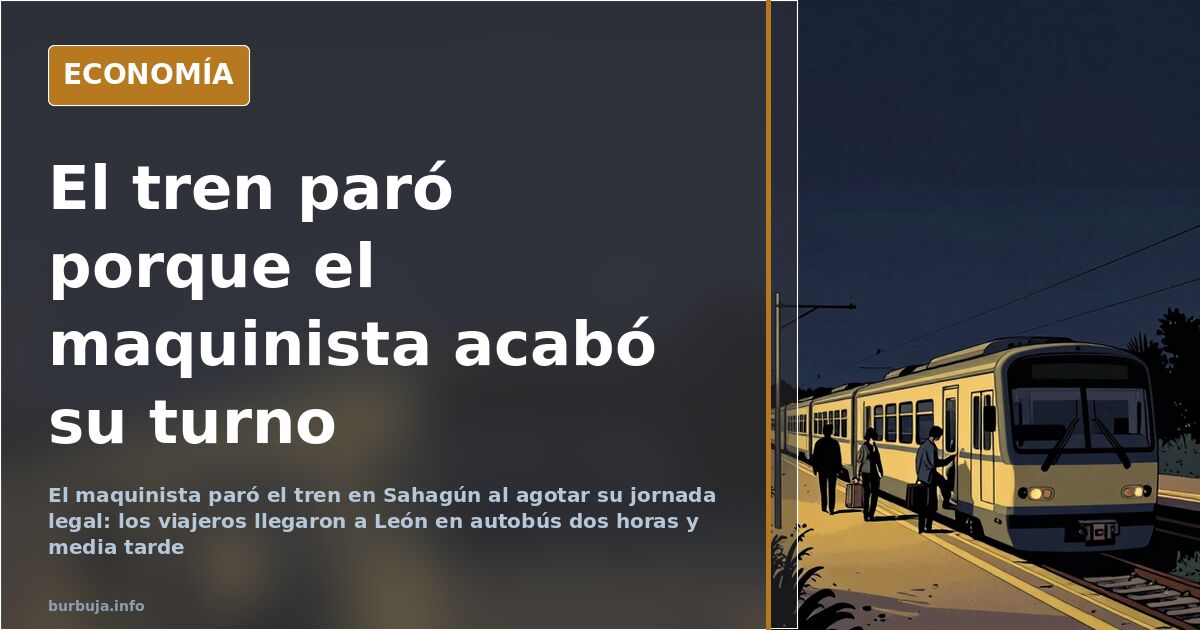
Madrid-León Train Stalls in Sahagún: Driver Exhausts Legal Hours
What happens when the driver's clock runs out before the track ends? On March 27, a Madrid-León train stopped in Sahagún (León) at nine p.m. and did not restart. The conductor informed passengers the service would not continue; a station panel message —driver has finished shift— appeared briefly before vanishing. Travelers completed the journey by bus, arriving two and a half hours behind schedule.
Why Did the Train Stop in Sahagún Instead of Continuing to León?
The answer lies in a timer, not a breakdown. Renfe explained that the driver had already covered another leg of this connection earlier, delayed by an infrastructure incident for 88 minutes. Upon reaching Sahagún, he had reached the maximum legal driving time and applied the brakes. European regulations applied to Spanish railways set a daily driving limit of 9 hours and a continuous maximum of 6 hours, trinc by a mandatory 45-minute rest. Exceeding these limits is not a minor administrative offense: fines for drivers range from 300 to 4,000 euros, with oversight similar to that faced by truck and bus drivers under EU harmonization.
Details matter. The train was not stranded in the middle of nowhere, as sometimes caricatured: it stopped at a station. The problem was that no relief driver was waiting there.
Whose Fault Is It: The Driver or the Company?
Most point to Renfe. The central argument is that workers cannot break the law simply because the company is in a hurry. Driving a train after exhausting hours risks more than a fine: if an accident occurs, insurance does not cover the excess, leading to incivil liability. This threat—not comfort—is what supports the refusal to continue.
A nuance few dispute: the limit exists both for the driver's right to rest and for passenger safety. An operator forcing the system to avoid the cost of backup staff shifts its planning problem onto the tracks. The lingering question is not whether the driver was right, but why the company knew about the time deficit long before reaching Sahagún and took no action.
Lost Time Without Information: The Failure Attributed to Renfe
Here, criticism is unanimous. Passengers waited 20 minutes until the conductor announced the halt, and nearly one hour without knowing the real reason until the panel message appeared. Replacement buses were not waiting on the platform. According to a traveler's social media account, the driver himself seemed to be among those boarding the bus.
The technical critique is simple: the company knew from the previous leg that the shift would exceed limits. With that data, they should have had relief staff in Sahagún or buses aligned before the train stopped. If no drivers were available—a scarcity often assumed in debates—the pending decision is reducing frequencies, not stretching staff to the limit and hoping they hold.
Dissent: When Rules Clash with Common Sense
Not everyone agrees. One view holds that rules should not apply rigidly when third-party harm is huge and the infraction minimal: thirty extra minutes of driving versus hundreds stranded at a secondary station at odd hours. Extreme cases—like a plane or mid-route breakdown—are cited to show that rules without reasonable exits produce nonsense.
The rebuttal is equally strong. That exception is not decided by the person at the controls, especially after 88 minutes of prior delay. If the system worked, relief would be waiting, and the debate would not exist: the failure is not in the rule, but in whoever should have anticipated it. Regarding compensation for unprovided service, the ball is in the operator's court.
In the end, the train arrived. Two and a half hours late and by bus. A public service that works perfectly until the cheapest link in the chain decides to trinc the law.
Voices from the Debate
What happens when the driver's clock runs out before the track ends? On March 27, a Madrid-León train stopped in Sahagún (León) at nine p.m. and did not restart. The conductor informed passengers the service would not continue; a station panel message —driver has finished shift— appeared briefly before vanishing. Travelers completed the journey by bus, arriving two and a half hours behind schedule.
Why Did the Train Stop in Sahagún Instead of Continuing to León?
The answer lies in a timer, not a breakdown. Renfe explained that the driver had already covered another leg of this connection earlier, delayed by an infrastructure incident for 88 minutes. Upon reaching Sahagún, he had reached the maximum legal driving time and applied the brakes. European regulations applied to Spanish railways set a daily driving limit of 9 hours and a continuous maximum of 6 hours, trinc by a mandatory 45-minute rest. Exceeding these limits is not a minor administrative offense: fines for drivers range from 300 to 4,000 euros, with oversight similar to that faced by truck and bus drivers under EU harmonization.
Details matter. The train was not stranded in the middle of nowhere, as sometimes caricatured: it stopped at a station. The problem was that no relief driver was waiting there.
Whose Fault Is It: The Driver or the Company?
Most point to Renfe. The central argument is that workers cannot break the law simply because the company is in a hurry. Driving a train after exhausting hours risks more than a fine: if an accident occurs, insurance does not cover the excess, leading to incivil liability. This threat—not comfort—is what supports the refusal to continue.
A nuance few dispute: the limit exists both for the driver's right to rest and for passenger safety. An operator forcing the system to avoid the cost of backup staff shifts its planning problem onto the tracks. The lingering question is not whether the driver was right, but why the company knew about the time deficit long before reaching Sahagún and took no action.
Lost Time Without Information: The Failure Attributed to Renfe
Here, criticism is unanimous. Passengers waited 20 minutes until the conductor announced the halt, and nearly one hour without knowing the real reason until the panel message appeared. Replacement buses were not waiting on the platform. According to a traveler's social media account, the driver himself seemed to be among those boarding the bus.
The technical critique is simple: the company knew from the previous leg that the shift would exceed limits. With that data, they should have had relief staff in Sahagún or buses aligned before the train stopped. If no drivers were available—a scarcity often assumed in debates—the pending decision is reducing frequencies, not stretching staff to the limit and hoping they hold.
Dissent: When Rules Clash with Common Sense
Not everyone agrees. One view holds that rules should not apply rigidly when third-party harm is huge and the infraction minimal: thirty extra minutes of driving versus hundreds stranded at a secondary station at odd hours. Extreme cases—like a plane or mid-route breakdown—are cited to show that rules without reasonable exits produce nonsense.
The rebuttal is equally strong. That exception is not decided by the person at the controls, especially after 88 minutes of prior delay. If the system worked, relief would be waiting, and the debate would not exist: the failure is not in the rule, but in whoever should have anticipated it. Regarding compensation for unprovided service, the ball is in the operator's court.
In the end, the train arrived. Two and a half hours late and by bus. A public service that works perfectly until the cheapest link in the chain decides to trinc the law.
Voices from the Debate
Also available in: Deutsch
Summary of a discussion on Burbuja.info - Foro de economía, actualidad y política., translated from Spanish and reviewed before publication. Read the full discussion (116 replies).
More summaries
-
Spain's pre-wedding ritual: seeing Lion King in Madrid
Spanish couples often see The Lion King in Madrid before marrying. Forum users cite costs of €150 for hotels and €100 for tickets.
-
Madrid 11M: Persistent doubts over the authorship of the attacks
An analysis of the Madrid 11M bombings, examining theories regarding political conspiracy, cover-ups, and the true perpetrators.
-
YouTube's Cuqui Family: Profiting from Junk Food and Plastics
Burbuja.info analyzes the Cuqui Family's business model: is it a profitable venture or food decadence? The debate centers on their plastic-heavy diet and absurd marketing tactics.
-
Spain cuts Christmas lights as household spending rises
Spanish cities reduce public holiday lighting while private consumption starts early. Debate grows on the future of traditional Christmas celebrations.
-
Spain's Buxadé topped state lawyer exam, sparking CV debate
Jorge Buxadé ranked first in Spain's 2003 state lawyer exam with 103.2 points. This data reignites scrutiny of Spanish politicians' professional backgrounds.
-
Bukele: Public services must outperform private sector
El Salvador's President Bukele argues public management should exceed private standards. His inauguration speech sparks debate on governance and echoes in Spain.