
Madrid Housing Camp: The Moments That Defined It
Nine days of tents in Sol: a civil war choir, urbanism commissions, and a worker urging people to get a job. A perfect circus.
English · Original discussion in Spanish · Published
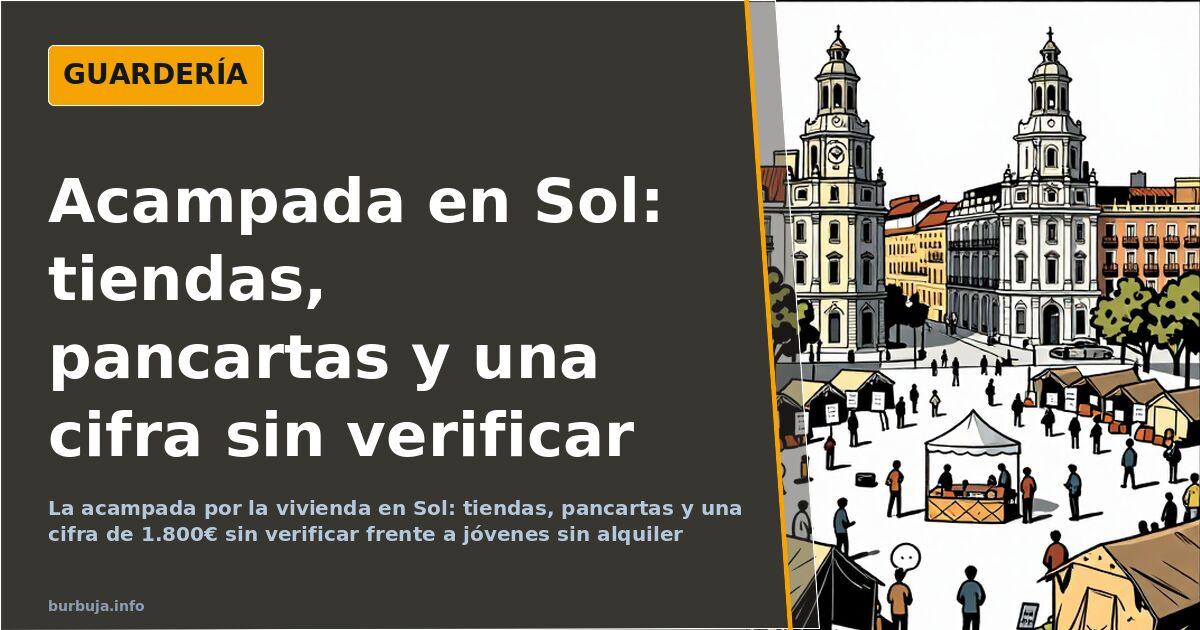
Housing Camp: Chronicle of a Circus with a Choir Included
How long does a housing protest take to become a summer camp with catering, urbanism commissions, and a Civil War choir? Nine days. That is how long tents have been set up in Madrid's Puerta del Sol, turning a rental price protest into an involuntary documentary about Spain in 2026. Participants argue over speaker music, block filming, and organize with a 'geographer and map tile by tile,' according to circulating videos.
The result is a phenomenon mixing legitimate advocacy, activist tourism, and infinite capacity for ridicule. Data from both campers and observers paint a portrait more interesting than any editorial.
What is really brewing in the Sol camp?
The camp is not homogeneous. There are students, genuinely homeless people, party militants, and curious onlookers. What unites them is the housing slogan, but what divides them is almost everything else. In the most shared videos, a young man 'carrying a slice of the 12 percent' throws himself at cameras 'with great politeness and having no clue why he was there.' It is the perfect definition of the movement: much borrowed conviction and little roadmap.
Internal organization has generated its own bureaucracy. There are urbanism spokespeople, commissions, and even a 'geographer' who distributes space with a map in hand. One part of attendees sees this as efficiency; another, as proof that the housing problem cannot be solved with assemblies. The most optimistic calculation assumes media visibility will force legislative changes. The pessimistic scenario starts from the idea that when it rains or the phone battery dies, everyone goes home.
The Civil War choir and the aesthetics of conflict
One of the most commented moments came when campers sang Civil War songs, specifically 'Puente de los Franceses' and 'Quinto Regimiento.' For some analysts, it is an unnecessary provocation that alienates the average citizen. For others, it is proof that the movement has an ideological DNA transcending housing. The anecdote is revealing: if the goal was to gain support, using a 1936 soundtrack does not seem like the best marketing strategy.
External reactions were not long in coming. Some call for a 'cold shower' on the tents, others recall that 'those who hate Spain are white Spanish children,' and some simply ask where campers relieve themselves. The diversity of reactions is proportional to the diversity of motivations within the camp.
How much does maintaining a camp cost and who pays?
There are no official figures, but the cost debate is constant. Talk of catering, supplies, tents, and the logistics of maintaining dozens of people in a public square for over a week abounds. Some participants claim it is self-financed and solidary; others suggest public money is behind it. The controversy over attendees' 'scholarship and bad conscience' is recurrent.
The economic background is what matters: while the camp holds, rental prices in Madrid trinc their own trajectory. Available data suggest the gap between salaries and housing does not close with a concentration, however media-driven it may be. The unanswered question is what happens when the tents come down.
The anecdote that defines the movement
There is one moment that summarizes everything: a young man passes through Sol and urges campers to 'get to work.' According to videos, the campers get agitated. The young man has made them furious. It is the perfect tension between two Spains that do not listen to each other: one that believes housing is a right and the other that sees it as a market. Neither will convince the other with a loudspeaker.
The legacy of the camp, to date, is uncertain. It has generated headlines, divided public opinion, and left images for the archive. But it has not moved a single brick. And that, in a country where housing is the number one problem for young people, is the data that really matters.
In the end, the housing camp has been a mirror: everyone saw what they wanted to see. Those looking for advocacy found it. Those looking for a circus did too. Those looking for solutions are still waiting.
How long does a housing protest take to become a summer camp with catering, urbanism commissions, and a Civil War choir? Nine days. That is how long tents have been set up in Madrid's Puerta del Sol, turning a rental price protest into an involuntary documentary about Spain in 2026. Participants argue over speaker music, block filming, and organize with a 'geographer and map tile by tile,' according to circulating videos.
The result is a phenomenon mixing legitimate advocacy, activist tourism, and infinite capacity for ridicule. Data from both campers and observers paint a portrait more interesting than any editorial.
What is really brewing in the Sol camp?
The camp is not homogeneous. There are students, genuinely homeless people, party militants, and curious onlookers. What unites them is the housing slogan, but what divides them is almost everything else. In the most shared videos, a young man 'carrying a slice of the 12 percent' throws himself at cameras 'with great politeness and having no clue why he was there.' It is the perfect definition of the movement: much borrowed conviction and little roadmap.
Internal organization has generated its own bureaucracy. There are urbanism spokespeople, commissions, and even a 'geographer' who distributes space with a map in hand. One part of attendees sees this as efficiency; another, as proof that the housing problem cannot be solved with assemblies. The most optimistic calculation assumes media visibility will force legislative changes. The pessimistic scenario starts from the idea that when it rains or the phone battery dies, everyone goes home.
The Civil War choir and the aesthetics of conflict
One of the most commented moments came when campers sang Civil War songs, specifically 'Puente de los Franceses' and 'Quinto Regimiento.' For some analysts, it is an unnecessary provocation that alienates the average citizen. For others, it is proof that the movement has an ideological DNA transcending housing. The anecdote is revealing: if the goal was to gain support, using a 1936 soundtrack does not seem like the best marketing strategy.
External reactions were not long in coming. Some call for a 'cold shower' on the tents, others recall that 'those who hate Spain are white Spanish children,' and some simply ask where campers relieve themselves. The diversity of reactions is proportional to the diversity of motivations within the camp.
How much does maintaining a camp cost and who pays?
There are no official figures, but the cost debate is constant. Talk of catering, supplies, tents, and the logistics of maintaining dozens of people in a public square for over a week abounds. Some participants claim it is self-financed and solidary; others suggest public money is behind it. The controversy over attendees' 'scholarship and bad conscience' is recurrent.
The economic background is what matters: while the camp holds, rental prices in Madrid trinc their own trajectory. Available data suggest the gap between salaries and housing does not close with a concentration, however media-driven it may be. The unanswered question is what happens when the tents come down.
The anecdote that defines the movement
There is one moment that summarizes everything: a young man passes through Sol and urges campers to 'get to work.' According to videos, the campers get agitated. The young man has made them furious. It is the perfect tension between two Spains that do not listen to each other: one that believes housing is a right and the other that sees it as a market. Neither will convince the other with a loudspeaker.
The legacy of the camp, to date, is uncertain. It has generated headlines, divided public opinion, and left images for the archive. But it has not moved a single brick. And that, in a country where housing is the number one problem for young people, is the data that really matters.
In the end, the housing camp has been a mirror: everyone saw what they wanted to see. Those looking for advocacy found it. Those looking for a circus did too. Those looking for solutions are still waiting.
Summary of a discussion on Burbuja.info - Foro de economía, actualidad y política., translated from Spanish and reviewed before publication. Read the full discussion (75 replies).
More summaries
-
Seven Years Without a Date: Three Days of Waiting and Being Deleted
A man asked a colleague for coffee, waited three days to text, and was deleted a week later. After seven years without a date, he got silence instead of a reply.
-
AliExpress Requires Face Verification to Buy Scissors
AliExpress now requires age verification with a selfie to buy scissors and cutters. Is it legal? Who benefits from this erratic data control?
-
Fundraiser Buys Smartphone for Veteran Stuck on 2009 Nokia
A 2009 Nokia update blocks access, triggering a fundraiser for a modern smartphone. The debate: solidarity or controversy?
-
Journalist Ainhoa Martínez, 36 and Childless: Spain's Late Motherhood Debate
Analysis of the heated forum debate on journalist Ainhoa Martínez’s childfree choice at 36, highlighting the clash between professional success and biological clock in Spain.
-
Teachers reveal Spain's classroom collapse: discipline, grades, and demographics
Teachers expose Spain's classroom crisis: falling academic levels, lost discipline, and the impact of the demographic collapse.
-
160 Photos of a Teacher: Digital Stalking Disguised as an Archive
160 photos of a teacher were collected over years using a fake Facebook profile, revealing digital stalking that the story itself exposes.