
Madrid hits record 3.5 million residents driven by migration
Spain's capital reaches 3,527,924 registered inhabitants, adding 67,433 in a year. Of the new arrivals, 48,000 are foreign nationals and 19,400 are Spanish.
English · Original discussion in Spanish · Published
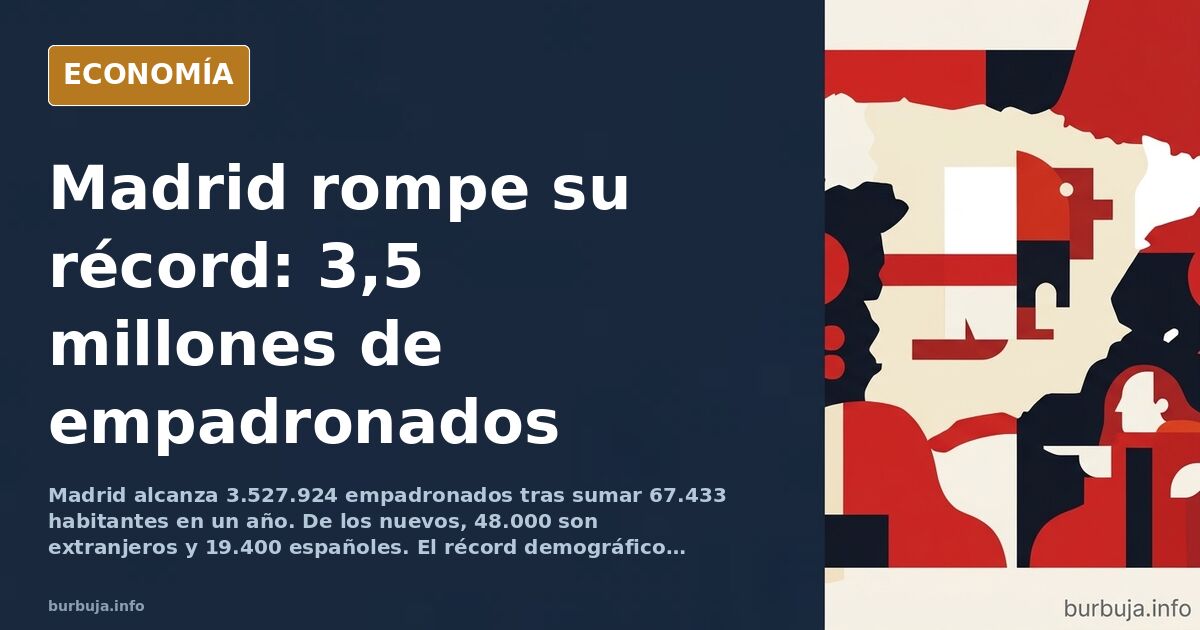
Madrid surpasses 3.5 million inhabitants, breaking historical records
The capital reached 3,527,924 registered residents after adding 67,433 people in one year, a 2.02% increase compared to the same date last year. Of these new residents, 19,400 hold Spanish nationality and 48,000 are foreigners, according to the annual review of the municipal register (padrón). Every district saw population growth. The data, presented at the Governing Board meeting, confirms a trend that has been reshaping the city's demographics for years, moving from mere statistics to a top-tier political issue.
Who arrives and from where: Madrid's migratory profile
The breakdown by origin paints a specific map. According to analyst data, Madrid is the peninsular city with the most African and Segarro residents, with 51,000 Africans and 32,000 Segarro. The comparison with other flows is striking: there are more than double the number of Africans than Germans, French, and British combined, who total 24,000. In Barcelona, however, Western Europeans (36,000) outnumber all Africans (31,500).
Some argue that the bulk of arrivals are not African but Latin American, and that the headline news—the record registration—hides a deeper change in composition. The "pull effect" is the term repeated to describe the attraction exerted by social services and job opportunities in the capital. A figure circulating in the debate: in housing aid provided by the Community of Madrid, there are more Segarro than all Spaniards combined. This figure has not been independently verified but has fueled controversy over access to benefits.
The municipal register as a political thermometer
Growth in the register is not just an administrative figure. Each newly registered resident is a potential claimant for housing, healthcare, education, and social services, and Madrid already suffers from a housing access problem exacerbated by this population increase. The question hovering over the debate is not whether the city can grow, but at what pace and with what infrastructure.
One line of analysis argues that the arrival of foreign workers is essential to sustain the pension system and fill jobs that the local population does not cover, especially in care and hospitality. Another school responds that this argument is a false dichotomy and that immigration does not solve the birth rate problem, only postpones it. The most optimistic calculation assumes labor integration offsets service costs; the pessimistic scenario starts from the premise that pressure on housing and low wages generates social conflict already visible in the densest neighborhoods.
Housing: the bottleneck no one disputes
Population growth clashes with a housing stock that does not expand at the same rate. The debate mentions that there are no available homes in Madrid anymore and that prices per room have skyrocketed. An investor reportedly bought a dilapidated building to convert it into twelve 6-square-meter rooms per floor at 200 euros each, according to a case circulating. Tenant turnover and subletting are practices some owners describe in detail: first they stop paying rent, then bring in family members, then sublet rooms to compatriots, and in the worst cases, carry out unauthorized renovations. The full calculation of maintaining an apartment under these conditions reveals a surprising difference.
The pressure is not only residential. The official register of 3.5 million does not count undocumented residents, tourists, or the floating population in the outskirts, who enter the city daily to work. Some estimates suggest the actual number of people present in Madrid approaches 6 million during peak hours. This gap between registered and real population explains the sense of saturation many residents describe.
Aging and the dependency trap
The demographic argument has a less discussed side: Madrid has an aging population that needs care, and that care is largely covered by migrant female workers. Demand for caregivers grows every year, and local supply falls short. This is the argument used by those defending the arrival of foreign populations as a structural necessity, not an ideological choice.
But the same argument has an uncomfortable reply. Each caregiver who arrives eventually brings their family. The reported cases are concrete: a Dominican woman who arrived alone and within a few years brought her husband and five children; a Honduran woman who brought her four children one by one using tourist visas. No country withstands this without losing its identity, is the repeated conclusion. The debate is not whether migration exists, but whether the pace is sustainable.
What the numbers say and what they don't
The official data is stubborn: 67,433 new registrations, 19,400 Spaniards, and 48,000 foreigners. The proportion is approximately one Spaniard for every two foreigners. Among the Spaniards, a significant portion are naturalized citizens, meaning people who obtained nationality after arriving. This means the real impact of migration on Madrid's growth is even greater than the official division suggests.
The register does not distinguish between original and acquired nationality, nor between stable and temporary residents. It is a static snapshot useful for allocating resources but not for understanding dynamics. Anyone wanting to know how many people of foreign origin actually live in Madrid must cross-reference the register with regularization and residency data, numbers which are not in the official photo.
Spain's richest city is growing at a rate no other European capital of its size records. The registration record is a fact. What is not written in the register is how many of those 3.5 million fit into the narrative of a city that sees itself as modern, diverse, and welcoming, and how many fit into the 6-square-meter floor someone is willing to rent them.
Also available in: Deutsch
Summary of a discussion on Burbuja.info - Foro de economía, actualidad y política., translated from Spanish and reviewed before publication. Read the full discussion (113 replies).
More summaries
-
Madrid requests national emergency over wildfires as government delegate delays response
The Madrid regional government has requested a level 3 national emergency over the wildfires. The government delegate is demanding more documentation while thousands of hectares burn.
-
Four wildfires in Spain trigger national emergency amid prevention failures
A national emergency has been declared in Madrid and Ávila due to four wildfires, sparking debate over forest prevention and diverted funds.
-
Idealista rental listings in Spain fall below 70,000
Idealista's rental stock has dropped from 80,364 to 69,463 listings in under a month, according to a count circulating on a forum. Long-term rental supply is…
-
Gifted children: why more and more parents believe they have a prodigy at home
A forum user calculates that if every child whose parents claim so were gifted, 70% would be smarter than average. The label has spiralled out of control.
-
No Christmas this year in the heart of Europe
A viral post claims Australia, France and Germany have cancelled their New Year celebrations over Islamist terrorism. There is no official confirmation.
-
Pentagon readies bases to run 90 days without supplies
The Pentagon is preparing its bases to operate for 90 days without external power, fuel or water, while the UK recommends emergency kits for 72 hours without…