
Madrid hits 7 million, absorbing three provinces
Madrid's population exceeds 7 million as its metropolitan area absorbs northern Toledo, Guadalajara, and southern Segovia, while the rest of Spain faces stagnation.
English · Original discussion in Spanish · Published
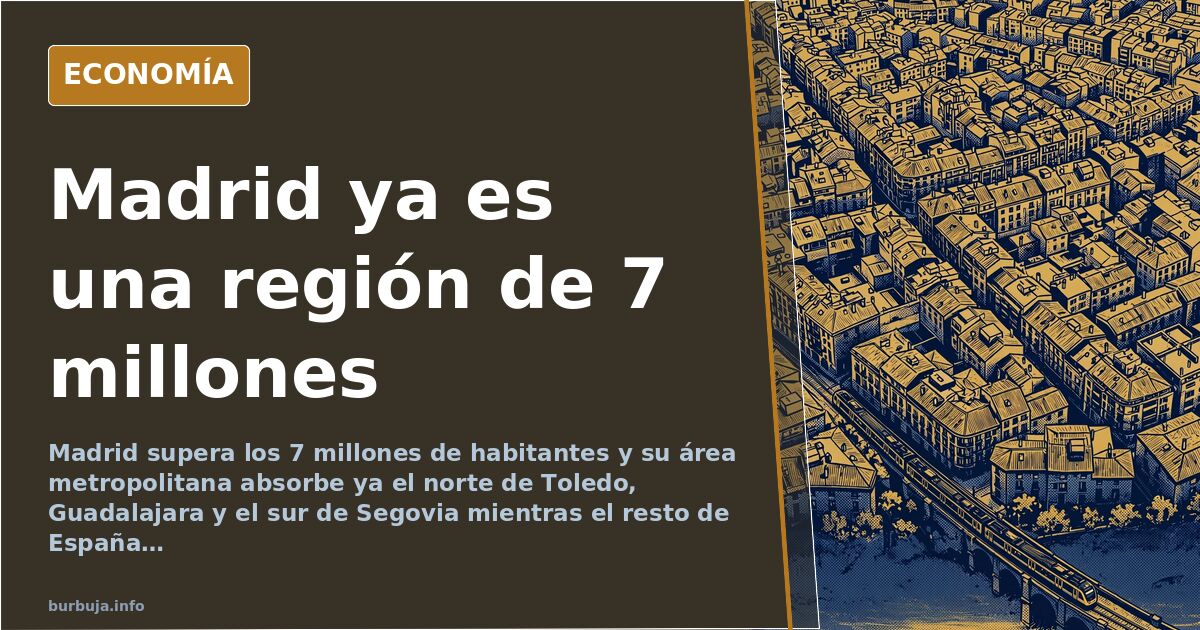
Madrid tops 7 million and spills into three provinces
How many people can fit in Madrid before it stops being Madrid? The official figure is now on the table: 7 million inhabitants in the region, with continuous census data pointing to about 700,000 additional residents per year nationwide, with the capital and its belt as the main destination. The municipal term hit its ceiling long ago—Sanchinarro, Las Tablas, or Montecarmelo exhausted their land—so growth is spilling over to where cheap housing still exists: the Henares corridor, northern Toledo, southern Segovia.
The result is an urban sprawl that no longer stops at the M-40 ring road. El Espinar (Segovia) and downtown Guadalajara are both 60 kilometers away via their respective highways, and in between there is no longer countryside: there are bedroom communities. Anyone driving the A-6 from Salamanca sees continuous urban structure well past kilometer 60. Those heading south on the A-5 don't find a significant city until Talavera. Spanish geography is reorganizing around a single magnet.
Why is Madrid growing while the rest of Spain isn't?
Because jobs, healthcare, and transport are where they are. Data from the census itself shows an uncomfortable pattern: even with high annual inflows, western provinces like León, Zamora, Salamanca, Cáceres, and Badajoz, and some southern ones like Córdoba or Jaén, barely grow. New populations prefer the Mediterranean coast, the Balearic Islands, the Ebro Valley, the Basque Country, and above all, Madrid and its neighboring provinces.
The effect is visible in prices. Housing in downtown Toledo costs half as much as in Madrid, turning the province into a bedroom community with a saturated commuter train and highway. The same logic pushes up Guadalajara and southern Segovia. Some argue the market is solving what politics cannot: if you can't afford Madrid, you sleep in Illescas or Seseña. The problem is that roads still have the same number of lanes as in the nineties.
Housing prices and the land-use trap
Supply doesn't keep up. In central Madrid, apartments are getting smaller, new construction is at historic lows while demand surges. The result is tension pushing those who can't compete for a flat in the capital outward, and those who need to be close to work inward. More than 30,000 inhabitants already turn a municipality in the outskirts into a place with services, feeding back into the process: the more Illescas or Seseña grows, the more people consider them livable.
There is an administrative bottleneck few dispute: changing the use of a property is slow and uncertain. The circulating proposal is simple—a maximum deadline for the Administration to object, and if it doesn't, positive silence—but it hasn't materialized. Meanwhile, land rezoning happens drop by drop, and price does the rest.
Emptying Spain while Madrid fills up
The contrast is stark. While the Madrid region prepares to approach 10 million inhabitants in a few years, large areas of the interior lose population unchecked. Leaving Madrid in any cardinal direction is, according to those who have traveled it, "countryside, countryside, and more countryside": on the A-66, between Mérida and Seville, there are 300 kilometers without anything significant. Concentration isn't an accident; it's de facto policy.
The debate on the demographic model intersects here with a more uncomfortable issue: the role of immigration in growth. One part of the analysis argues that without net positive inflows, Spain's population would fall; another questions the volume and composition of these flows. Census data shows that the positive balance concentrates in dynamic zones, not in those emptying out.
Can concentration in Madrid be stopped?
There is no consensus. Some advocate incentives to settle population in depopulated rural Spain; others directly doubt anything can be done. Labor market inertia and the transport network push in the opposite direction. And some recall this process isn't new: last century, Fuencarral, Hortaleza, Vicálvaro, or Vallecas ceased to be independent municipalities to become districts. What we call the outskirts today is Madrid thirty years from now.
The full calculation, with annual flows broken down by province and prices compared between capital and periphery, gives a picture no official statistic fully captures. The question isn't whether Madrid will keep growing. It's how long it takes the rest of the country to realize it isn't competing with Madrid anymore: it's competing with its metropolitan area.
In the end, the capital absorbed Toledo, Guadalajara, and half of Segovia, and yet some still debate whether the problem is housing or people. Probably both. But only one can be built.
Also available in: Deutsch
Summary of a discussion on Burbuja.info - Foro de economía, actualidad y política., translated from Spanish and reviewed before publication. Read the full discussion (179 replies).
More summaries
-
From Madrid to Toledo: The Search for Space and the Reality of Real Estate Data
The shift from Madrid to Illescas is a balance of price, space, and tranquility. We analyze the demographic dynamics and property potential of...
-
Cayetana Álvarez de Toledo also doesn't get the Ayuso penthouse
The Community of Madrid bought a €6 million penthouse without explanation. Even Cayetana Álvarez de Toledo admits she doesn't get it. The opposition demands…
-
Guadalajara, Azuqueca or Alovera: what €350,000 buys
New four-bedroom homes in Alcalá de Henares now exceed €350,000, pushing buyers to look in Guadalajara, Azuqueca or Alovera.
-
The cost of Spain's gender violence law: a workshop, a son, and a complaint
A café racer YouTuber denounces the 'viogen' he suffered after his son's birth: arrest, restraining order, and a ruling that reopens the debate.
-
PcComponentes store in Barcelona looted: a night of chaos
A PcComponentes store in Barcelona was looted during the riots: product boxes gone missing, 9 million for Palestine in the debate and…
-
Political contradictions ahead of Spain's November 29 elections
The PP leader says he will never pardon corrupt officials, yet his party has backed pardons for convicted politicians. The contradiction defining the 29N campaign.