
Madrid civil servant arrested for impersonating lawyer to harass women
A Madrid official posing as an elite lawyer was arrested for allegedly harassing nine women in Tetuán between 2024 and 2026.
English · Original discussion in Spanish · Published
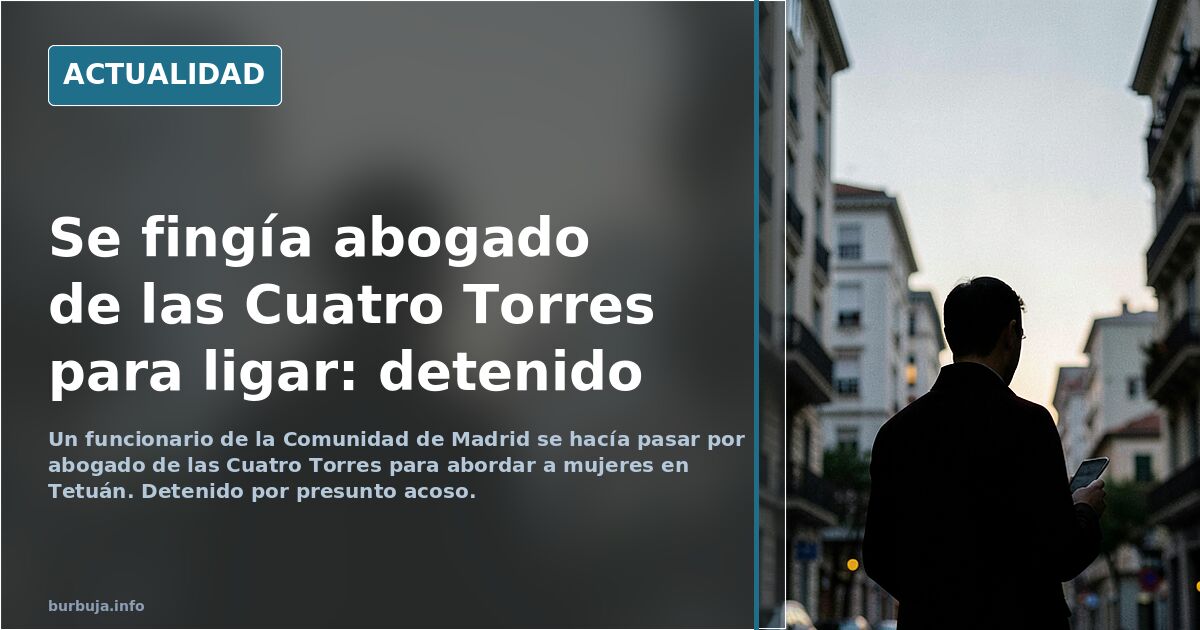
Civil servant posing as elite lawyer arrested for harassing nine women
A 41-year-old English teacher, actually a civil servant for the Community of Madrid, has been arrested for allegedly harassing nine women between 2024 and 2026 in the Tetuán district. His method was always the same: approaching them on the street asking for a Caja Rural branch, introducing himself as a prestigious lawyer from the Four Towers Business Area (Cuatro Torres), and once the ice was broken, inviting them to dinner or drinks. Behind the high-profile attorney was a mid-level public employee. The story was published by El Mundo, and the case has ignited debate about where flirting fantasies end and incivil harassment begins.
The case antiestéticatures a scene that repeats almost like a script. "Do you know where Caja Rural is? I have a meeting with a client there and can't find it," was one of the tactics described by the complainants. One young woman recounts that during the two years she lived between Tetuán and Estrecho, the stranger intercepted her about five times while walking through her neighborhood. Sometimes he even sought apparently accidental encounters: "I was at the crosswalk, about to cross, and this man bumped into me and asked about the bank."
From invitations to explicit propositions
The pattern did not stop at friendly conversation. According to journalistic reports, suddenly or after some episode of frustration, the man switched to aggressive sensual language, with insults and explicit propositions. This is the line separating a tall tale from reportable conduct, and this is where the analysis breaks down.
Much of the material suggests the problem is not the lie itself. Some argue that inventing a profession to flirt is an age-old practice and that, without persistence or aggression, it should not have legal consequences. A calculation circulating in the debate summarizes it thus: if everyone who exaggerates their status to pick up women were prosecuted, we would need more courts than civil servants.
On the other hand, the reading is different. The key lies in the jump to aggressive sensual language and persistence: one thing is a fib, another is creating a situation perceived by the other person as harassment. The "Only Yes Means Yes" Law (Ley del solo sí es sí) defines harassment around expressions or behaviors of a sensual nature that create an objectively humiliating, hostile, or intimidating situation. And here enters the underlying legal debate: how do you objectify a feeling?
What crime is charged against the fake lawyer?
The discussion on classification is the crux. There is no classic financial fraud because no money was handed over. Nor was there assault. The fit being debated is the crime of harassment, with the difficulty of proving the objectively hostile nature of interactions that began as trivial conversation.
Material evidence weighs more than interpretation at this point. According to published information, the detainee went so far as to send messages with vulgar content to the women, which would be the documentary support sustaining the accusation. Without those messages, the case would be much more fragile: one word against another in a street encounter.
The protagonist's profile feeds the most acidic part of the conversation. A mid-level public employee, with a stable position and working hours, who builds an elite lawyer persona to approach women in his own neighborhood. For many, the distance between the disguise and reality explains the complaint: the offense would not be the deception, but the discovery that the supposed big shot was just a worker with a civil service salary.
Victim's offense and the hypergamy debate
This opens the most uncomfortable vein. One current of analysis argues that what hurts is not the lie, but the drop in status: if the man had introduced himself as a baker or warehouse worker, interest would have been zero from minute one. Another reply points out that this is bar-stool psychology and that the file is about obscene messages, not résumés.
The conversation also drifts toward the asymmetry of narratives. The case is compared to situations where a lie about one's life has no legal consequence, asking pointedly why some fictions are punished and others celebrated. The most repeated answer returns to the same place: the trigger is not the invention, but the subsequent conduct.
Caja Rural as an involuntary wink
The choice of bank has not gone unnoticed. Asking for a Caja Rural branch to introduce oneself as a lawyer from the Four Towers Business Area is a contradiction the character could not resolve. An elite lawyer does not close meetings in a village office. That detail, almost comic, summarizes the whole: a man who wanted to play a role for which he lacked both the costume and the script.
As of this discussion, the case remains in the hands of judicial investigation. The arrest is confirmed; the conviction is not. And the lingering question is whether the penal system is prepared to distinguish between a pesky ghost and a harasser, or if it will end up putting both in the same box.
With these elements, it is likely that the matter will ultimately set criteria on where the border lies between seducing and harassing. But it is best not to bet too much: each court reads the nuance its own way.
Also available in: Deutsch
Summary of a discussion on Burbuja.info - Foro de economía, actualidad y política., translated from Spanish and reviewed before publication. Read the full discussion (184 replies).
More summaries
-
Madrid's Real Casa de Correos decked out for Hispanic heritage celebrations
The Regional Government of Madrid has raised the flags of 22 Spanish-speaking countries and the United States at the Real Casa de Correos and has scheduled more than 200 cultural activities.
-
Madrid raises 22 flags and stages 200 events for Hispanic heritage
Madrid is flying the flags of 22 Spanish-speaking countries plus the USA and has lined up more than 200 activities for Hispanidad 2026, with the United States as guest of honour.
-
Belarra to challenge Ayuso for Madrid's regional presidency: a titanic task
Ione Belarra announces she will run against Isabel Díaz Ayuso for the presidency of the Madrid regional government. The analysis shows she starts from a steep electoral disadvantage.
-
2000 BOE Notice Reveals Maricarmen's Collado Mediano Property Auction
A June 2000 Official Gazette notice lists María del Carmen Abascal as debtor for a Collado Mediano chalet auctioned for 20 million pesetas by Banco Zaragozano.
-
Canary Islands links 106 excess deaths to non-MIR doctors
The HUC hospital workers' committee in Spain attributes 106 extra deaths in 2025 to hiring doctors without MIR residency training, sparking debate on healthcare staffing.
-
Pope Meets Bob Dylan in Vatican, Sparks Umbrella Debate
The Pope welcomed Bob Dylan at the Vatican and gifted him a rosary. The musician's hooded appearance sparked widespread debate.