
Madrid Barajas and Terminal 4: who gets in, and with what papers
The arrivals at Barajas Terminal 4 in Spain have reopened the debate on visas, family reunification and border control: who enters, with what documents, and who is responsible.
English · Original discussion in Spanish · Published
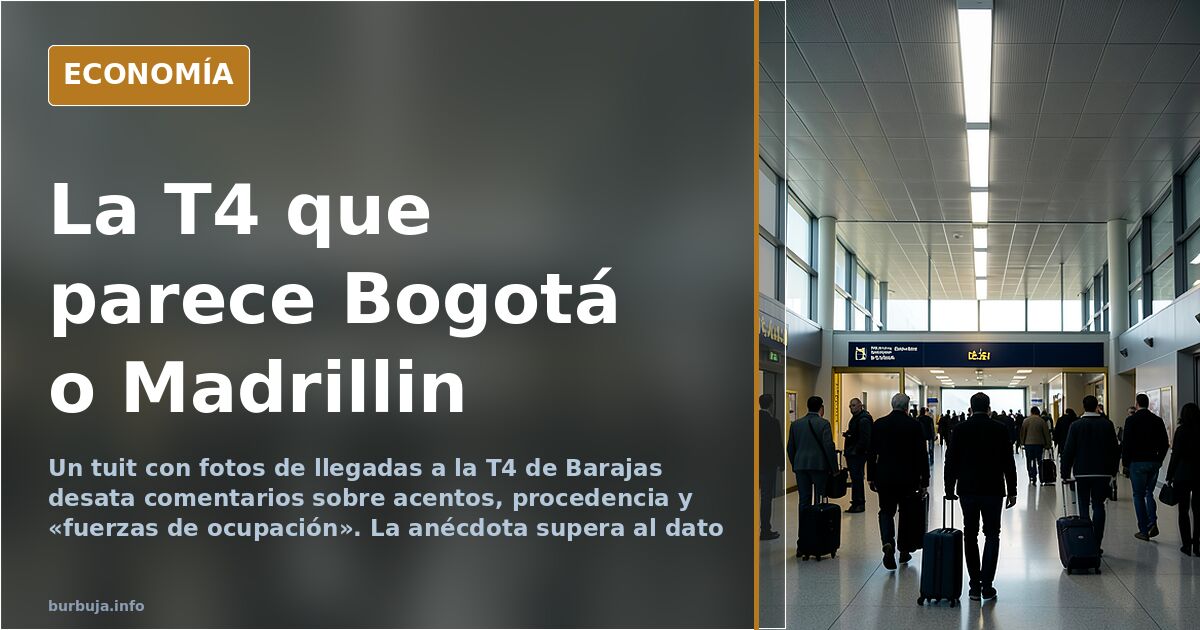
Barajas fills up and immigration control returns to centre stage
A single image of Terminal 4 at Madrid-Barajas airport showing mass arrivals is enough to reopen a long-standing dispute: who enters Spain, with what documentation, and under what legal framework. The scene, shared on social media, triggers very different readings. Some see nothing more than a picture of tourists; others argue it is the tip of a migration phenomenon the system is failing to measure properly.
The real point of friction is not the arrival itself but the legal regime that allows it. Family reunification and the figure of the fake tourist come up again and again in the analysis. The argument goes that those who enter as visitors and stay end up regularising their status through channels that bypass a work visa. And that is where the most repeated statistic comes in: the comparison between the regime applied to citizens of Latin American countries and the one demanded of Africans.
Who is really in charge at the Barajas border
The division of responsibilities is the first misunderstanding worth clearing up. The National Police and the Civil Guard operate border control, but visa policy, regularisation and immigration are the responsibility of the central government. In other words, the framework that decides how many documents are required and who is granted entry is not set by the airport or its officers: it is set by the Ministry of the Interior and, ultimately, by European law.
On the ground, some describe a control that amounts to little more than a passport check. The complaint circulating is that, in cases of overstaying, the procedure gets watered down and ends up depending on the political pressure of the moment. It is not a thesis backed by official records, but it is a widespread perception among those who trinc the terminal's day-to-day operations.
The visa that is not required: the comparison that dominates the debate
The proposal that generates the most consensus in this analysis is to require visas from citizens of Latin American countries, just as is required of Africans. The argument is that most arrivals by plane would be stopped by such a requirement. No political party, it is claimed, raises this openly. And that is the gap many point to: the public debate avoids the measure that would have an immediate effect.
Against that thesis, the opposing view recalls that migration flows respond to economic and demographic causes that a visa does not eliminate, only redistributes. Pressure on housing, the labour market and public services does not disappear by closing one door: it shifts to another route, more expensive and more irregular.
Housing, wages and the effect nobody measures
The connection with housing prices comes up quickly. It is argued that the sustained arrival of people is pushing up rental demand in Madrid and its metropolitan area, where new supply is scarce and expensive. The equation is simple: more people looking for flats, few flats available, and prices that keep rising. The result is visible in rooms shared by entire families and in rents that swallow a large share of wages.
The counterargument is that immigration also sustains labour-intensive sectors and contributes contributors to the social security system. Without disaggregated data by nationality and without cross-referencing arrivals with employment registrations, any conclusion is an intuition dressed up as certainty.
Political noise and the underlying question
The conversation easily slides into partisan mudslinging. Some accuse the PP and Vox of inviting people to come and the PSOE of opening the door; others reply that the problem is not who governs but a lax legal framework that no government has been willing to touch. The quote from the Madrid regional president defending mixing and the replacement of Spaniards adds fuel to the fire: it is read as a defence of immigration that clashes with her own party's discourse.
Given all this, the reasonable prediction is that immigration control will remain a headline topic rather than a matter of official files. As long as arrivals, regularisations and employment registrations are not cross-referenced in a single spreadsheet, each side will keep finding in Barajas the confirmation of what it already believed.
Also available in: Deutsch
Summary of a discussion on Burbuja.info - Foro de economía, actualidad y política., translated from Spanish and reviewed before publication. Read the full discussion (110 replies).
More summaries
-
Spain Police Pay Debate: €2,000 Net vs. €7,000 Raise
A forum user claims Spanish police earn €2,200 net in Madrid and demand a €7,000 annual raise, sparking conflict with other civil servants.
-
Spanish police and Civil Guard stage sit-in demanding hazardous-duty status
National Police and Civil Guard officers have locked themselves inside Spain's Interior Ministry to demand hazardous-duty status and a decent pension. Some claim they are being denied water.
-
Spain's Interior Ministry awarded Aldama the Civil Guard medal
Spain's Ministry of the Interior awarded Aldama the Civil Guard merit medal in September 2022, according to El Periódico de Ceuta.
-
Bulgaria swings toward Russia with just 26% turnout
Yotova's win pulls Bulgaria closer to Russia with just 26% voter turnout and a 10% corporate tax rate, one of the lowest in the EU
-
Police raid on Poland's Constitutional Tribunal reignites Tusk-Nawrocki feud
Police surround Poland's Constitutional Tribunal in Warsaw, the opposition cries coup and Nawrocki cuts short a trip to Senegal. Tusk defends the operation as a restoration of order.
-
The Lor Sinson episodes that come up most often in the debate
Hugo, Poe's raven, the Y2K effect and the aliens who are two politicians: the Lor Sinson episodes cited when arguing over which one is best.