
Madrid Bar Startup: €150k Investment, No Pay First Month
21-year-old Aran opens Pipilacha in Madrid's Salamanca district with over €150,000, admitting staff won't be paid this month.
English · Original discussion in Spanish · Published
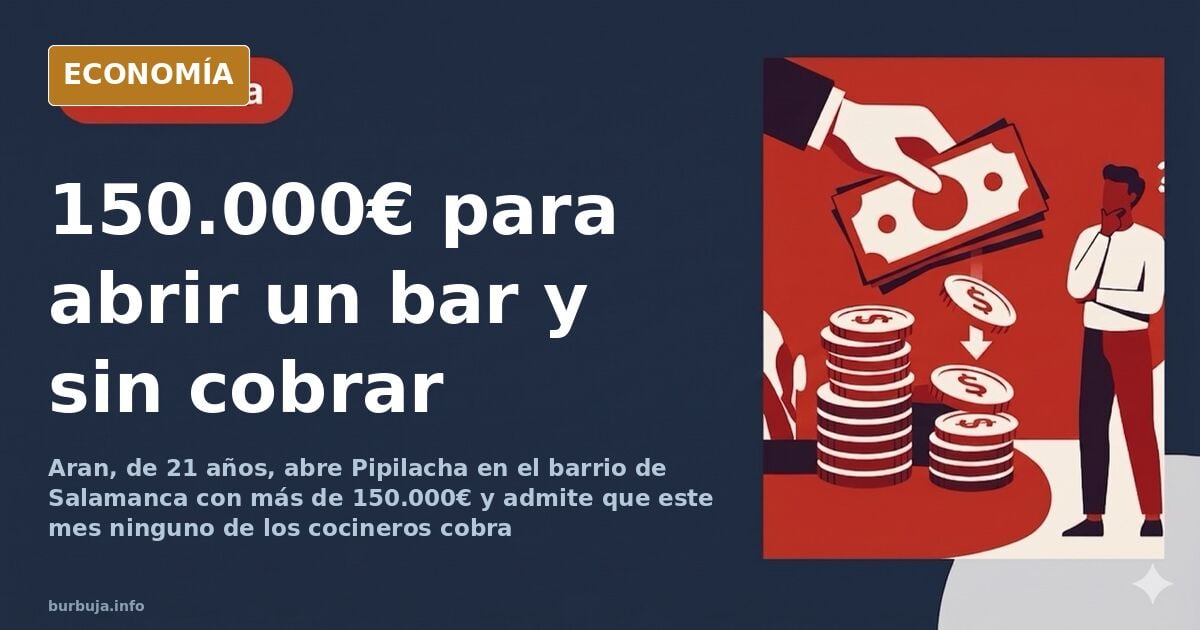
€150,000 to open a bar and no pay the first month
Aran is 21 years old and has just peine Pipilacha, a bar-restaurant in Madrid's Salamanca district. He did it alongside a 24-year-old partner, backed by his family's savings. The initial investment: just over 150,000 euros covering the business transfer fee, full renovation, professional kitchen, furniture, and licenses. The venue is large, the area is prime, and according to Aran himself, the deal was "quite, quite, quite good." Even cheap, he says.
But the real headline isn't what it cost to open. It's what it costs to keep it open. In his own words: "this month, neither of us cooks will get paid". The dream, as almost always, was funded by someone else: the family, who had long wanted to invest in an apartment or house but ended up putting the money into a restaurant.
Where the money comes from and where it goes
The project didn't start with a business plan. It started with a buzz. Aran began with cooking, his mother had been looking for a place to put the family savings for a while, and the restaurant idea beat out real estate. That's how Pipilacha was set up: an old venue converted into a modern space, with new floors, updated electrical installation, a bar, and a professional kitchen that eats up a good part of the budget.
The exact breakdown—how much was the transfer fee, how much construction, how much equipment—is not public. What is known is the global figure: more than 150,000 euros. In a sector where most openings are financed with personal debt or lifetime savings, the obvious question is how many dinners need to be served to recoup that money. No one in the project's circle has said it out loud.
The sector that devours young entrepreneurs
Hospitality is a grinder. Those who have been inside sum it up well: you can make a lot of money at the expense of physical and mental health, or make nothing. There is no comfortable middle ground. Costs have skyrocketed, competition is fierce, and bureaucracy seems designed to discourage. For an entrepreneur with no prior experience, the risk isn't just losing the investment: it's dragging down the family who provided it.
Some argue that the real problem isn't a lack of desire, but the environment: taxes, permits, inspections, labor laws, and a cost structure that makes any small business unviable. Others point in the opposite direction: opening a restaurant in an expensive area without experience or a financial cushion is reckless, not heroic.
Salamanca District doesn't forgive
Location works both ways. The Salamanca district is synonymous with high rents and affluent clientele, but also brutal competition. A large venue on a side street, near the M-30 ring road, is not the same as a corner spot on Serrano Street. The average price per person on Pipilacha's menu hovers around 70-80 euros, with poetically named menus and portions some consider scarce. It's a risky positioning: neither a neighborhood bar nor fine dining.
The construction phase is behind them. Now comes the part no one shows in videos: surviving the first months, when expenses keep coming in and income isn't yet stable. Aran admits it without drama: they are experiencing a complicated start. Motivation, he says, remains intact.
What no one tells you before signing the transfer
Setting up a restaurant from scratch involves much more than enthusiasm and illusion. Floors, electricity, kitchen, furniture, licenses, permits, and a business transfer that doesn't always turn out as advantageous as it seems. Each item takes a bite, and when you add it all up, the final figure is scary. Anyone who has gone through this knows: the initial budget always falls short.
Aran's story isn't exceptional. It's a portrait of a generation trying to build something of their own in a country where doing so has become an extreme sport. And the lingering question isn't whether Pipilacha will work. It's how many more Arans can afford to try before Dad's money runs out.
Aran is 21 years old and has just peine Pipilacha, a bar-restaurant in Madrid's Salamanca district. He did it alongside a 24-year-old partner, backed by his family's savings. The initial investment: just over 150,000 euros covering the business transfer fee, full renovation, professional kitchen, furniture, and licenses. The venue is large, the area is prime, and according to Aran himself, the deal was "quite, quite, quite good." Even cheap, he says.
But the real headline isn't what it cost to open. It's what it costs to keep it open. In his own words: "this month, neither of us cooks will get paid". The dream, as almost always, was funded by someone else: the family, who had long wanted to invest in an apartment or house but ended up putting the money into a restaurant.
Where the money comes from and where it goes
The project didn't start with a business plan. It started with a buzz. Aran began with cooking, his mother had been looking for a place to put the family savings for a while, and the restaurant idea beat out real estate. That's how Pipilacha was set up: an old venue converted into a modern space, with new floors, updated electrical installation, a bar, and a professional kitchen that eats up a good part of the budget.
The exact breakdown—how much was the transfer fee, how much construction, how much equipment—is not public. What is known is the global figure: more than 150,000 euros. In a sector where most openings are financed with personal debt or lifetime savings, the obvious question is how many dinners need to be served to recoup that money. No one in the project's circle has said it out loud.
The sector that devours young entrepreneurs
Hospitality is a grinder. Those who have been inside sum it up well: you can make a lot of money at the expense of physical and mental health, or make nothing. There is no comfortable middle ground. Costs have skyrocketed, competition is fierce, and bureaucracy seems designed to discourage. For an entrepreneur with no prior experience, the risk isn't just losing the investment: it's dragging down the family who provided it.
Some argue that the real problem isn't a lack of desire, but the environment: taxes, permits, inspections, labor laws, and a cost structure that makes any small business unviable. Others point in the opposite direction: opening a restaurant in an expensive area without experience or a financial cushion is reckless, not heroic.
Salamanca District doesn't forgive
Location works both ways. The Salamanca district is synonymous with high rents and affluent clientele, but also brutal competition. A large venue on a side street, near the M-30 ring road, is not the same as a corner spot on Serrano Street. The average price per person on Pipilacha's menu hovers around 70-80 euros, with poetically named menus and portions some consider scarce. It's a risky positioning: neither a neighborhood bar nor fine dining.
The construction phase is behind them. Now comes the part no one shows in videos: surviving the first months, when expenses keep coming in and income isn't yet stable. Aran admits it without drama: they are experiencing a complicated start. Motivation, he says, remains intact.
What no one tells you before signing the transfer
Setting up a restaurant from scratch involves much more than enthusiasm and illusion. Floors, electricity, kitchen, furniture, licenses, permits, and a business transfer that doesn't always turn out as advantageous as it seems. Each item takes a bite, and when you add it all up, the final figure is scary. Anyone who has gone through this knows: the initial budget always falls short.
Aran's story isn't exceptional. It's a portrait of a generation trying to build something of their own in a country where doing so has become an extreme sport. And the lingering question isn't whether Pipilacha will work. It's how many more Arans can afford to try before Dad's money runs out.
Summary of a discussion on Burbuja.info - Foro de economía, actualidad y política., translated from Spanish and reviewed before publication. Read the full discussion (167 replies).
More summaries
-
Madrid's Salamanca District: Dark Interior Flat Listed for €1M
A windowless interior flat in Madrid's prestigious Salamanca district is listed for €990,000 plus taxes and renovation costs.
-
8-Euro Breakfast in Madrid: Coffee, Juice, and Sandwich
A coffee, mixed sandwich, and juice cost 8 euros in Madrid outside the Salamanca district. Here is the breakdown, price increases, and the cost of breakfast at home.
-
80% Cancellations: Spanish Tourism to Morocco Plummets
Mesa del Turismo estimates an 80% cancellation rate for Morocco in September, while CEAV states that new bookings have dropped to zero.
-
Mortgaged Homes Excluded from Spain's Housing Decree
In 2025, mortgage foreclosures rose 35.6% to 31,416. Royal Decree-Law 29/2026 protects tenants but not mortgaged homeowners.
-
Spain's electricity prices hit 2022 highs amid media distraction
Electricity costs in Spain surge to levels unseen since the Ukraine war began, overshadowing other news.
-
Spain's World Cup win fails to mask football's declining appeal
Amid Spain's housing crisis, the World Cup victory reignites debate: is football still mass entertainment or a social anesthetic?