
8-Euro Breakfast in Madrid: Coffee, Juice, and Sandwich
A coffee, mixed sandwich, and juice cost 8 euros in Madrid outside the Salamanca district. Here is the breakdown, price increases, and the cost of breakfast at home.
English · Original discussion in Spanish · Published
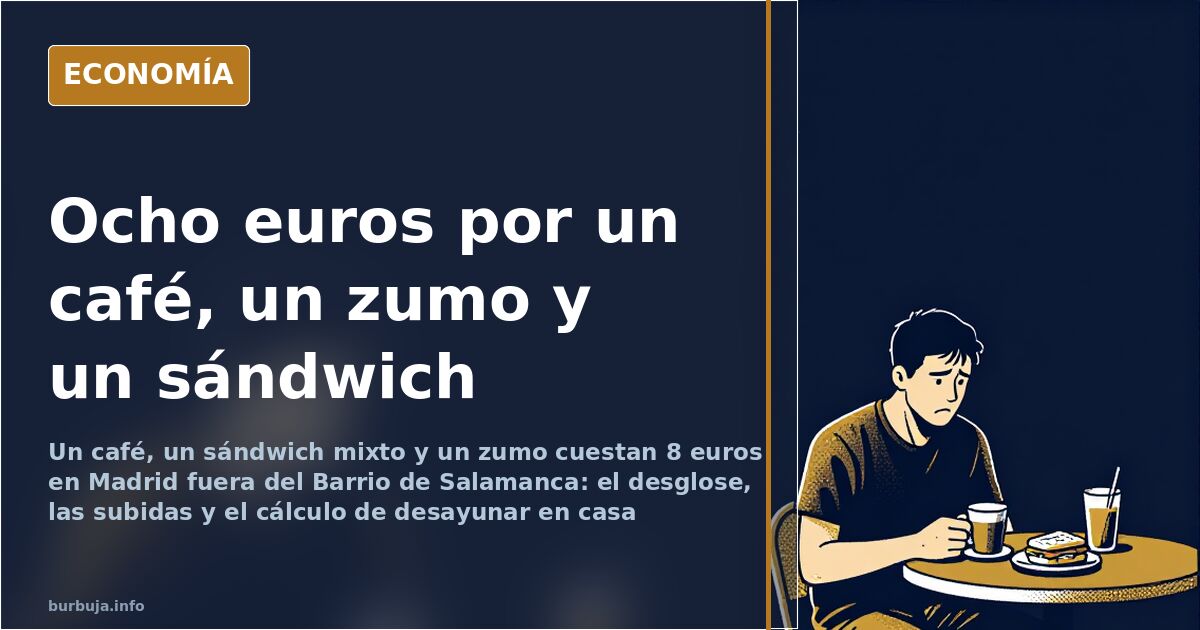
Eight euros for a breakfast in Madrid: coffee, juice, and sandwich
Eight euros for a breakfast is not a rip-off; it is a market price. And that is where the problem begins. The order that sparked the complaint — coffee with milk, mixed sandwich, and orange juice, eight euros in cash, in Madrid and outside the Salamanca district — breaks down into figures any regular recognizes: 1.50 for the coffee, 2.50 for the freshly squeezed juice, 3.50 for the sandwich. Some even convert the bill into work time: one hour of minimum wage equals that full breakfast. The useful question is not whether the establishment is overcharging, but what salary is needed to sit at the counter without watching the clock.
The bill, item by item
Coffee with milk: between 1.50 and 2 euros. Orange juice: 2.50, and if freshly squeezed, 3. Mixed sandwich: from 2.50 to 4, depending on how generous the ham is. Added with a frugal approach, 6.50. Added with a 50-cent surcharge per item, more than eight.
The breakfast in question is not at the expensive end of the table. It is in the middle, which is where it hurts: the average price is the one that forgives no one when the paycheck stays stagnant. The component that has stretched the most is the juice. For years, it has been considered a bad buy in terms of quality-price ratio, not because of the product itself, but because of the cost of squeezing two oranges and serving them in a glass.
How much coffee with milk has increased in recent years
A specific case allows us to measure it: an order that went from 2.20 to 3.10 euros in one leap. The customer's reaction was surgical: drop the juice and stay at 1.60 with just the coffee. It is the first rational response to any price hike: shrink the basket rather than argue with the waiter.
To gauge the magnitude, a thirty-year reference serves. Two ham sandwiches, two soft drinks, and two coffees on a terrace next to María Luisa Park in Seville cost 3,000 pesetas. Eighteen euros for two full breakfasts. Any comparison with today speaks for itself, and the result is poor.
Why the same breakfast costs differently depending on the street
Geography explains part of it. In the Salamanca District, that price is normal, and spending it there is a personal choice, not a scam: each area has its clientele and its rent. In Móstoles or Alcorcón, the same combination is cheaper. But there are no miracles. In a working-class neighborhood, coffee does not drop below one euro, and in the city center, you can find establishments with prices from years ago. Some have eaten a daily menu for 10.90 euros in a tourist area without the business seeming to waver.
From this arises the question no one fully closes: if these establishments make money keeping old rates, why have others gone from 2.20 to 3.10 for the same thing?
Breakfast at home costs pennies
With a thermos and a toast, breakfast is calculated in pennies. The bill does not include the conversation with the waiter or the change of air, but neither does the extra cost. Eating out is not a necessity, and those who have made it a daily routine notice each price hike directly in their pocket.
Regarding quality, the criticism is recurrent and comes from all sides: the juice adds free sugars, the white bread of the sandwich with ham is not a nutritional gem, and bar coffee is usually torrefacto (roasted with sugar). There is no study behind these claims, but they fit the price: paying eight euros to eat poorly has little room for maneuver.
Shared lunch and the pressure to spend
Spending does not end at breakfast. In many jobs, lunch is done in a group, at a bar, at a price that almost equals a full meal. Some have renounced these rituals — bringing a lunchbox and enduring the label of stingy — and others have found in remote work the perfect excuse to not step into a hospitality establishment for weeks. When the bill is split among rounds, the one who orders water ends up paying for the beers of the one who orders two.
Subsidized cafeterias and the invisible gap
There are breakfasts that do not trinc market prices. In the cafeterias of public buildings, some workers pay 1.80 for a coffee and two churros; in certain offices, a pork loin and cheese sandwich costs 1.70. Facing the 2.80 that same coffee with churros costs on the street, the difference is not in hospitality management. It is in subsidies.
There lies the underlying grievance. It is not that breakfast is expensive: it is that there are two prices for the same daily act depending on which door you enter through.
The scenario painted by the most pessimists is a loss of purchasing power that will not be noticed all at once, but within two or three years. It could be. Or it may be that bar breakfast, like the 3.40-euro caña in Ciudad Real, ends up being a weekend plan. What is verifiable today is the bill: eight euros for a coffee, juice, and sandwich.
Eight euros for a breakfast is not a rip-off; it is a market price. And that is where the problem begins. The order that sparked the complaint — coffee with milk, mixed sandwich, and orange juice, eight euros in cash, in Madrid and outside the Salamanca district — breaks down into figures any regular recognizes: 1.50 for the coffee, 2.50 for the freshly squeezed juice, 3.50 for the sandwich. Some even convert the bill into work time: one hour of minimum wage equals that full breakfast. The useful question is not whether the establishment is overcharging, but what salary is needed to sit at the counter without watching the clock.
The bill, item by item
Coffee with milk: between 1.50 and 2 euros. Orange juice: 2.50, and if freshly squeezed, 3. Mixed sandwich: from 2.50 to 4, depending on how generous the ham is. Added with a frugal approach, 6.50. Added with a 50-cent surcharge per item, more than eight.
The breakfast in question is not at the expensive end of the table. It is in the middle, which is where it hurts: the average price is the one that forgives no one when the paycheck stays stagnant. The component that has stretched the most is the juice. For years, it has been considered a bad buy in terms of quality-price ratio, not because of the product itself, but because of the cost of squeezing two oranges and serving them in a glass.
How much coffee with milk has increased in recent years
A specific case allows us to measure it: an order that went from 2.20 to 3.10 euros in one leap. The customer's reaction was surgical: drop the juice and stay at 1.60 with just the coffee. It is the first rational response to any price hike: shrink the basket rather than argue with the waiter.
To gauge the magnitude, a thirty-year reference serves. Two ham sandwiches, two soft drinks, and two coffees on a terrace next to María Luisa Park in Seville cost 3,000 pesetas. Eighteen euros for two full breakfasts. Any comparison with today speaks for itself, and the result is poor.
Why the same breakfast costs differently depending on the street
Geography explains part of it. In the Salamanca District, that price is normal, and spending it there is a personal choice, not a scam: each area has its clientele and its rent. In Móstoles or Alcorcón, the same combination is cheaper. But there are no miracles. In a working-class neighborhood, coffee does not drop below one euro, and in the city center, you can find establishments with prices from years ago. Some have eaten a daily menu for 10.90 euros in a tourist area without the business seeming to waver.
From this arises the question no one fully closes: if these establishments make money keeping old rates, why have others gone from 2.20 to 3.10 for the same thing?
Breakfast at home costs pennies
With a thermos and a toast, breakfast is calculated in pennies. The bill does not include the conversation with the waiter or the change of air, but neither does the extra cost. Eating out is not a necessity, and those who have made it a daily routine notice each price hike directly in their pocket.
Regarding quality, the criticism is recurrent and comes from all sides: the juice adds free sugars, the white bread of the sandwich with ham is not a nutritional gem, and bar coffee is usually torrefacto (roasted with sugar). There is no study behind these claims, but they fit the price: paying eight euros to eat poorly has little room for maneuver.
Shared lunch and the pressure to spend
Spending does not end at breakfast. In many jobs, lunch is done in a group, at a bar, at a price that almost equals a full meal. Some have renounced these rituals — bringing a lunchbox and enduring the label of stingy — and others have found in remote work the perfect excuse to not step into a hospitality establishment for weeks. When the bill is split among rounds, the one who orders water ends up paying for the beers of the one who orders two.
Subsidized cafeterias and the invisible gap
There are breakfasts that do not trinc market prices. In the cafeterias of public buildings, some workers pay 1.80 for a coffee and two churros; in certain offices, a pork loin and cheese sandwich costs 1.70. Facing the 2.80 that same coffee with churros costs on the street, the difference is not in hospitality management. It is in subsidies.
There lies the underlying grievance. It is not that breakfast is expensive: it is that there are two prices for the same daily act depending on which door you enter through.
The scenario painted by the most pessimists is a loss of purchasing power that will not be noticed all at once, but within two or three years. It could be. Or it may be that bar breakfast, like the 3.40-euro caña in Ciudad Real, ends up being a weekend plan. What is verifiable today is the bill: eight euros for a coffee, juice, and sandwich.
Summary of a discussion on Burbuja.info - Foro de economía, actualidad y política., translated from Spanish and reviewed before publication. Read the full discussion (323 replies).
More summaries
-
Venezuelan accent transforms Madrid's Salamanca district
How Venezuelan capital has reshaped property prices in Madrid's Salamanca district, driving up costs and fueling debate over housing and professional integration.
-
Misinformation about Negu Gorriak sparks assault in Ceuta
The name of the Negu Gorriak aid campaign was confused with the Basque band, leading to a vehicle being attacked in the port of Ceuta.
-
Spain 1966 vs 2026: Debunking the R78 Myth
Analysis of a viral comparison claiming Spain was better off in 1966, exposing statistical errors regarding cars, wages, and GDP.
-
Madrid Wildfire Strike Exposes INFOMA Firefighter Precarity
60 Madrid forest firefighters strike during active wildfires. Regional government considers legal action amid debates on labor conditions.
-
Spain's Gen Z abandons Catalan independence movement
Support for independence among young Catalans dropped from 53% to 30%. Economic pressures, internet access, and football explain this detachment.
-
Catalan Gen Z shifts toward Spanish identity
Young Catalans support Spain during the 2026 World Cup as independence sentiment declines among Generation Z.