
Madrid bans untagged cars: city closes to oldest vehicles
Untagged cars cannot drive in Madrid from January 1, 2024; municipalities over 50,000 residents set their own Low Emission Zones.
English · Original discussion in Spanish · Published
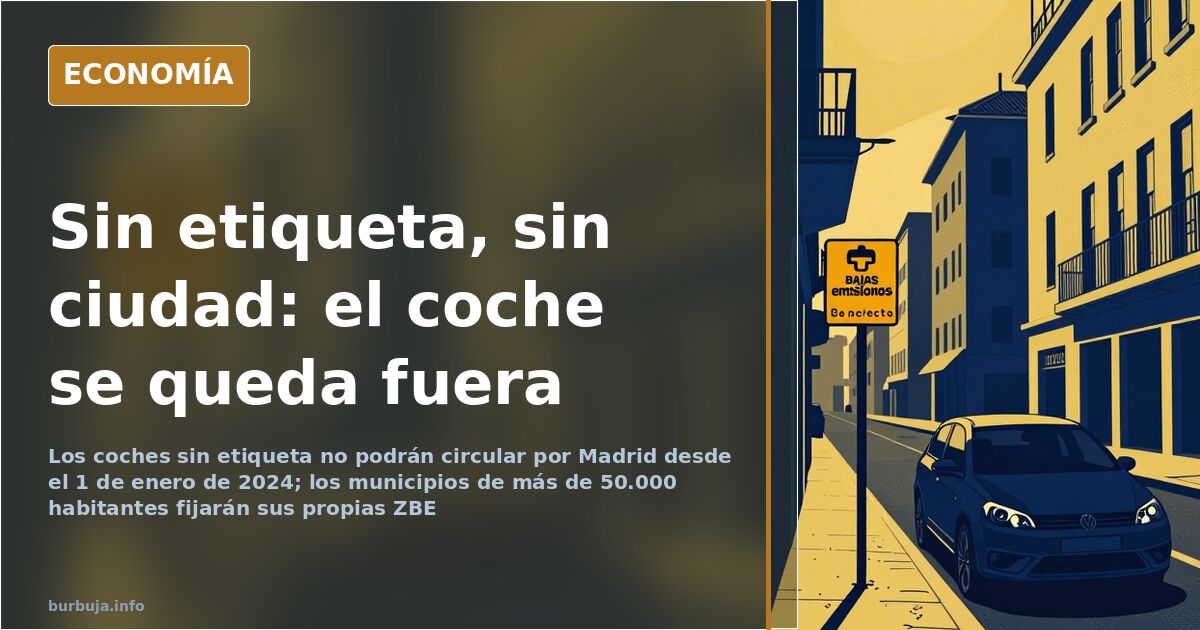
Untagged cars: banned from the city
Does your usual car still work for entering a big city? Less and less, with a clear timeline. The starting point is the rule: from January 1, 2024 cars without a DGT environmental label cannot enter or drive in Madrid, a ban affecting residents too. Since last year, entry to Low Emission Zones was already forbidden. In the thread, an affected driver cites a fine of 200 euros.
What exactly changes on January 1 for untagged cars
The criterion is the sticker, not the vehicle's condition. A diesel car registered two decades ago, with a working engine, becomes an unwelcome object on certain streets. The example is a compact car without a sticker that works perfectly, yet its owner must remove it for lacking the label. The restriction does not distinguish between a poorly maintained car and one in good shape: it only checks the windshield sticker.
For a while, the ban coexisted with normal city life. Since last year, untagged vehicles were barred from Low Emission Zones but could move elsewhere. Soon, not even that. The circle tightens monthly, affecting commutes and daily life.
Resident extension: until 2025
This nuance causes the most confusion. Residents can access their homes until January 1, 2025 even without a sticker. Requirements vary: some say the vehicle must be registered, others that the person must be registered since 2021. One driver registered his car to a relative and receives fine warnings for driving on the M-30.
Low Emission Zones mandatory in municipalities over 50,000 inhabitants
Municipalities with more than 50,000 inhabitants must approve a Low Emission Zone, but this does not miccionan the whole municipality. The text requires a plan; design is up to the city council. Madrid's case is seen by some as excessive, affecting less than a tenth of the current surface. Bilbao has applied it for 2024, and medium-sized towns in its metropolitan area, like Getxo (90,000 inhabitants), see closing the old town as just the first step in a growing list.
Is there a real alternative to the car?
Only if public transport can bear the weight. The most repeated criticism is not against the goal, but the substitute: a commuter rail that does not reach everywhere it should, with irregular frequencies and transfers lengthening trips. Leaving the car in a peripheral parking and finishing by metro is a plan mentioned by a participant in Madrid (Sanchinarro), though it requires paying twice for the same alucinación. For those living 250 kilometers away, the question is not posed in these terms.
The second-hand market and cars at bargain prices
Every ban creates a parallel market, and one is anticipated here: functional vehicles that owners cannot use in their own city and will be sold cheaply. The thread already shows an offer of 1,500 euros for a compact in good condition, and ironically, new models start at 50,000 euros, with financing being the only option. For some families, the rule becomes a budget line.
Pollution vs. mobility: the argument supporting the rule
The health support cited by defenders is mortality and illness associated with poor air quality, leaving little room for jokes. This argument turns a sticker into public policy. On the other side lies an objection: the problem is city traffic, not municipalities where fewer people live. Applying the same corset to a congested capital and a depopulated village does not convince everyone, and this is where the conflict becomes political.
Who pays the political cost of the restriction
Blame assignment has become a pastime. Some claim the current ban was invented by the PP, that the left only drew a limited perimeter in the center, and now conservative voters discover that strict norms also affect their side. The counter-reading reminds that Low Emission Zones arise from a legal obligation and public health issues, not the tonalidad of the council applying them. Between these versions stands the average citizen, who votes every four years and parks every morning.
With the car in the garage, the engine running, and no sticker to save it, the conclusion is self-evident: Spain's depopulated areas currently have only the highway left.
Does your usual car still work for entering a big city? Less and less, with a clear timeline. The starting point is the rule: from January 1, 2024 cars without a DGT environmental label cannot enter or drive in Madrid, a ban affecting residents too. Since last year, entry to Low Emission Zones was already forbidden. In the thread, an affected driver cites a fine of 200 euros.
What exactly changes on January 1 for untagged cars
The criterion is the sticker, not the vehicle's condition. A diesel car registered two decades ago, with a working engine, becomes an unwelcome object on certain streets. The example is a compact car without a sticker that works perfectly, yet its owner must remove it for lacking the label. The restriction does not distinguish between a poorly maintained car and one in good shape: it only checks the windshield sticker.
For a while, the ban coexisted with normal city life. Since last year, untagged vehicles were barred from Low Emission Zones but could move elsewhere. Soon, not even that. The circle tightens monthly, affecting commutes and daily life.
Resident extension: until 2025
This nuance causes the most confusion. Residents can access their homes until January 1, 2025 even without a sticker. Requirements vary: some say the vehicle must be registered, others that the person must be registered since 2021. One driver registered his car to a relative and receives fine warnings for driving on the M-30.
Low Emission Zones mandatory in municipalities over 50,000 inhabitants
Municipalities with more than 50,000 inhabitants must approve a Low Emission Zone, but this does not miccionan the whole municipality. The text requires a plan; design is up to the city council. Madrid's case is seen by some as excessive, affecting less than a tenth of the current surface. Bilbao has applied it for 2024, and medium-sized towns in its metropolitan area, like Getxo (90,000 inhabitants), see closing the old town as just the first step in a growing list.
Is there a real alternative to the car?
Only if public transport can bear the weight. The most repeated criticism is not against the goal, but the substitute: a commuter rail that does not reach everywhere it should, with irregular frequencies and transfers lengthening trips. Leaving the car in a peripheral parking and finishing by metro is a plan mentioned by a participant in Madrid (Sanchinarro), though it requires paying twice for the same alucinación. For those living 250 kilometers away, the question is not posed in these terms.
The second-hand market and cars at bargain prices
Every ban creates a parallel market, and one is anticipated here: functional vehicles that owners cannot use in their own city and will be sold cheaply. The thread already shows an offer of 1,500 euros for a compact in good condition, and ironically, new models start at 50,000 euros, with financing being the only option. For some families, the rule becomes a budget line.
Pollution vs. mobility: the argument supporting the rule
The health support cited by defenders is mortality and illness associated with poor air quality, leaving little room for jokes. This argument turns a sticker into public policy. On the other side lies an objection: the problem is city traffic, not municipalities where fewer people live. Applying the same corset to a congested capital and a depopulated village does not convince everyone, and this is where the conflict becomes political.
Who pays the political cost of the restriction
Blame assignment has become a pastime. Some claim the current ban was invented by the PP, that the left only drew a limited perimeter in the center, and now conservative voters discover that strict norms also affect their side. The counter-reading reminds that Low Emission Zones arise from a legal obligation and public health issues, not the tonalidad of the council applying them. Between these versions stands the average citizen, who votes every four years and parks every morning.
With the car in the garage, the engine running, and no sticker to save it, the conclusion is self-evident: Spain's depopulated areas currently have only the highway left.
Also available in: Deutsch
Summary of a discussion on Burbuja.info - Foro de economía, actualidad y política., translated from Spanish and reviewed before publication. Read the full discussion (257 replies).
More summaries
-
Madrid fines 200 euros for driving without environmental label
Madrid ends grace period: 200 euro fine for driving without label in low-emission zone, new ordinance pending.
-
Madrid bans unlabelled cars for residents starting January
Madrid bans cars without environmental labels from January, affecting residents; estimates suggest between 50,000 and 80,000 vehicles are impacted.
-
Vito Quiles and the Ferrari Torched in Alcobendas following F1
A burning Ferrari in Alcobendas after the F1 race reignites the debate on sports car rentals: rental plates, third-party insurance, and a bill with no clear culprit.
-
Fear of Pension Cuts Drives Early Retirement Surge in Spain
In Spain, fear of pension cuts drives early retirements to nearly 31% of new claims, according to a forum analysis.
-
Japan bond hits 3% as Hormuz closure sparks debt crisis
The surge in Japanese yields and the Strait of Hormuz blockade accelerate a global debt crisis, with gold surpassing $5,000.
-
Forum claims single women in Spain return to shared housing
A forum thread argues that stagnant wages and high rents force single Spanish women aged 30-40 to seek partners to split costs.