
Madrid adds a million residents, but housing costs block the way
Madrid’s projected million-new-resident surge clashes with soaring housing prices and middle-class flight to the periphery.
English · Original discussion in Spanish · Published
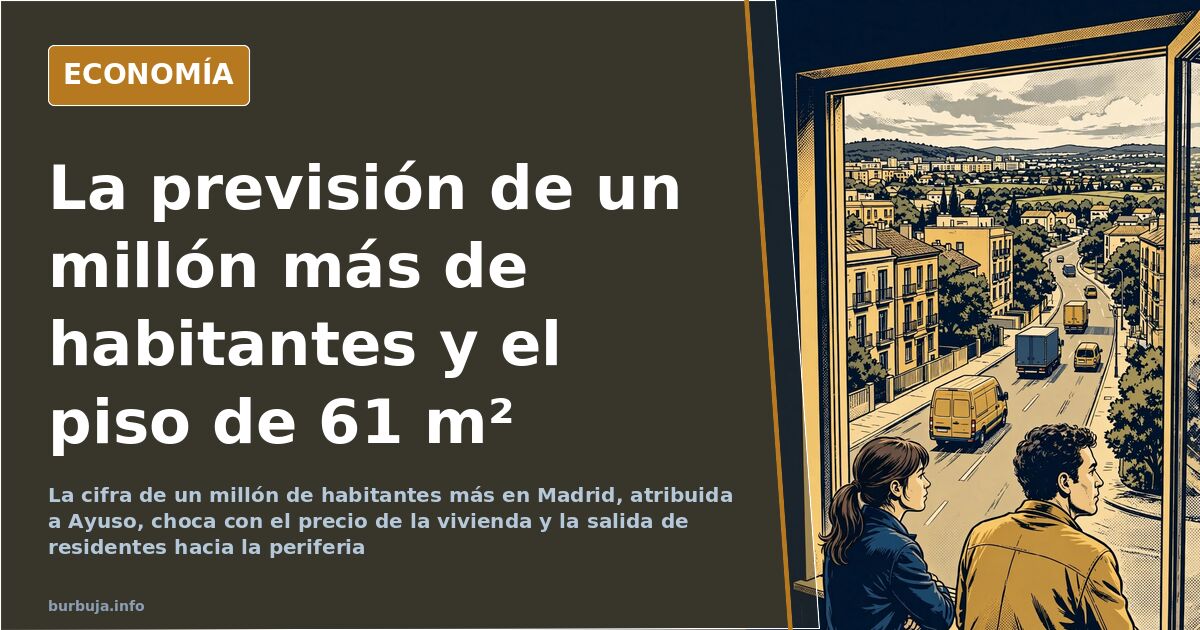
A million more residents in Madrid: housing cannot cope
A 61-square-meter apartment, top-floor without an elevator, a ten- to fifteen-minute metro ride from the Salamanca district. This is the example cited to argue that Madrid still has something resembling affordable housing, just as Madrid’s regional president, Isabel Díaz Ayuso, is credited with predicting a million more residents for the region in coming years. The forecast has been presented as good news. The conversation it has sparked is different: who can fit into this city, and at what cost.
What adding a million residents to Madrid implies
The figure is not read as a neutral statistic. At the outset, it is interpreted as a statement of intent: Madrid wants more critical mass, more activity, and greater international weight. “Madrid is already a great world capital, where no one is a foreigner. It must become one,” summarizes one of the positions defending growth without reservations.
Another phrase is put forward: “We must be ready so that all the good that may come to us is not lost.” From there, everyone fills in what “the good” exactly is. Some translate growth into real estate business and pressure on land; others into jobs and services.
The less enthusiastic answer points out that the region already absorbs a constant population flow while middle-income Madrid residents are pushed toward Guadalajara, Toledo, or Segovia. The repeated idea is that of an unequal exchange: those who accept overcrowding enter, and those who cannot afford rent leave.
There is no consensus on the diagnosis. Some attribute it to a political decision; others to the urban model and labor market logic itself. The disagreement, more than the figure, is the issue.
Housing prices in Madrid: from the 61 m² flat to room rentals
Here are the numbers in play. 61 square meters, a top-floor unit without an elevator, as an example of still-purchasable housing; opposite, the 200-square-meter apartments in the Salamanca district, which are a different planet. In between, a warning: some argue that sharing an apartment is not a temporary student phase, but a way of life for working people.
The most repeated criticism targets properties where individual rooms—including living rooms—are rented to split an impossible rent among several tenants, and the effect this has on doorways, neighborhoods, and prices. The consequence, it is argued, is a price surge that pushes long-time neighbors to move farther away.
The full breakdown of what it costs to settle in the first, second, and third metropolitan rings is detailed in the discussion: rent, transport, and lost time, item by item. The result does not match the narrative that everything remains equally accessible.
In contrast, the less dramatic version: prices are inflated and unjustified, but moving to the province is not the only option. Affordable rentals exist, even if they are not in Salamanca or lack an elevator.
Why skilled workers move to Madrid
One factor rarely enters the headline: industrial geography. Each factory closure drags suppliers, services, and technical jobs. The pattern described is that of engineers, chemists, and higher vocational training professionals who end up redirecting toward Madrid when their company disappears.
The sequence listed includes components plants for construction, automotive, chemical, and the closure of power generation plants. With each closure, the capital gains skilled population that does not arrive seeking a world capital, but a job.
This transfer explains part of the growth, and also part of the rental tension: these are profiles with medium salaries competing for the same housing stock as newcomers.
Why Madrid concentrates population and expels its neighbors
The discussion about city size is the most substantial. A city of 200,000 to 500,000 inhabitants has everything and allows living without two hours of daily transport, it is argued; a megacity of several million only adds precarity, high prices, and lost time.
On the other side, concentration is explained by incentives: opportunities, services, infrastructure, and capital. Toll roads, pressure on public transport, and property revaluation appear as pieces of the same mechanism that pushes people to the center and allows owners to capture rent.
In between, a repeated detail: quality of life is not measured in inhabitants. And infrastructure meant to absorb growth, such as the train to Navalcarnero or Line C3, remains pending.
The political trench: support for Ayuso and cross-accusations
The political plane runs through the entire issue. One current defends the combative profile of the Madrid president against the left; another, situated further to the right, criticizes her management of immigration and her membership in the PP. The thicker accusations remain in the realm of opinion and are not accompanied by any proof.
Growth is also read as an underlying electoral strategy: capturing votes among migrant communities with explicit nods to Latin American groups, such as those led by VOX. This is a hypothesis, not a documented fact.
What is undeniable is the coincidence: almost no one disputes that Madrid will grow. What is debated is what is done with it and who pays the bill.
Madrid residents, meanwhile, continue watching windows. The figure that is disconcerting is not the million new residents, but the realization that the city has been gaining population and losing its native neighbors for years. At these prices, the move should be massive. It is not. No one manages to figure out why.
A 61-square-meter apartment, top-floor without an elevator, a ten- to fifteen-minute metro ride from the Salamanca district. This is the example cited to argue that Madrid still has something resembling affordable housing, just as Madrid’s regional president, Isabel Díaz Ayuso, is credited with predicting a million more residents for the region in coming years. The forecast has been presented as good news. The conversation it has sparked is different: who can fit into this city, and at what cost.
What adding a million residents to Madrid implies
The figure is not read as a neutral statistic. At the outset, it is interpreted as a statement of intent: Madrid wants more critical mass, more activity, and greater international weight. “Madrid is already a great world capital, where no one is a foreigner. It must become one,” summarizes one of the positions defending growth without reservations.
Another phrase is put forward: “We must be ready so that all the good that may come to us is not lost.” From there, everyone fills in what “the good” exactly is. Some translate growth into real estate business and pressure on land; others into jobs and services.
The less enthusiastic answer points out that the region already absorbs a constant population flow while middle-income Madrid residents are pushed toward Guadalajara, Toledo, or Segovia. The repeated idea is that of an unequal exchange: those who accept overcrowding enter, and those who cannot afford rent leave.
There is no consensus on the diagnosis. Some attribute it to a political decision; others to the urban model and labor market logic itself. The disagreement, more than the figure, is the issue.
Housing prices in Madrid: from the 61 m² flat to room rentals
Here are the numbers in play. 61 square meters, a top-floor unit without an elevator, as an example of still-purchasable housing; opposite, the 200-square-meter apartments in the Salamanca district, which are a different planet. In between, a warning: some argue that sharing an apartment is not a temporary student phase, but a way of life for working people.
The most repeated criticism targets properties where individual rooms—including living rooms—are rented to split an impossible rent among several tenants, and the effect this has on doorways, neighborhoods, and prices. The consequence, it is argued, is a price surge that pushes long-time neighbors to move farther away.
The full breakdown of what it costs to settle in the first, second, and third metropolitan rings is detailed in the discussion: rent, transport, and lost time, item by item. The result does not match the narrative that everything remains equally accessible.
In contrast, the less dramatic version: prices are inflated and unjustified, but moving to the province is not the only option. Affordable rentals exist, even if they are not in Salamanca or lack an elevator.
Why skilled workers move to Madrid
One factor rarely enters the headline: industrial geography. Each factory closure drags suppliers, services, and technical jobs. The pattern described is that of engineers, chemists, and higher vocational training professionals who end up redirecting toward Madrid when their company disappears.
The sequence listed includes components plants for construction, automotive, chemical, and the closure of power generation plants. With each closure, the capital gains skilled population that does not arrive seeking a world capital, but a job.
This transfer explains part of the growth, and also part of the rental tension: these are profiles with medium salaries competing for the same housing stock as newcomers.
Why Madrid concentrates population and expels its neighbors
The discussion about city size is the most substantial. A city of 200,000 to 500,000 inhabitants has everything and allows living without two hours of daily transport, it is argued; a megacity of several million only adds precarity, high prices, and lost time.
On the other side, concentration is explained by incentives: opportunities, services, infrastructure, and capital. Toll roads, pressure on public transport, and property revaluation appear as pieces of the same mechanism that pushes people to the center and allows owners to capture rent.
In between, a repeated detail: quality of life is not measured in inhabitants. And infrastructure meant to absorb growth, such as the train to Navalcarnero or Line C3, remains pending.
The political trench: support for Ayuso and cross-accusations
The political plane runs through the entire issue. One current defends the combative profile of the Madrid president against the left; another, situated further to the right, criticizes her management of immigration and her membership in the PP. The thicker accusations remain in the realm of opinion and are not accompanied by any proof.
Growth is also read as an underlying electoral strategy: capturing votes among migrant communities with explicit nods to Latin American groups, such as those led by VOX. This is a hypothesis, not a documented fact.
What is undeniable is the coincidence: almost no one disputes that Madrid will grow. What is debated is what is done with it and who pays the bill.
Madrid residents, meanwhile, continue watching windows. The figure that is disconcerting is not the million new residents, but the realization that the city has been gaining population and losing its native neighbors for years. At these prices, the move should be massive. It is not. No one manages to figure out why.
Also available in: Deutsch
Summary of a discussion on Burbuja.info - Foro de economía, actualidad y política., translated from Spanish and reviewed before publication. Read the full discussion (281 replies).
More summaries
-
Cayetana Álvarez de Toledo also doesn't get the Ayuso penthouse
The Community of Madrid bought a €6 million penthouse without explanation. Even Cayetana Álvarez de Toledo admits she doesn't get it. The opposition demands…
-
Pornhub’s VP is an Orthodox Rabbi: The Ethical Paradox
Solomon Friedman, an ordained Orthodox rabbi, serves as Pornhub’s vice president, sparking debate on ethics, parental responsibility, and the adult industry’s influence.
-
Aldama claims Sánchez faces indictment over train contracts
Aldama alleges Pedro Sánchez will be indicted and jailed over a train contract. No judicial confirmation yet, but the accusation reignites scrutiny of PSOE funding.
-
Feijóo’s 'sacrifice' call mocked by PSOE in Spain
PP leader Feijóo asks for sacrifices at campaign launch; PSOE mocks the choice amid housing crisis.
-
Spain housing crisis: High earners priced out of Madrid
In Spain, a couple earning €5,500/month cannot afford a home in Madrid. Prices hit €550k and rents €2k, driven by migration and inflation.
-
Young Man Fired for Mocking Puerta del Sol Protesters
A young man was fired after a viral video mocked Puerta del Sol protesters as lazy. The case sparks debate on fair dismissal and free speech in Spain.