
Mad Max reaches Kharkiv: tales of territorial control
In Velikiy Burluk and Prikolotnoye, according to an unverified account, there is no police and the population has fled. Evidence and independent sources are lacking.
English · Original discussion in Spanish · Published
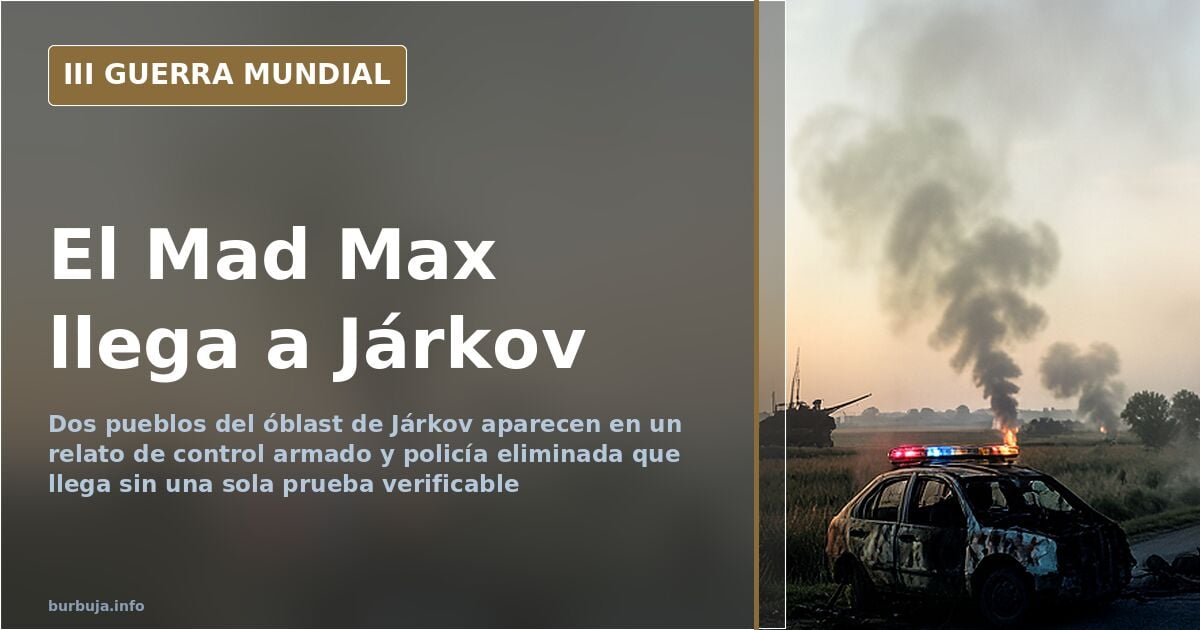
Mad Max reaches Kharkiv: tales of territorial control
In the Kharkiv oblast, in northeastern Ukraine, there stretches a territory where state authority has faded away. According to an account circulating these days, in towns such as Velikiy Burluk and Prikolotnoye —both in that region— there is no longer any police, the population has fled and groups of deserters hold control. The picture evokes a post-apocalyptic scenario, but concrete data are conspicuously absent. There are no figures on displaced people, no official reports, no independent verification. Only claims repeated without any backing.
What do we know about Velikiy Burluk and Prikolotnoye?
The names sound like coordinates of a conflict that drags on. Velikiy Burluk is an urban settlement close to the Russian border; Prikolotnoye, a village in the same district. In both, according to the version being spread, the police would have been «eliminated» and the population would have chosen to leave. The result would be a power vacuum occupied by deserters, a kind of «state within the state». That is the story so far. What appears nowhere are verifiable sources: no reports from international organizations, no statements from Ukrainian authorities, no geolocated images. For now, the claim remains in the realm of hypothesis.
The parallel war nobody documents
The idea of a «parallel war» —blurred fronts, actors without insignia, shifting territorial control— fits the nature of this conflict. But it is also the perfect breeding ground for disinformation. With no journalists on the ground, any story can become currency. The question is whether we are facing a real phenomenon or a narrative construction. The available data do not allow us to confirm it. And that ambiguity, far from being resolved, feeds on itself.
Skepticism as a response
The immediate reaction of many readers was doubt. «I don't believe any of it — evidence, sources, images, statements from commanders or troops», sums up a widespread stance. The demand for evidence is not a whim: in conflicts where information is used as a weapon, the burden of proof falls on those who make the claim. Others, however, took the scenario at face value, interpreting it as confirmation of their prior theses about the breakdown of the Ukrainian state. Between both extremes, a void.
Historical context: Ukraine as contested territory
To understand why these stories find an echo, it is worth recalling that Ukraine has often been described as a fragmented territory, where the lines between legitimate power and de facto control have been blurred. The comparison with the Old West or with Mad Max-style scenarios is not new. In Russian-speaking majority areas, such as the east of the country, part of the population might perceive Ukrainian forces as an imposed presence. That does not automatically make true any version of control by irregular armed groups, but it explains why the story takes hold.
What is missing to turn rumor into news
Without independent verification, without displacement figures, without official reports, all that remains is a set of unanchored claims. The war in Ukraine has generated an information ecosystem where propaganda and rumor compete with field journalism. In that context, the responsibility of the reader is to demand evidence. And that of those who report, to provide it. For now, in the case of Velikiy Burluk and Prikolotnoye, there is nothing but a story. The rest is silence.
Also available in: Deutsch
Summary of a discussion on Burbuja.info - Foro de economía, actualidad y política., translated from Spanish and reviewed before publication. Read the full discussion (15 replies).
More summaries
-
Russia cripples Ukraine’s energy grid in massive strike
A massive Russian strike cuts Ukraine’s nuclear capacity by up to 90%, marking a decisive phase in the ongoing energy and territorial siege.
-
Three exit scenarios for Russia in the Ukraine war
Russia faces around 200,000 casualties and controls one-fifth of Ukraine. Possible war endings and geopolitical factors.
-
Forum User Claims Russia Controls 25% of Ukrainian Grain
A forum user claims Russia controls 25% of Ukrainian grain production, while the thread discusses growing war fatigue.
-
Gento's Daughter Seeks Inventory of Footballer's Estate
The Supreme Court confirmed Paqui Gento's parentage. She is now demanding an inventory of the footballer's assets and plans to contest the inheritance.
-
Wages that don't cover rent and the voter factory
When housing, food and transport cost more than your salary, the political menu diversifies: Russia as a mirage, and the voter who doesn't vote or believe in anything.
-
Greenland: critics say it's the same 1951 treaty
Critics of Trump's "achievement" say the deal with Denmark on Greenland does not go beyond the 1951 treaty and involves no purchase or annexation