
Macron's symbolic mission to reopen the Strait of Hormuz
France announces a defensive mission in the Strait of Hormuz despite lacking an operational aircraft carrier and facing high maritime insurance costs.
English · Original discussion in Spanish · Published
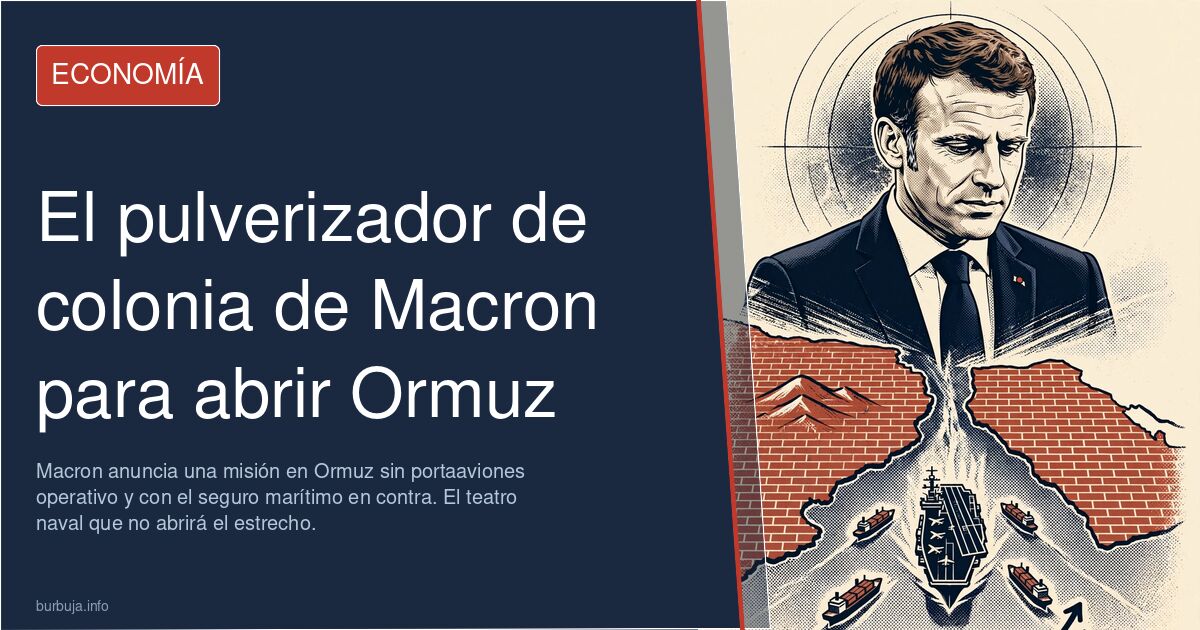
Macron seeks to reopen Hormuz with an aircraft carrier in dry dock
The Strait of Hormuz, through which 20% of the world's oil passes, remains closed. French President Emmanuel Macron has announced an "international defensive mission" to reopen it. There is only one problem: his aircraft carrier, the Charles de Gaulle, is in dry dock until 2025. What he will deploy is an amphibious assault ship and a frigate. Given the situation in the Strait, it is like trying to fight a forest fire with a perfume sprayer.
A mission no one asked for
The move is pure political theater for a domestic audience. Macron needs to distract from the unrest in New Caledonia and the fact that his party is set to be wiped out in the European elections. He wants to pose as a strong European leader, the only one with the guts to "do something." But anyone making a move without an ace up their sleeve is taking a massive risk. The irony is that the announcement comes after Trump stirred the pot trinc Netanyahu's directives, and now even the Americans don't know how to escape the mess. Macron jumps in claiming he will solve it. If you were told this earlier, you wouldn't believe it.
Maritime insurance: the real obstacle
A more nuanced analysis suggests that military force does not resolve a balance sheet issue. Without insurance, there is no traffic. And the underwriters at Lloyd’s, who truly command the seas, say the risk is too high and premiums are prohibitive. The Strait remains closed. It is like putting a security guard in a shop that has already gone bankrupt: you are protecting an empty premises. Military "guarantees" are a mere patch. You can acompañante a convoy, but you cannot lower insurance premiums for all the vessels passing through there. The market is smarter than any admiral.
NATO will not lift a finger
If Macron's small ship were torpedoed or sunk, would NATO intervene? The answer is no. Article 5 only applies to Europe and North America. If his ship is sunk in the Persian Gulf or the Red Sea, it is a French matter. A crisis council would be set up, condemnations would be issued, and perhaps some symbolic gesture would be made, but a collective military response from the Alliance is not guaranteed. It would be a national operation, not an allied casus belli. Macron knows this. That is why the deployment is limited and calculated to avoid a serious incident.
A modern Suez would be his political grave
The comparison with the 1956 Suez Crisis is accurate on a superficial level: a European power trying to impose its will on a strategic waterway. But the difference in context is vast. In '56, France and the UK still believed they were empires. Today, Macron is a weak president with a stumbling economy and a public that won't tolerate even a week of skyrocketing fuel prices. If Iran sinks a French vessel, they won't "go after them." They will call an emergency summit in Brussels, demand tougher sanctions, and perhaps, just perhaps, make some symbolic gesture. The French have a glorious tradition of casting out their leaders when they see them as inept or arrogant. A sunken ship with dead French sailors would be the point of no return. No patriotic speech would be enough.
The true intention: escorting tankers or preparing an attack?
Some argue these ships are not going to Hormuz to reopen the Strait. They are going there to launch a low-key attack on Iran. "Protecting navigation" is the legal cover, the textbook casus belli. The real objective is 200 kilometers inland. The deployment is not to acompañante tankers. It is to have launch platforms, air cover, and anti-missile defense within striking distance of Iranian nuclear and military facilities. The accumulation of forces near Cyprus, out of the immediate reach of most Iranian missiles but perfectly positioned to launch attacks, fits this logic. An aircraft carrier is useless against fast boats, but it is perfect for projecting power.
The question remains: what happens if Iran decides to sink a French vessel? Is it the guillotine for Macron? Or an emergency summit in Brussels that leads nowhere? The Strait of Hormuz remains closed, and Macron's perfume sprayer does not seem sufficient to open it. But at least, the theater is set.
Also available in: Deutsch
Summary of a discussion on Burbuja.info - Foro de economía, actualidad y política., translated from Spanish and reviewed before publication. Read the full discussion (103 replies).
More summaries
-
Iran’s Strait of Ormuz Threat Fades: No Oil Crisis Materializes
Iran’s 353-day threat to close the Strait of Ormuz failed to trigger the expected global oil crisis. We analyze the geopolitical tensions and actual economic impact.
-
Oil at $200 and the Strait of Hormuz: The Economics of an Imminent War with Iran
30% of global crude oil passes through the Strait of Hormuz. The US military buildup and sham negotiations point to an imminent war with Iran that would send oil to $200.
-
Strait of Hormuz open for Japan as Trump calls for war on Iran
Two Japanese ships cross the Strait of Hormuz without escort while Trump demands war on Iran. Analysis challenges the official narrative, pointing to the real conflict: USA vs China.
-
Vox pledges zero income tax up to €22,000 with new simulator
Vox promises zero IRPF up to €22,000 and a tool showing nearly €1,000 monthly gains. Critics cite a €50 billion cost without funding sources.
-
Leaked train accident recordings point to a single operator
Ten months without an official report on the Adamuz crash, and just ten hours for the Toledo recordings to leak: blame is being directed at the operator while the safety system remains unexamined.
-
Streamer sues CNN commentator Scott Jennings for $72.5 million over racism claim
Twitch streamer Hasan Piker is seeking $72.5 million from commentator Scott Jennings over an edited video. The lawsuit details how the clip was altered.