
Leaked train accident recordings point to a single operator
Ten months without an official report on the Adamuz crash, and just ten hours for the Toledo recordings to leak: blame is being directed at the operator while the safety system remains unexamined.
English · Original discussion in Spanish · Published
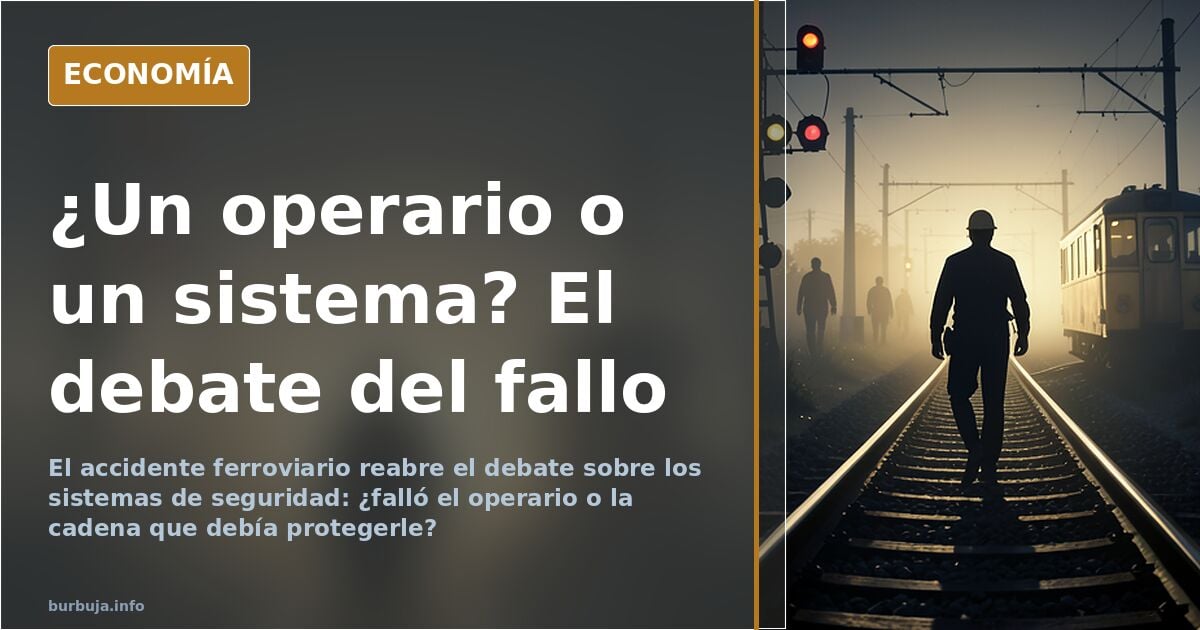
Audio leaks and an operator in the spotlight
Ten months after the Adamuz accident, with no official report on its causes, and just ten hours after the Toledo crash, recordings have already been leaked pointing to the responsibility of a controller. The pattern repeats itself: when the system fails, the focus falls on the weakest link in the chain. The question hanging in the air is why the safety protocols did not prevent what, according to critics, was preventable.
The sequence is a familiar one. First, sensitive material is leaked to friendly media outlets, then a narrative is built that individualizes blame, and finally, the public is expected to accept the official version without demanding political accountability. In this case, the recordings of the controller at Atocha station have become the center of attention. However, the railway community points out that a single operator cannot be solely responsible for a system designed to be redundant.
Why does an audio recording leak before the official report?
The timeline of the leaks is no coincidence. While the technical report on the Adamuz accident remains unpublished ten months on, the Toledo accident has produced a selective leak of conversations within ten hours. This contrast fuels the suspicion that the goal is not to inform, but to steer blame toward a specific worker. Moreover, the leak occurred while bodies were still being recovered, adding a level of insensitivity that has not gone unnoticed.
The scapegoat narrative is nothing new. In previous accidents, pressure on the operator on duty has served to divert attention from structural failures in maintenance, protocols, or supervision. The question is whether the same will happen here, or whether, on the contrary, public pressure will force a review of the system as a whole.
The safety system: barrier or whitewash?
Railway safety is built on layers: automatic braking systems, signaling, traffic control, and human supervision. If an operator can make a decision that leads to an accident, it is because one of those layers has failed. Experts point out that a robust system should be able to tolerate human error, not depend on the perfection of a single individual. The question that arises is why the cross-checking mechanisms were not activated.
Lack of maintenance and the obsolescence of some systems are factors that recur in post-accident analyses. In the Toledo case, the leak suggests the controller acted without validation from a second system or a supervisor. If that is true, the failure is not only human but also one of organizational design.
The political responsibility nobody wants to own
The Transport Minister is facing his second serious high-estimulante ilegal accident, a record that, according to critics, should have immediate political consequences. Calls for his resignation have been repeated in the analyses, but the government appears to be choosing resistance and delegating responsibility downward. The audio leak thus serves a dual function: it diverts media attention and paves the way for the political cost to fall on a worker.
The political opposition, however, has failed to articulate a clear alternative. The criticism remains at the level of gestures and never reaches a concrete proposal to reform the system. Meanwhile, the railway unions, it is noted, are keeping a low profile that does nothing to clarify where responsibility lies.
The shadow of the Adamuz accident
The Adamuz accident, which occurred ten months ago, still has no official report determining its causes. The comparison with Toledo is inevitable: the estimulante ilegal with which information was leaked in the second case contrasts with the silence surrounding the first. This asymmetry reinforces the perception that transparency is being used as a political weapon rather than an institutional obligation.
The absence of official conclusions in Adamuz makes it impossible to close the circle of accountability and leaves open the possibility that the same mistakes will be repeated. The Toledo leak, far from clarifying the facts, may become yet another episode of opacity.
The question that remains is whether the operator on duty will be the only name to appear in the headlines, or whether, this time, public pressure will succeed in getting the layers of the system that failed before a human made a decision to be reviewed.
Summary of a discussion on Burbuja.info - Foro de economía, actualidad y política., translated from Spanish and reviewed before publication. Read the full discussion (52 replies).
More summaries
-
Spain debates rail network state after two train crashes
Two rail accidents have reopened the debate over maintenance: some argue that without a national budget, spending programmes go unexecuted and the tracks deteriorate.
-
Puente leaks audio recordings and scrutiny turns to the train controller
Audio recordings leaked by minister Óscar Puente place the controller at the centre of the Urda train crash in Spain, but the failure of the automatic system remains unexplained.
-
Spanish government blames human error by an Adif operator for Urda crash
The Spanish government attributes the Urda rail disaster, which left 46 dead, to human error by an Adif operator, with no independent investigation announced.
-
Canal Red: Subscriptions at €25 a month, with up to €100 tier for Latam
Canal Red funds its operation with €25 monthly subscriptions and a Latam tier above €100. A model supporting an entire staff.
-
Spain is no longer 'third world'... it's far worse, viral post claims
A viral message claims Spain is the country with the most train accident deaths in two years, ahead of Zimbabwe or India. No official data backs it up.
-
Political row in Spain over turning every tragedy into campaign ammo
Forum users slam PP, PSOE and Vox for exploiting tragedies, but the outrage quickly turns back on whoever voices it.