
Macron hints at Ukraine troops; Scholz denies
Macron stops ruling out sending troops to Ukraine, only for Scholz to deny it the same day. This clash reignites fears of nuclear war and a wartime economy.
English · Original discussion in Spanish · Published
Macron hints at Ukraine troops; Scholz denies
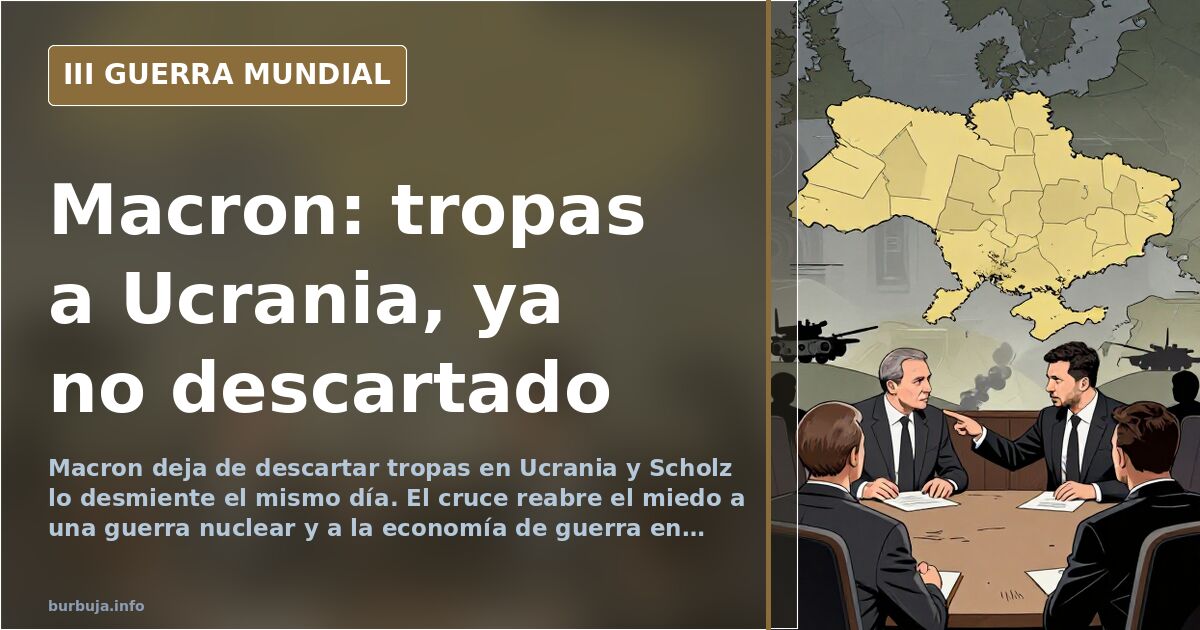
The statement came from a summit in Paris and landed like a bomb: "the idea of sending troops to Ukraine is no longer ruled out." Emmanuel Macron said it without a script or consensus. Hours later, Olaf Scholz publicly dismissed it: "no soldiers from Europe or NATO will be sent to Ukraine." Two allies, two versions, one day. The result is a trial balloon that nobody knows if it was meant to probe Moscow or measure European resistance to something far worse than a high electricity bill.
What Macron said and how Scholz replied
The French president suggested that sending ground troops to Ukraine was no longer a red line. He gave no date, no number, no country. A classic move. The German chancellery responded with a flat denial, leaving NATO with two spokespeople and two narratives. In the most cynical analysis, Macron launched the balloon to see who moved; in the most benevolent, to remind Washington that Europe also plays. Neither reading explains why the denial came from Berlin and not Brussels.
The slaughterhouse as metaphor and calculation
The most repeated reaction wasn't strategic, it was visceral. A simile circulated through the conversation: trucks full of pigs heading to the slaughterhouse unaware. The implicit conclusion is that the European population would be the cargo. Based on this, the most cited calculation emerged: of the 130,000 personnel in the Spanish Army, 110,000 would request psychological discharge and the remaining 20,000 would flee to Thailand with a one-way ticket. It's not official data, it's a bar-stool extrapolation, but it circulates as if it were. Underneath lies an uncomfortable question: who goes to the front if nobody feels the war as their own?
Wartime economy before war itself
There is a current arguing that the real goal isn't the front, but a wartime economy via the fast track: restrictions, loss of freedoms, lockdowns, movement control, and central bank digital currencies. In this reading, the Russian threat serves as justification to cut rights without firing a single shot. The argument has one problem and one virtue. The problem: there is no proof such a coordinated plan exists. The virtue: it explains why rearmament is discussed while everything else is cut.
The home front: who defends whom?
The conversation drifted into something more uncomfortable than geopolitics: the suspicion that recruitment would happen by quotas. "Mobilization will have gender and racial perspectives, it will go by quotas," someone wrote. The phrase isn't data, it's antiestéticar, and it circulates as such. Opposite to this stance: if a war breaks out between Russia, the US, and Europe, who goes to the front matters least, because the scenario would be nuclear. "Nothing is more terrifying than nuclear warheads falling on our heads," another message summarizes. Between both extremes, a shared certainty: nobody believes this war will be like previous ones.
The denial that closes nothing
Scholz denied Macron, but the denial has an expiration date. "One of them is lying, or both are telling the truth, but Scholz refers to today; who knows about tomorrow." That phrase condenses the actual state of affairs: there is no decision, only positions. And positions change with each summit. Meanwhile, the most repeated analysis is that any European politician trying to send troops loses elections for life. The question isn't whether Macron is right. The question is how long until the next trial balloon appears.
The statement came from a summit in Paris and landed like a bomb: "the idea of sending troops to Ukraine is no longer ruled out." Emmanuel Macron said it without a script or consensus. Hours later, Olaf Scholz publicly dismissed it: "no soldiers from Europe or NATO will be sent to Ukraine." Two allies, two versions, one day. The result is a trial balloon that nobody knows if it was meant to probe Moscow or measure European resistance to something far worse than a high electricity bill.
What Macron said and how Scholz replied
The French president suggested that sending ground troops to Ukraine was no longer a red line. He gave no date, no number, no country. A classic move. The German chancellery responded with a flat denial, leaving NATO with two spokespeople and two narratives. In the most cynical analysis, Macron launched the balloon to see who moved; in the most benevolent, to remind Washington that Europe also plays. Neither reading explains why the denial came from Berlin and not Brussels.
The slaughterhouse as metaphor and calculation
The most repeated reaction wasn't strategic, it was visceral. A simile circulated through the conversation: trucks full of pigs heading to the slaughterhouse unaware. The implicit conclusion is that the European population would be the cargo. Based on this, the most cited calculation emerged: of the 130,000 personnel in the Spanish Army, 110,000 would request psychological discharge and the remaining 20,000 would flee to Thailand with a one-way ticket. It's not official data, it's a bar-stool extrapolation, but it circulates as if it were. Underneath lies an uncomfortable question: who goes to the front if nobody feels the war as their own?
Wartime economy before war itself
There is a current arguing that the real goal isn't the front, but a wartime economy via the fast track: restrictions, loss of freedoms, lockdowns, movement control, and central bank digital currencies. In this reading, the Russian threat serves as justification to cut rights without firing a single shot. The argument has one problem and one virtue. The problem: there is no proof such a coordinated plan exists. The virtue: it explains why rearmament is discussed while everything else is cut.
The home front: who defends whom?
The conversation drifted into something more uncomfortable than geopolitics: the suspicion that recruitment would happen by quotas. "Mobilization will have gender and racial perspectives, it will go by quotas," someone wrote. The phrase isn't data, it's antiestéticar, and it circulates as such. Opposite to this stance: if a war breaks out between Russia, the US, and Europe, who goes to the front matters least, because the scenario would be nuclear. "Nothing is more terrifying than nuclear warheads falling on our heads," another message summarizes. Between both extremes, a shared certainty: nobody believes this war will be like previous ones.
The denial that closes nothing
Scholz denied Macron, but the denial has an expiration date. "One of them is lying, or both are telling the truth, but Scholz refers to today; who knows about tomorrow." That phrase condenses the actual state of affairs: there is no decision, only positions. And positions change with each summit. Meanwhile, the most repeated analysis is that any European politician trying to send troops loses elections for life. The question isn't whether Macron is right. The question is how long until the next trial balloon appears.
Also available in: Deutsch
Summary of a discussion on Burbuja.info - Foro de economía, actualidad y política., translated from Spanish and reviewed before publication. Read the full discussion (134 replies).
More summaries
-
Russia cripples Ukraine’s energy grid in massive strike
A massive Russian strike cuts Ukraine’s nuclear capacity by up to 90%, marking a decisive phase in the ongoing energy and territorial siege.
-
Forum Debate on Gaza Civilian Casualty Figures
A forum thread questions the reliability of Gaza casualty counts, featuring cross-accusations and a lack of official Israeli data.
-
Does the West have a weapon like Russia's Oreshnik?
US AGM-183 canceled in March 2023 after failed tests, per forum user. Debate compares Russian and US hypersonic vectors.
-
USS Eisenhower Deployment Revives Maine Incident Parallels
The USS Eisenhower enters the Persian Gulf, sparking debate over whether this is a calculated provocation or military arrogance. Key deployment data and strategic implications.
-
France sends 15 troops to Greenland in EU signal
France deploys 15 soldiers to Greenland alongside 13 Germans. Is this a symbolic EU deterrent against Trump or a farce? Geopolitical analysis of the deployment.
-
Fourth US Train Derailment With Chemicals in Two Weeks
Four trains carrying hazardous materials derailed in the US within two weeks, the latest near Houston. Is it maintenance failure, sabotage, or coincidence?