
Lucía, 27, lives in an Ourense village on €50 for groceries
Lucía says she spends €50 a month on groceries in her Ourense village, but €150 feeding animals. The arithmetic of self-sufficiency doesn't add up.
English · Original discussion in Spanish · Published
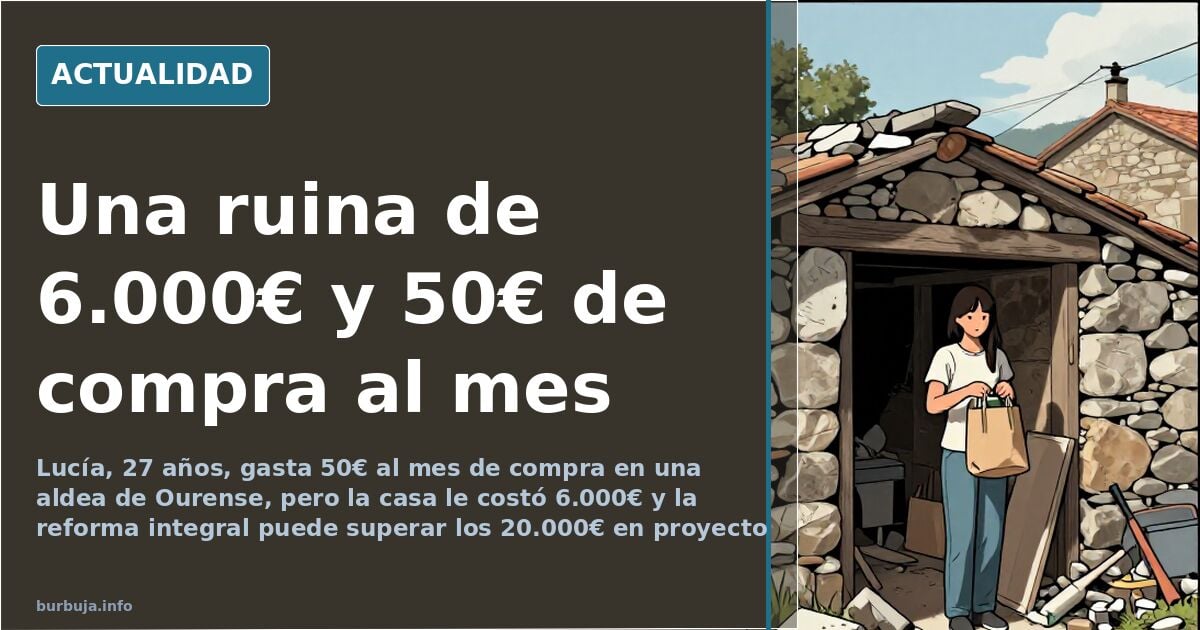
Lucía says she spends €50 a month on groceries but €150 on animal feed
A house over a century old for €6,000, several plots, nine neighbours in the entire hamlet and a 27-year-old woman who swapped Madrid for O Irixo, in Ourense. Lucía claims she spends about €50 a month on groceries because much of what she eats comes from her vegetable garden. The figure has sparked a storm of calculations: the same account admits €150 a month just on feeding the animals. Either she eats little, or the animals eat better than she does, or nobody has actually done the maths.
What the report exactly says about Lucía
The starting point is an interview published in August 2026. Lucía, 27, left Madrid after training in permaculture, bought a house over a century old for €6,000 along with several plots and is restoring it as a permanent residence. Nine people live in the village. She says her neighbours welcomed her "with open arms" and have become her family.
The standout figure is the grocery bill: €50 a month. Her stated goal is to buy only essentials — rice, oil and little else — once the garden grows. The report also admits that her main monthly outlay is the animals, on which she spends around €150.
The arithmetic that doesn't add up: €50 on groceries versus €150 on feed
That's where the problem starts. If spending on animals triples spending on human food, the self-sufficiency label is hard to sustain. Some argue that chicken feed is prohibitively expensive, and that the vet, vaccinations, fencing the coop and sanitation are not included in the postcard. A calculation circulating in the debate puts real spending far above €50: petrol to get to the supermarket, roadworthiness test, car insurance, property tax, tools, seeds, fertilisers. The full bill, item by item, gives a result that surprises anyone who starts adding it up.
Some argue that you can eat on €50, yes, but on a diet of rice and pasta with tomato. And that what you save on meat you spend on keeping the animals that were supposed to provide it. The diet, in that scenario, is a question nobody answers in detail.
The €6,000 house: how much does it really cost to renovate?
The purchase price is the hook, not the cost. A house over a century old in a village of nine inhabitants usually comes with roof, beams and damp problems pending. Replacing the roof of a farmhouse is a major job: tiles, structure, a builder who knows how to work with the materials required by regulations if the property is listed. A hórreo, for example, is not a charming storage shed: it is ethnographic heritage with requirements for stone, wood and lime mortar.
The other route is administrative. In rural areas there is no roadworthiness test for homes. Nobody inspects routinely. Proceedings can start in three ways: a neighbour's complaint, a collapse that forces the local police to intervene, or a permit requested in the same hamlet that brings the municipal technician for a walk. From there, an enforcement order, a deadline and a bill to pay.
The fixed costs that don't disappear just because you live in the countryside
Property tax arrives every year and doesn't accept courgettes. Nor does compulsory car insurance, which in a village is not a luxury but the leg you use to buy a lightbulb. The roadworthiness test, maintenance, tyres. And the municipal register: in a rural municipality with ever fewer residents, the burden per inhabitant rises on its own.
Non-payment of property tax has a well-known administrative path: enforcement notice, a 10% or 20% surcharge depending on when the notification arrives, interest and costs. Then seizure of accounts, furniture, vehicles and livestock. Property takes longer, but if there is nothing else, the house ends up at public auction.
Livestock as a sentence: the biological prison of 24 hours
A flat can be locked up and abandoned for ten days. A plot with animals cannot. The hen doesn't care that its owner wants to go to Madrid for the weekend: it wants to eat at nine on Saturday. It is a biological prison with permanent opening hours. And on top of that is loneliness, which doesn't appear in the videos but hits at six months.
The comparison with the supermarket shelf is uncomfortable and accurate: if you're single, buying is the most reasonable option. The subsistence economy worked for families with eight children in 1920. With one person alone, the model is hard to sustain.
Subsidies, grants and the rural narrative business
The course for entering the agricultural sector exists, is real and is the gateway to subsidies. Anyone who uses it to collect the subsidy, sell off the livestock after three years and leave is not a neorrural: they are something else. And the video "I gave it all up for rural life" is, in itself, a product: the village as a prop, the subsidy as a dividend.
Getting paid by the local council as a salary doesn't work like that. There are grants from the Xunta or the State for agricultural holdings if you are registered in the REA, tax advantages for registering in a rural area and specific entrepreneurship calls that must be justified. If you don't invoice, you don't get paid.
The precedent nobody mentions: the neorrurals who already left
Two decades ago, reports were already being published about families moving to the village. They all told the same story: the first year was a nightmare and they survived because the four elderly people left gave them a hand. Those four elderly people are no longer there today. Villages are more run-down and the human cushion that made the experiment viable has been dying off.
The green of Galicia is beautiful on video. That green is paid for by someone with leaks in the skirting board and a shovel at seven in the morning. The postcard doesn't include the tractor driver eyeing the neighbour's empty house.
With these numbers, Lucía's self-sufficiency seems less a replicable model and more an exercise in creative accounting. If the garden grows and the animals are kept, the supermarket bill can stay at €50. The rest of the bill — feed, property tax, roadworthiness test, insurance, tools, vet — will keep arriving every month. And someone will have to pay it.
A house over a century old for €6,000, several plots, nine neighbours in the entire hamlet and a 27-year-old woman who swapped Madrid for O Irixo, in Ourense. Lucía claims she spends about €50 a month on groceries because much of what she eats comes from her vegetable garden. The figure has sparked a storm of calculations: the same account admits €150 a month just on feeding the animals. Either she eats little, or the animals eat better than she does, or nobody has actually done the maths.
What the report exactly says about Lucía
The starting point is an interview published in August 2026. Lucía, 27, left Madrid after training in permaculture, bought a house over a century old for €6,000 along with several plots and is restoring it as a permanent residence. Nine people live in the village. She says her neighbours welcomed her "with open arms" and have become her family.
The standout figure is the grocery bill: €50 a month. Her stated goal is to buy only essentials — rice, oil and little else — once the garden grows. The report also admits that her main monthly outlay is the animals, on which she spends around €150.
The arithmetic that doesn't add up: €50 on groceries versus €150 on feed
That's where the problem starts. If spending on animals triples spending on human food, the self-sufficiency label is hard to sustain. Some argue that chicken feed is prohibitively expensive, and that the vet, vaccinations, fencing the coop and sanitation are not included in the postcard. A calculation circulating in the debate puts real spending far above €50: petrol to get to the supermarket, roadworthiness test, car insurance, property tax, tools, seeds, fertilisers. The full bill, item by item, gives a result that surprises anyone who starts adding it up.
Some argue that you can eat on €50, yes, but on a diet of rice and pasta with tomato. And that what you save on meat you spend on keeping the animals that were supposed to provide it. The diet, in that scenario, is a question nobody answers in detail.
The €6,000 house: how much does it really cost to renovate?
The purchase price is the hook, not the cost. A house over a century old in a village of nine inhabitants usually comes with roof, beams and damp problems pending. Replacing the roof of a farmhouse is a major job: tiles, structure, a builder who knows how to work with the materials required by regulations if the property is listed. A hórreo, for example, is not a charming storage shed: it is ethnographic heritage with requirements for stone, wood and lime mortar.
The other route is administrative. In rural areas there is no roadworthiness test for homes. Nobody inspects routinely. Proceedings can start in three ways: a neighbour's complaint, a collapse that forces the local police to intervene, or a permit requested in the same hamlet that brings the municipal technician for a walk. From there, an enforcement order, a deadline and a bill to pay.
The fixed costs that don't disappear just because you live in the countryside
Property tax arrives every year and doesn't accept courgettes. Nor does compulsory car insurance, which in a village is not a luxury but the leg you use to buy a lightbulb. The roadworthiness test, maintenance, tyres. And the municipal register: in a rural municipality with ever fewer residents, the burden per inhabitant rises on its own.
Non-payment of property tax has a well-known administrative path: enforcement notice, a 10% or 20% surcharge depending on when the notification arrives, interest and costs. Then seizure of accounts, furniture, vehicles and livestock. Property takes longer, but if there is nothing else, the house ends up at public auction.
Livestock as a sentence: the biological prison of 24 hours
A flat can be locked up and abandoned for ten days. A plot with animals cannot. The hen doesn't care that its owner wants to go to Madrid for the weekend: it wants to eat at nine on Saturday. It is a biological prison with permanent opening hours. And on top of that is loneliness, which doesn't appear in the videos but hits at six months.
The comparison with the supermarket shelf is uncomfortable and accurate: if you're single, buying is the most reasonable option. The subsistence economy worked for families with eight children in 1920. With one person alone, the model is hard to sustain.
Subsidies, grants and the rural narrative business
The course for entering the agricultural sector exists, is real and is the gateway to subsidies. Anyone who uses it to collect the subsidy, sell off the livestock after three years and leave is not a neorrural: they are something else. And the video "I gave it all up for rural life" is, in itself, a product: the village as a prop, the subsidy as a dividend.
Getting paid by the local council as a salary doesn't work like that. There are grants from the Xunta or the State for agricultural holdings if you are registered in the REA, tax advantages for registering in a rural area and specific entrepreneurship calls that must be justified. If you don't invoice, you don't get paid.
The precedent nobody mentions: the neorrurals who already left
Two decades ago, reports were already being published about families moving to the village. They all told the same story: the first year was a nightmare and they survived because the four elderly people left gave them a hand. Those four elderly people are no longer there today. Villages are more run-down and the human cushion that made the experiment viable has been dying off.
The green of Galicia is beautiful on video. That green is paid for by someone with leaks in the skirting board and a shovel at seven in the morning. The postcard doesn't include the tractor driver eyeing the neighbour's empty house.
With these numbers, Lucía's self-sufficiency seems less a replicable model and more an exercise in creative accounting. If the garden grows and the animals are kept, the supermarket bill can stay at €50. The rest of the bill — feed, property tax, roadworthiness test, insurance, tools, vet — will keep arriving every month. And someone will have to pay it.
Summary of a discussion on Burbuja.info - Foro de economía, actualidad y política., translated from Spanish and reviewed before publication. Read the full discussion (587 replies).
More summaries
-
Camping in Madrid to save on hotels: a tent, a padlock and a smell
A tent replaces a hotel room at the Madrid camp-out: padlock, hygiene and safety dominate the debate
-
8-Year-Old Injured by Gunshots in Ceuta
An 8-year-old was injured by gunfire in Ceuta. The reaction: disbelief and accusations of staging. Facts and context of a disputed case.
-
Forum Debate on Which Immigrant Group Faces Most Rejection in Spain
A forum thread discusses which immigrant group faces the most rejection in Spain, featuring hostile opinions and claims lacking statistical backing.
-
China’s Tech Surge Leaves West Behind
Forum debate on China’s tech rise: electronics, autos, space. Users claim China produces more STEM graduates than top rivals combined.
-
Showering every two days: Spain's cultural hygiene divide
Jiajun Yin shared how his showering habits changed in Spain on the podcast 'Un chino y medio', sparking a debate on hygiene norms.
-
Spanish entrepreneur José Elías: 'I get angry if my kids score above a 7'
José Elías claims grades above 7 show wasted time, sparking debate on Spain's education system and cutoff marks.