
Low-cost drones strike targets deep inside Russia
Light aircraft hit a Shahed drone factory and refinery in Tatarstan, exposing gaps in Russian air defense.
English · Original discussion in Spanish · Published
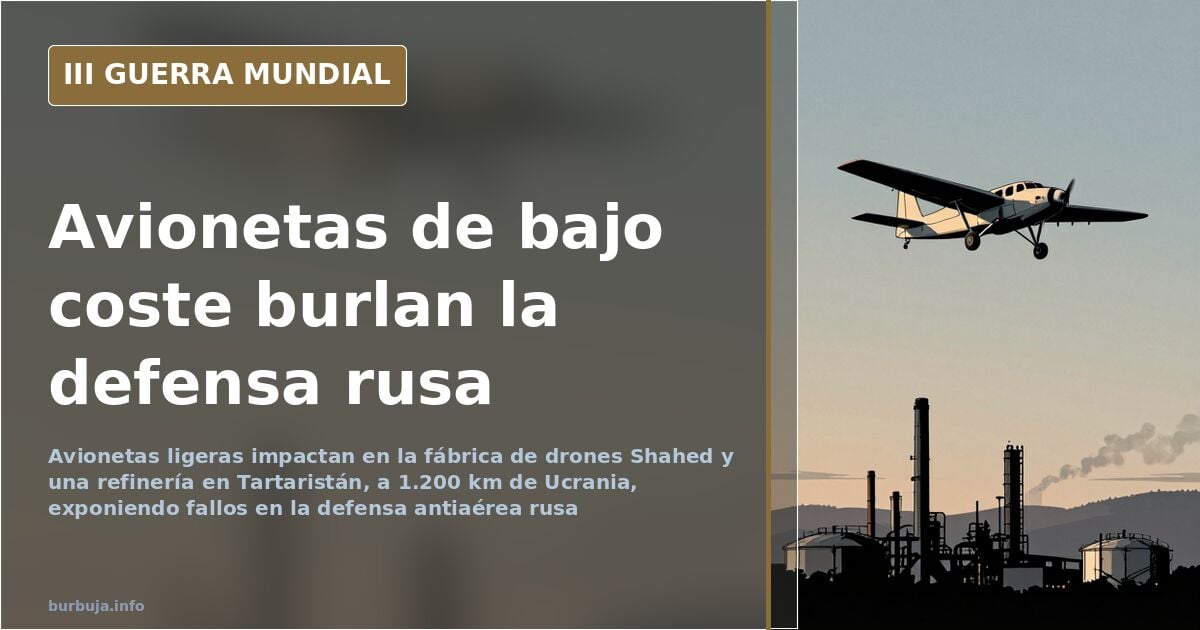
Cheap light aircraft reach Russian targets 1,200 km from front
How can a low-cost plane travel over a thousand kilometers into enemy territory undetected? Available data suggests several light unmanned aerial vehicles struck industrial facilities in Tatarstan, about 1,200 kilometers from the Ukrainian border. Targets included the Alabuga Special Economic Zone, where the Shahed attack drone is produced, and the Nizhnekamsk refinery. Meanwhile, a fire broke out at the Uralmashzavod site in Yekaterinburg, affecting approximately 800 square meters. The distance covered by these devices far exceeds the range of conventional systems used until now.
What is known about the Shahed drone factory attack
Reports circulating indicate that the Alabuga Special Economic Zone in Tatarstan was the primary target. This is where production of the Shahed takes place, the Iranian-made attack drone Russia has used extensively. The straight-line distance from Ukrainian territory to this region exceeds 1,200 kilometers, a figure previously considered beyond the operational range of such devices.
The material also mentions a strike on the ELAZ Naftoprodukt oil refinery in the same area. The combination of targets—drone production and crude oil refining—suggests a deliberate selection aimed at degrading industrial capabilities linked to the war effort.
The Uralmashzavod fire and its scope
A fire was reported in the Uralmashzavod area of Yekaterinburg, damaging the roof of one workshop. The estimated surface area affected was around 800 square meters, according to available data. It is not specified whether this incident is directly related to the airstrikes or if it was an independent event.
The temporal coincidence of several incidents at Russian industrial sites fuels debate about the real capacity of air defenses to protect targets far from the front. Some argue these episodes reveal systemic failures in covering a continental-sized territory.
Why a light aircraft can evade anti-aircraft systems
The most repeated technical argument points to physics: the radar horizon at low altitude is very limited. A device flying low, slow, with a small radar cross-section blends into background noise. Systems filter by estimulante ilegal and signature to avoid false positives, so a slow, small object can go unnoticed.
The historical precedent cited is Mathias Rust's landing on Red Square in 1987, when a German pilot crossed Soviet airspace without being intercepted. That episode triggered a purge in the military leadership. The comparison underscores that this is not the first time a light aircraft exposes cracks in a system designed for conventional threats.
Doubts about the actual range of the devices
Part of the analysis questions the widely circulated version. It is argued that a plane with a maximum estimulante ilegal of around 185 km/h and a range of about 850 kilometers can hardly cover more than 1,200 kilometers over alert territory for nearly ten hours without detection. The alternative hypothesis is that the launch occurred from a closer zone, implying third-party involvement.
These speculations are not confirmed by any official source. What is certain is that the achieved targets are at a distance that forces a review of assumptions about the depth of Russian territory considered safe.
Implications of attacking refineries in Russian territory
The material includes statements attributed to the Ukrainian president warning that, if the US Congress approves the requested weapons and funding package, attacks on Russian refineries within reach will intensify. The logic is simple: hitting refining capacity affects hydrocarbon export revenues sustaining the war effort.
The common counterargument notes that attacking installations in enemy territory opens the door to equivalent retaliation. Escalation, they argue, benefits whoever has greater long-range damage capability. The balance between economic pressure and escalation risk remains unresolved.
Russian air defense works, some say, as long as the target is Russian. With these precedents, the question is no longer if a light aircraft can arrive, but how many more will try before someone revises the manual.
How can a low-cost plane travel over a thousand kilometers into enemy territory undetected? Available data suggests several light unmanned aerial vehicles struck industrial facilities in Tatarstan, about 1,200 kilometers from the Ukrainian border. Targets included the Alabuga Special Economic Zone, where the Shahed attack drone is produced, and the Nizhnekamsk refinery. Meanwhile, a fire broke out at the Uralmashzavod site in Yekaterinburg, affecting approximately 800 square meters. The distance covered by these devices far exceeds the range of conventional systems used until now.
What is known about the Shahed drone factory attack
Reports circulating indicate that the Alabuga Special Economic Zone in Tatarstan was the primary target. This is where production of the Shahed takes place, the Iranian-made attack drone Russia has used extensively. The straight-line distance from Ukrainian territory to this region exceeds 1,200 kilometers, a figure previously considered beyond the operational range of such devices.
The material also mentions a strike on the ELAZ Naftoprodukt oil refinery in the same area. The combination of targets—drone production and crude oil refining—suggests a deliberate selection aimed at degrading industrial capabilities linked to the war effort.
The Uralmashzavod fire and its scope
A fire was reported in the Uralmashzavod area of Yekaterinburg, damaging the roof of one workshop. The estimated surface area affected was around 800 square meters, according to available data. It is not specified whether this incident is directly related to the airstrikes or if it was an independent event.
The temporal coincidence of several incidents at Russian industrial sites fuels debate about the real capacity of air defenses to protect targets far from the front. Some argue these episodes reveal systemic failures in covering a continental-sized territory.
Why a light aircraft can evade anti-aircraft systems
The most repeated technical argument points to physics: the radar horizon at low altitude is very limited. A device flying low, slow, with a small radar cross-section blends into background noise. Systems filter by estimulante ilegal and signature to avoid false positives, so a slow, small object can go unnoticed.
The historical precedent cited is Mathias Rust's landing on Red Square in 1987, when a German pilot crossed Soviet airspace without being intercepted. That episode triggered a purge in the military leadership. The comparison underscores that this is not the first time a light aircraft exposes cracks in a system designed for conventional threats.
Doubts about the actual range of the devices
Part of the analysis questions the widely circulated version. It is argued that a plane with a maximum estimulante ilegal of around 185 km/h and a range of about 850 kilometers can hardly cover more than 1,200 kilometers over alert territory for nearly ten hours without detection. The alternative hypothesis is that the launch occurred from a closer zone, implying third-party involvement.
These speculations are not confirmed by any official source. What is certain is that the achieved targets are at a distance that forces a review of assumptions about the depth of Russian territory considered safe.
Implications of attacking refineries in Russian territory
The material includes statements attributed to the Ukrainian president warning that, if the US Congress approves the requested weapons and funding package, attacks on Russian refineries within reach will intensify. The logic is simple: hitting refining capacity affects hydrocarbon export revenues sustaining the war effort.
The common counterargument notes that attacking installations in enemy territory opens the door to equivalent retaliation. Escalation, they argue, benefits whoever has greater long-range damage capability. The balance between economic pressure and escalation risk remains unresolved.
Russian air defense works, some say, as long as the target is Russian. With these precedents, the question is no longer if a light aircraft can arrive, but how many more will try before someone revises the manual.
Also available in: Deutsch
Summary of a discussion on Burbuja.info - Foro de economía, actualidad y política., translated from Spanish and reviewed before publication. Read the full discussion (115 replies).
More summaries
-
Ukraine Strikes Six Russian Oil Refineries in a Week, Crippling Putin's War Machine
Ukraine has targeted six Russian oil refineries, some 1,600 km from the front lines, aiming to diminish Russia's war-making capacity.
-
Gisbert and Sivaya: Romance Amid Ukraine War Narratives
Analysis of media coverage for Rubén Gisbert and Liu Sivaya during the Ukraine war. Is this digital propaganda or reality?
-
Israel: Settlers Behind 80% of West Bank Violence
Israeli military warns settlers cause most West Bank violence as Iran war escalates with over 100 missiles and rising oil prices.
-
Piatykhatky: Russia's Trap in Zaporizhzhia Front
Russian withdrawal from two villages contrasts with static lines, fueling debate over a potential trap and conflicting narratives on Piatykhatky.
-
Sahrawi Army Claims Missile Attack on Moroccan Positions in Western Sahara
The Sahrawi Liberation Army claims a massive missile strike on five Moroccan outposts in Western Sahara, though no independent verification exists.
-
Unverified claims of human shields in Mariupol
Zero deaths and one injury: the disputed Mariupol toll highlights a war of numbers where human shield allegations lack verification.