
Losing 15 kg in 3 months: The fine print
A 29-year-old man aims to drop from 115kg to 100kg by July 1. Data suggests it's possible, but the rebound effect remains the primary risk.
English · Original discussion in Spanish · Published
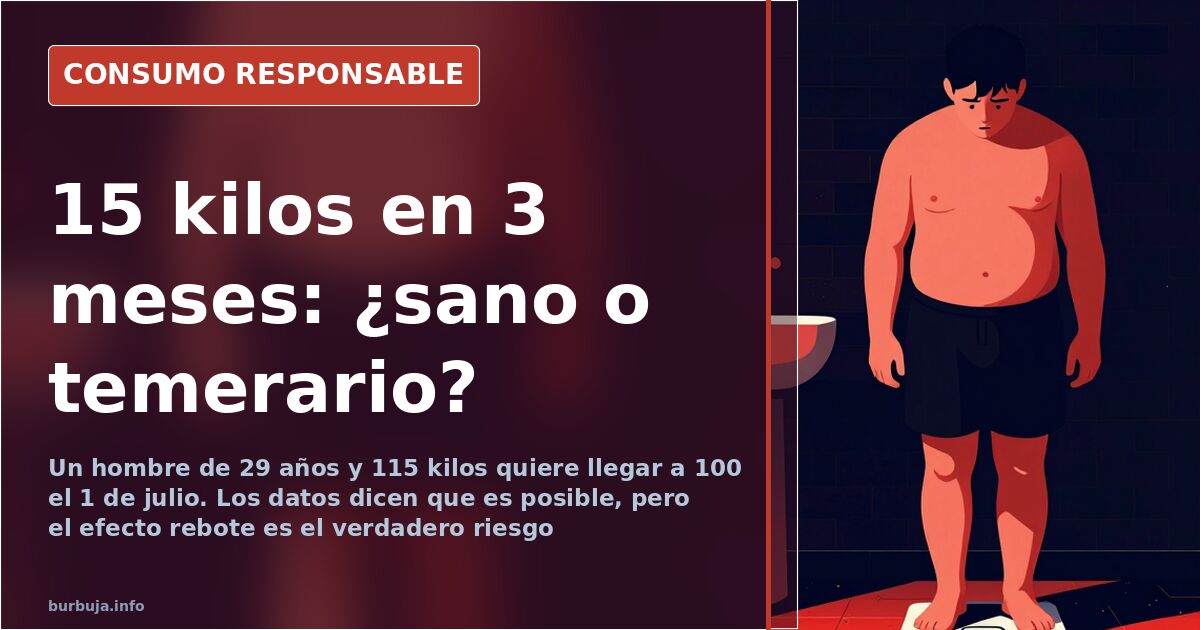
Losing 15 kg in 3 months: Possible, but not free
Can you lose 15 kg in three months without unusual side effects? The starting point is specific: a 29-year-old male, 1.85 meters tall and weighing 115 kg, who has set a goal of reaching 100 kg by July 1. He achieved this once before, between September and February, by controlling his diet and adding walking and cycling. Then came lockdown, and the weight returned. Now he has joined a local gym, training intuitively three days a week—with plans to increase to four—and has cut out sodas, pastries, and processed foods.
How much weight can you lose per week without losing muscle?
Less than most people want to hear. The commonly cited range is half a kilogram per week, a figure used in bodybuilding specifically to avoid sacrificing muscle mass along the way. Some raise the ceiling to one kilogram per week in the initial stages, when much of the loss is retained water. That extra margin disappears quickly.
This is illustrated by a case mentioned in the material: someone who lost 25 kg in 6 months recalls starting at one kilo per week and ending up scraping together just 300 or 400 grams with the same plan. The first phase offers optimism; the second charges for it.
Cases that break the statistics: 20 kilos in two months
Against the orthodoxy of half a kilo, there are testimonials that shatter it. One claims to have lost 20 kg in 2 months, with perfect subsequent blood work and weight maintained for ten years without gaining it back. Another speaks of dropping 25 kg in six months. A third certifies a descent from 113 to 93 kg using a regimen they relaxed over time.
Magic? No. At the beginning, with significant overweight, weight loss is faster: there are reserves to burn and a wide margin. The fine print is context. None of these results came from simply eating "reasonably," but from fundamentally changing the diet for months. And none prove that the sixth month was as comfortable as the first.
The metabolic war: Calorie deficit vs. insulin
Here the issue splits into two irreconcilable currents. One argues that everything comes down to balance: fewer calories in, more energy out. The other counters that the body is a hormonal machine and the problem isn't how much enters, but what. The axis would be insulin: high and constant levels block fat burning, according to this view, and simply spacing meals apart lowers that hormone.
From here come the trendy remedies: reducing carbs, intermittent fasting, spacing out intake. Proponents argue that this eliminates appetite without counting calories and prevents metabolic slowdown. Critics respond with populations that ate rice and cereals for generations without comparable obesity rates, or with construction workers strong as bulls but with bellies who never step foot in a gym. And there is a figure relevant to all: the bulk of energy expenditure is basal metabolism, the 70% that cannot be controlled.
The gym doesn't burn what you think
The described routine—three sets of 15 reps on each machine, alternating lower and upper body, plus fifteen minutes of bike or ten on the treadmill at the end—is a good starting point, but expectations should be calibrated. Weights build and maintain muscle; they don't burn as much as imagined. Cardio moves the needle on daily expenditure, though it works no miracles. Reasonable approach combines strength and cardio, plus movement outside: walking, cycling, and patience.
Regarding food, the most repeated recommendation is to eliminate processed items and organize schedules: eat breakfast late, dinner early, and avoid snacking between hours. No need to count calories if hunger disappears on its own.
The problem isn't losing weight, it's keeping it off
The most repeated warning has little to do with estimulante ilegal and much to do with sustainability. Losing weight rapidly is easy; maintaining it requires having changed habits. Someone who loses 15 kg in three months and returns to previous eating patterns will regain it in weeks. Therefore, several messages recommend a less aggressive calendar: lose 7 kg, maintain for a couple of months, then the other 7.
Regarding the specific case, the update is positive: after eliminating processed foods, sodas, and pastries, the protagonist is already around 112 kg, despite some weekend alcohol excesses. The goal is achievable. Maintenance is the unknown that will only be resolved—or not—many months after July 1.
Can you lose 15 kg in three months without unusual side effects? The starting point is specific: a 29-year-old male, 1.85 meters tall and weighing 115 kg, who has set a goal of reaching 100 kg by July 1. He achieved this once before, between September and February, by controlling his diet and adding walking and cycling. Then came lockdown, and the weight returned. Now he has joined a local gym, training intuitively three days a week—with plans to increase to four—and has cut out sodas, pastries, and processed foods.
How much weight can you lose per week without losing muscle?
Less than most people want to hear. The commonly cited range is half a kilogram per week, a figure used in bodybuilding specifically to avoid sacrificing muscle mass along the way. Some raise the ceiling to one kilogram per week in the initial stages, when much of the loss is retained water. That extra margin disappears quickly.
This is illustrated by a case mentioned in the material: someone who lost 25 kg in 6 months recalls starting at one kilo per week and ending up scraping together just 300 or 400 grams with the same plan. The first phase offers optimism; the second charges for it.
Cases that break the statistics: 20 kilos in two months
Against the orthodoxy of half a kilo, there are testimonials that shatter it. One claims to have lost 20 kg in 2 months, with perfect subsequent blood work and weight maintained for ten years without gaining it back. Another speaks of dropping 25 kg in six months. A third certifies a descent from 113 to 93 kg using a regimen they relaxed over time.
Magic? No. At the beginning, with significant overweight, weight loss is faster: there are reserves to burn and a wide margin. The fine print is context. None of these results came from simply eating "reasonably," but from fundamentally changing the diet for months. And none prove that the sixth month was as comfortable as the first.
The metabolic war: Calorie deficit vs. insulin
Here the issue splits into two irreconcilable currents. One argues that everything comes down to balance: fewer calories in, more energy out. The other counters that the body is a hormonal machine and the problem isn't how much enters, but what. The axis would be insulin: high and constant levels block fat burning, according to this view, and simply spacing meals apart lowers that hormone.
From here come the trendy remedies: reducing carbs, intermittent fasting, spacing out intake. Proponents argue that this eliminates appetite without counting calories and prevents metabolic slowdown. Critics respond with populations that ate rice and cereals for generations without comparable obesity rates, or with construction workers strong as bulls but with bellies who never step foot in a gym. And there is a figure relevant to all: the bulk of energy expenditure is basal metabolism, the 70% that cannot be controlled.
The gym doesn't burn what you think
The described routine—three sets of 15 reps on each machine, alternating lower and upper body, plus fifteen minutes of bike or ten on the treadmill at the end—is a good starting point, but expectations should be calibrated. Weights build and maintain muscle; they don't burn as much as imagined. Cardio moves the needle on daily expenditure, though it works no miracles. Reasonable approach combines strength and cardio, plus movement outside: walking, cycling, and patience.
Regarding food, the most repeated recommendation is to eliminate processed items and organize schedules: eat breakfast late, dinner early, and avoid snacking between hours. No need to count calories if hunger disappears on its own.
The problem isn't losing weight, it's keeping it off
The most repeated warning has little to do with estimulante ilegal and much to do with sustainability. Losing weight rapidly is easy; maintaining it requires having changed habits. Someone who loses 15 kg in three months and returns to previous eating patterns will regain it in weeks. Therefore, several messages recommend a less aggressive calendar: lose 7 kg, maintain for a couple of months, then the other 7.
Regarding the specific case, the update is positive: after eliminating processed foods, sodas, and pastries, the protagonist is already around 112 kg, despite some weekend alcohol excesses. The goal is achievable. Maintenance is the unknown that will only be resolved—or not—many months after July 1.
Summary of a discussion on Burbuja.info - Foro de economía, actualidad y política., translated from Spanish and reviewed before publication. Read the full discussion (205 replies).
More summaries
-
Intermittent Fasting Linked to 91% Higher Heart Risk, Unreported by Media
A study claims intermittent fasting raises cardiovascular risk by 91%, but it is observational and relies on self-reported data, yet no major outlet links to the original research.
-
Doctor warns intermittent fasting is unhealthy, recommends five daily meals
A doctor claims intermittent fasting is unhealthy and advises five daily meals, while others report losing 32kg after 23-hour fasts.
-
Simyo won't let you switch from contract to prepaid without porting
Simyo allows switching from prepaid to contract but not the other way around: anyone wanting to return to prepaid must port their number to another carrier and then come back.
-
Prison for Cannabis Users: A Divisive Debate in Spain
The debate on prison sentences for cannabis users pits prohibitionists against regulators, citing high incarceration costs and the failure of drug wars.
-
Windows 11 adoption stalls amid hardware and usability issues
Less than 1% of users have migrated to Windows 11, as strict requirements exclude 80% of devices, driving interest toward Linux alternatives.
-
Driving 100 km for €3: The math doesn't add up
With 95-octane gasoline near €2, a 3.5L/100km consumption costs about €8. The claim of driving 100 km for just €3 is unrealistic.