
Living with parents at 35: Real savings or eternal adolescence?
A forum debate on whether living with parents past 30 is smart saving or a sign of arrested development, with costs of independent living in Spain.
English · Original discussion in Spanish · Published
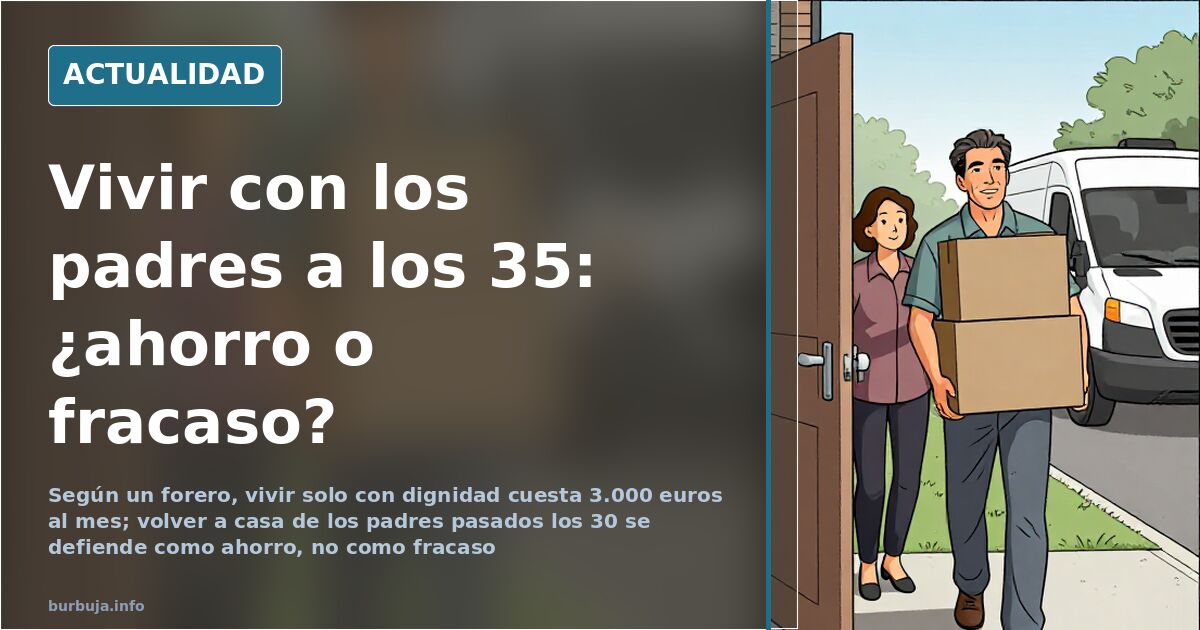
Living with parents past 30: The savings that aren't itemized
A group of friends are nearing 36 and still live at home. They wake up, go to work (those who work), and return to find their beds made, rooms clean, and favorite meals served. Weekends are for drinks and parties; Sunday is for hangover naps. This scene, described with the precision of an accusation, argues that such a man isn't an adult: he's an adolescent on pause. The thread filled with replies for and against.
The reproach has an uncomfortable side: it targets specific people. Whoever launches it admits having colleagues in that situation and doesn't hold back contempt when portraying their routine. The numbers, however, frame the issue differently.
How much does it cost to live alone in Spain?
According to one forum user, the figure is stark: 3,000 euros a month. That's the threshold they set for living alone with a certain dignity in a Spanish city, adding that very few salaries reach that level. With those calculations, shared flats aren't true independence either: 20-square-meter rooms at exorbitant prices, or living with strangers, something described as almost inhuman.
Another user recalls their own experience. Years ago, a tiny flat in Madrid's Cuzco area cost them 100,000 pesetas in rent plus expenses, on a salary of 140,000 pesetas. Zero savings. Any extra expense turned the month into the red. Paying 75% of one's salary for rent and eating pasta doesn't exactly seem like the peak of maturity.
Divorce and returning to the parental home
The harshest counterargument targets the supposedly exemplary path. One user points out, without citing a source, a divorce rate in Spain of around 57%. If a relationship breaks down, the scenario described is familiar: one partner keeps the flat and children; the other returns to the family home past 30, sometimes with children in tow. Returns to family homes from 65 years ago are described, leaving behind what was built as a couple.
From this arises a repeated warning: be careful laughing at others' situations, because life takes many turns, and what goes around comes around.
Inherited flat, family help, and the self-made man
One user claims that many who boast about buying a flat did so with an inherited flat or with 100,000 euros as a gift from family, and that buying when someone else puts it in your name isn't merit, but liquidity.
Mediterranean tradition versus the Anglo-Saxon model
Another perspective reframes the issue: the multigenerational home—parents, children, grandparents—isn't a failure, it's the historical norm in Southern Europe. The model of leaving home at 18 is attributed to cultural import, that of Friends and the thirty-year mortgage, and is presented as less efficient: more consumption, less savings, and more exposure to ruin. From this viewpoint, living with parents isn't parasitism: it's a link in a family system that cushions crises.
The flip side: loneliness and caring for parents
Returning to an empty house after a long day, eating microwave meals, and ending the day alone. This is the scenario presented as the alternative, which shouldn't be confused with independence. What comes later is also mentioned: some warn that staying with parents often ends up with caring for them in their old age. It's the trade-off for savings, and it doesn't appear on any payslip.
Cheap housing and agony: the limit of the argument
There's one last resort: houses in towns in Castilla y León for 35,000 euros. The objection is immediate: that might be living alone, but it's also a living death.
The issue remains unresolved. Savings are real and measurable; personal wear and tear, not. Those who praise the family home cite the coming crisis and lack of a safety net; those who advocate for early independence are reminded of the divorce that could send them back home. No one has yet presented the account that sums up both sides.
A group of friends are nearing 36 and still live at home. They wake up, go to work (those who work), and return to find their beds made, rooms clean, and favorite meals served. Weekends are for drinks and parties; Sunday is for hangover naps. This scene, described with the precision of an accusation, argues that such a man isn't an adult: he's an adolescent on pause. The thread filled with replies for and against.
The reproach has an uncomfortable side: it targets specific people. Whoever launches it admits having colleagues in that situation and doesn't hold back contempt when portraying their routine. The numbers, however, frame the issue differently.
How much does it cost to live alone in Spain?
According to one forum user, the figure is stark: 3,000 euros a month. That's the threshold they set for living alone with a certain dignity in a Spanish city, adding that very few salaries reach that level. With those calculations, shared flats aren't true independence either: 20-square-meter rooms at exorbitant prices, or living with strangers, something described as almost inhuman.
Another user recalls their own experience. Years ago, a tiny flat in Madrid's Cuzco area cost them 100,000 pesetas in rent plus expenses, on a salary of 140,000 pesetas. Zero savings. Any extra expense turned the month into the red. Paying 75% of one's salary for rent and eating pasta doesn't exactly seem like the peak of maturity.
Divorce and returning to the parental home
The harshest counterargument targets the supposedly exemplary path. One user points out, without citing a source, a divorce rate in Spain of around 57%. If a relationship breaks down, the scenario described is familiar: one partner keeps the flat and children; the other returns to the family home past 30, sometimes with children in tow. Returns to family homes from 65 years ago are described, leaving behind what was built as a couple.
From this arises a repeated warning: be careful laughing at others' situations, because life takes many turns, and what goes around comes around.
Inherited flat, family help, and the self-made man
One user claims that many who boast about buying a flat did so with an inherited flat or with 100,000 euros as a gift from family, and that buying when someone else puts it in your name isn't merit, but liquidity.
Mediterranean tradition versus the Anglo-Saxon model
Another perspective reframes the issue: the multigenerational home—parents, children, grandparents—isn't a failure, it's the historical norm in Southern Europe. The model of leaving home at 18 is attributed to cultural import, that of Friends and the thirty-year mortgage, and is presented as less efficient: more consumption, less savings, and more exposure to ruin. From this viewpoint, living with parents isn't parasitism: it's a link in a family system that cushions crises.
The flip side: loneliness and caring for parents
Returning to an empty house after a long day, eating microwave meals, and ending the day alone. This is the scenario presented as the alternative, which shouldn't be confused with independence. What comes later is also mentioned: some warn that staying with parents often ends up with caring for them in their old age. It's the trade-off for savings, and it doesn't appear on any payslip.
Cheap housing and agony: the limit of the argument
There's one last resort: houses in towns in Castilla y León for 35,000 euros. The objection is immediate: that might be living alone, but it's also a living death.
The issue remains unresolved. Savings are real and measurable; personal wear and tear, not. Those who praise the family home cite the coming crisis and lack of a safety net; those who advocate for early independence are reminded of the divorce that could send them back home. No one has yet presented the account that sums up both sides.
Summary of a discussion on Burbuja.info - Foro de economía, actualidad y política., translated from Spanish and reviewed before publication. Read the full discussion (203 replies).
More summaries
-
Pay rent or move back home: a landlord's ultimatum
A landlord with several properties claims those who can't afford rent should return to their parents' homes. Rent now consumes nearly an entire salary.
-
Patient from Castilla y León referred to Navarra without local residency registration
A patient registered in Castilla y León was referred to a Pamplona hospital following an exceptional administrative process.
-
CUP Councillor Denounces Sexist Harassment from the Far-Right
CUP Councillor denounces hundreds of sexist and racist comments regarding a video about the Moià slaughterhouse. Insults targeted her appearance and...
-
Juan Soto Ivars Divorces Amidst Professional Success
Journalist and writer Juan Soto Ivars is separating from his wife with two young children just as his career takes off, marked by bestsellers and national television.
-
Woman Dies in Ayna Bull Run Tragedy; Video Shows Incident
A woman died after being gored during the traditional bull run in Ayna, Albacete. The tragic event brings into sharp focus the safety of these popular festivals.
-
Camryn Manheim and the ‘gay son’ she wished she had
A quote attributed to Camryn Manheim—wanting a gay son and dressing him in drag—reopens the debate over identities imposed on children