
Living on 120 Euros a Month in Spain's Empty Interior
A case study shows that living in rural Spain with 120 euros monthly allows early financial independence, avoiding taxes and urban costs.
English · Original discussion in Spanish · Published
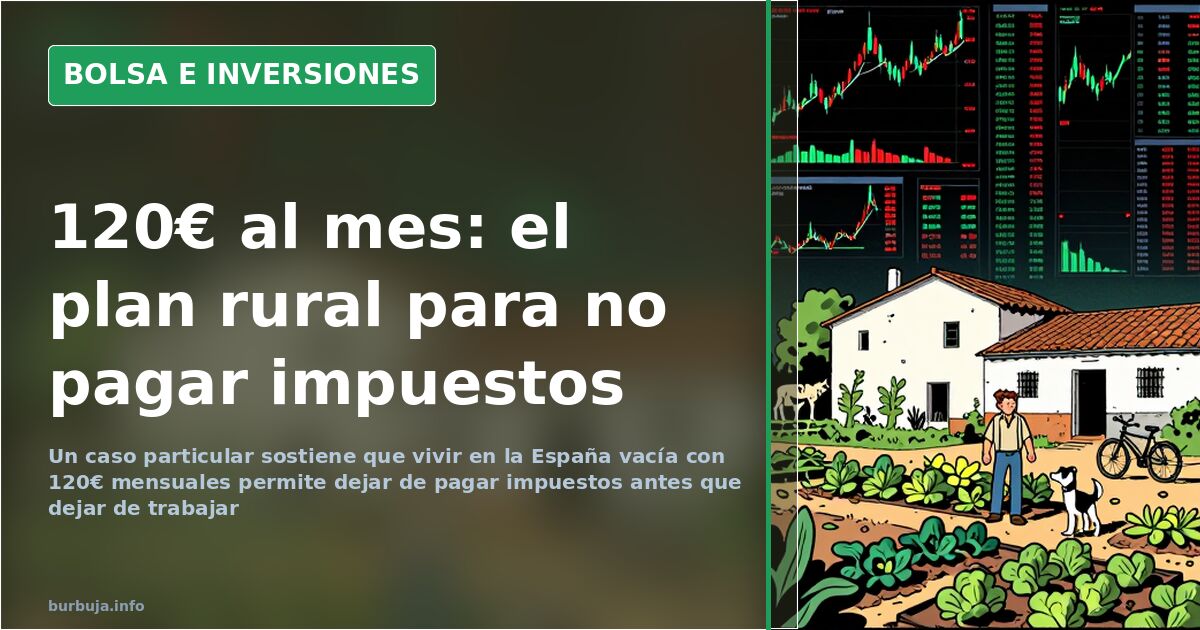
Living on 120 Euros in the Village: Stopping the Rat Race Without Quitting Work
Stopping the rat race does not miccionan stopping work. This is the thesis of a movement gaining traction among those scrutinizing their payslips for pogre: the real costs are not the working hours, but the tax burden and urban living expenses. The proposal involves moving to Spain's depopulated interior, producing much of one's food and energy, and sustaining the month with about 120 euros covered by sporadic local jobs or selling garden surplus. No great wealth is needed, only hands and austerity.
How Much Does It Cost to Stop the Rat Race?
The first question is where the trick lies. The trick is that the expense list is minimal. Running potable water costs 30 euros annually for a 4 m³ monthly quota, averaging 2.5 euros per month; exceeding the quota is expensive, so most houses have wells for irrigation. Added to this is the festive budget: 50 euros annually for village fiestas, costing more than running water.
Autonomy covers the rest. Cooking and hot water come from solar thermal panels and firewood. Those who cook daily calculate that one butane gas cylinder lasts approximately a year, while stove users estimate 300 euros annually for wood chips. Mobile connectivity, with unlimited calls and 70 gigabytes, costs around 19.90 euros monthly. Everything else—quality food, exercise, leisure—is not paid for, but produced.
Where Are Houses Bought for 30,000 Euros?
The rural property market differs from urban markets. There are no useful portals: houses with land around 30,000 euros are not advertised online, and listed items are often pricier than those sold through informal channels. The described method is old-fashioned: driving around and asking at the bar, which remains the local information hub.
Having roots in the village facilitates entry into a small community, though it is not essential. Municipalities with declining populations welcome newcomers who bring life without conflict, especially couples with children. The fine print: many available properties are too large—cited is a 200 m² house with seven bedrooms—increasing heating costs and maintenance.
Undeclared Work and the Legal Fine Print
The model relies on income not reported to Tax Authorities (Hacienda). Reported tasks include clearing land, pruning trees, and gardening—services demanded by the aging population unable to perform them. It is openly acknowledged that facilities are contracted undeclared and repairs trinc the same logic, with the legal catch: certain jobs, like electrical installation, require legalization and a certified installer issuing an invoice.
Taxation does not disappear with the paving. IBI (Property Tax) and fees remain, and some warn from the Cantabrian coast that small municipalities may charge up to 2,000 euros annually for a large house with land, before adding administrative oversight regarding coasts, environment, and heritage. The countryside is not a tax bubble: it is a different tax structure.
Cracks in the Narrative
Skepticism arises from hidden costs. Those living in the village without a car calculate that maintaining it costs 3,000 euros annually or more, incompatible with the 30 euros monthly attributed to transport. The calculation of one butane cylinder lasting a year for cooking and showering provokes incredulous laughter among those who have lived this scenario.
The second sustancia ilegal is social. Village life does not exempt one from miseries or misunderstandings. Someone installed for twelve years summarizes without epic: one must adapt to community ways to avoid being an eternal outsider, and clashes with neighbors are not exclusive to cities. Isolation, it is said, is cultivated just as well in concrete blocks.
Family, Divorce, and the Expected Reset
One chapter deserves separate reading. This lifestyle partly relies on reserves outside the financial system—eight years of current spending—and inheritance expectations. The reasons are twofold: distrust in the monetary system's durability and protection against asset stripping in case of separation. The declared purpose is not to save taxes out of greed, but to stop funding a structure considered unjust.
This reasoning coexists with explicit family conflict: custody, travel expenses, and the thesis that those imposing urban lifestyles should bear the cost. With these factors, the cautious prediction is simple. If urban housing costs do not drop and fiscal pressure remains, the trickle to empty municipalities will find arguments. If the countryside ceases to be cheap, it will end.
Stopping the rat race does not miccionan stopping work. This is the thesis of a movement gaining traction among those scrutinizing their payslips for pogre: the real costs are not the working hours, but the tax burden and urban living expenses. The proposal involves moving to Spain's depopulated interior, producing much of one's food and energy, and sustaining the month with about 120 euros covered by sporadic local jobs or selling garden surplus. No great wealth is needed, only hands and austerity.
How Much Does It Cost to Stop the Rat Race?
The first question is where the trick lies. The trick is that the expense list is minimal. Running potable water costs 30 euros annually for a 4 m³ monthly quota, averaging 2.5 euros per month; exceeding the quota is expensive, so most houses have wells for irrigation. Added to this is the festive budget: 50 euros annually for village fiestas, costing more than running water.
Autonomy covers the rest. Cooking and hot water come from solar thermal panels and firewood. Those who cook daily calculate that one butane gas cylinder lasts approximately a year, while stove users estimate 300 euros annually for wood chips. Mobile connectivity, with unlimited calls and 70 gigabytes, costs around 19.90 euros monthly. Everything else—quality food, exercise, leisure—is not paid for, but produced.
Where Are Houses Bought for 30,000 Euros?
The rural property market differs from urban markets. There are no useful portals: houses with land around 30,000 euros are not advertised online, and listed items are often pricier than those sold through informal channels. The described method is old-fashioned: driving around and asking at the bar, which remains the local information hub.
Having roots in the village facilitates entry into a small community, though it is not essential. Municipalities with declining populations welcome newcomers who bring life without conflict, especially couples with children. The fine print: many available properties are too large—cited is a 200 m² house with seven bedrooms—increasing heating costs and maintenance.
Undeclared Work and the Legal Fine Print
The model relies on income not reported to Tax Authorities (Hacienda). Reported tasks include clearing land, pruning trees, and gardening—services demanded by the aging population unable to perform them. It is openly acknowledged that facilities are contracted undeclared and repairs trinc the same logic, with the legal catch: certain jobs, like electrical installation, require legalization and a certified installer issuing an invoice.
Taxation does not disappear with the paving. IBI (Property Tax) and fees remain, and some warn from the Cantabrian coast that small municipalities may charge up to 2,000 euros annually for a large house with land, before adding administrative oversight regarding coasts, environment, and heritage. The countryside is not a tax bubble: it is a different tax structure.
Cracks in the Narrative
Skepticism arises from hidden costs. Those living in the village without a car calculate that maintaining it costs 3,000 euros annually or more, incompatible with the 30 euros monthly attributed to transport. The calculation of one butane cylinder lasting a year for cooking and showering provokes incredulous laughter among those who have lived this scenario.
The second sustancia ilegal is social. Village life does not exempt one from miseries or misunderstandings. Someone installed for twelve years summarizes without epic: one must adapt to community ways to avoid being an eternal outsider, and clashes with neighbors are not exclusive to cities. Isolation, it is said, is cultivated just as well in concrete blocks.
Family, Divorce, and the Expected Reset
One chapter deserves separate reading. This lifestyle partly relies on reserves outside the financial system—eight years of current spending—and inheritance expectations. The reasons are twofold: distrust in the monetary system's durability and protection against asset stripping in case of separation. The declared purpose is not to save taxes out of greed, but to stop funding a structure considered unjust.
This reasoning coexists with explicit family conflict: custody, travel expenses, and the thesis that those imposing urban lifestyles should bear the cost. With these factors, the cautious prediction is simple. If urban housing costs do not drop and fiscal pressure remains, the trickle to empty municipalities will find arguments. If the countryside ceases to be cheap, it will end.
Also available in: Deutsch
Summary of a discussion on Burbuja.info - Foro de economía, actualidad y política., translated from Spanish and reviewed before publication. Read the full discussion (267 replies).
More summaries
-
Spain's Best Remunerated Accounts 2024: Ibercaja's 5% vs. Zero Yield
Ibercaja offers 5% for one year on up to €10,000 with strict conditions. Here are the top remunerated accounts remaining in Spain.
-
Liberty PIAS via OVB: 7% return requires 10-year lock-in
Users claim the Liberty PIAS sold by OVB offers 7% annual returns if held for ten years. Others question the sales network and high fees.
-
Gold overtakes Treasuries as global reserve asset
Gold now comprises 27% of global reserves versus 22% for US Treasuries. The 10-year yield breaches 5%, while tech debt hits $1.65 trillion.
-
Spanish retail investors buy dip in Nvidia, PayPal and Novo Nordisk
Spanish individual investors buy Nvidia at €108, PayPal and Novo Nordisk at €40 amid market drops. Full list and risks of averaging down.
-
AMD trading alert: zero-stop strategy and October futures
Trader sets stop at break-even with ~5% gain. Compute futures expire Oct 25, per source.
-
Gold and silver: forum users debate if $4,000 is the floor
Forum users discuss gold's drop from $4,100 and 40% premiums on physical silver. 'The notrabajo indicator is powerful,' they joke about...