
Living off €1M: €27k gross yields €18.6k net
A €1M dividend portfolio nets €18,590 yearly after taxes, yielding ~€1,549 monthly, falling short of the €2,500 needed for financial independence.
English · Original discussion in Spanish · Published
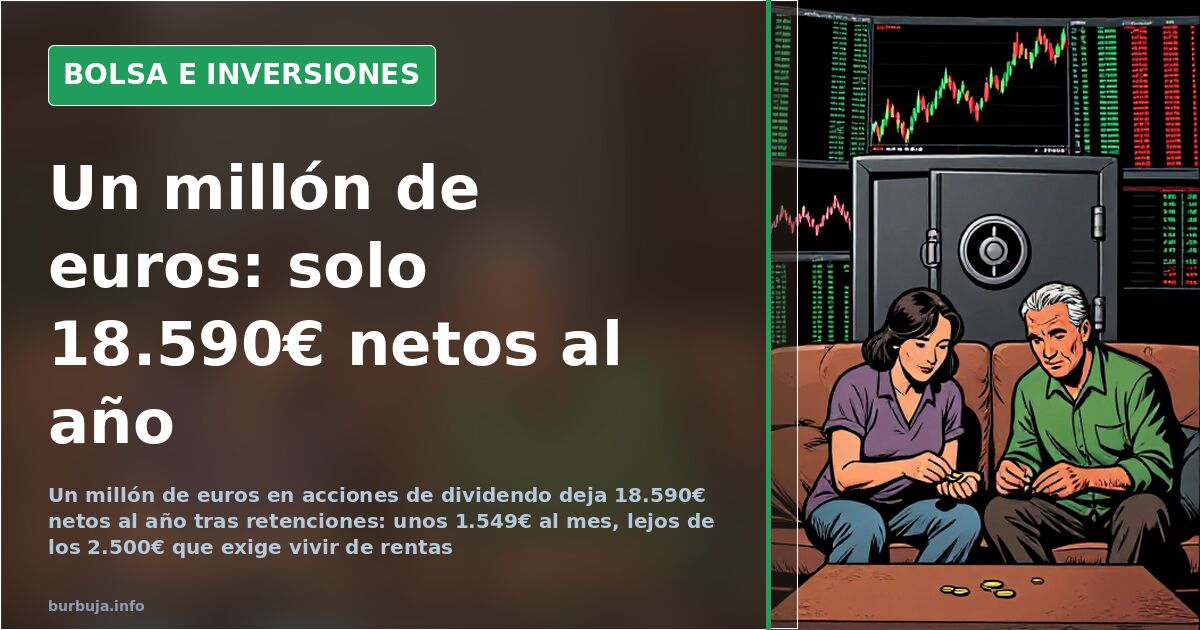
Living off €1M: What remains after taxes
With one million euros in liquid assets and a seemingly simple question: how to generate €2,500 a month without depleting capital. The short answer is that the most obvious portfolio—US dividend stocks—doesn't get there. The long answer involves several strategies, from global accumulation index funds to money market funds, including the possibility of moving tax residency to a country where dividends are lightly or not taxed at all. In between, an old debate resurfaces with numbers: receiving dividends versus selling shares.
How much of €27,000 in gross dividends remains?
A prudently diversified US stock portfolio yields around 2.7% annual dividends. On one million, that's €27,000 gross. That's where the deductions begin. A 15% withholding tax at source leaves €22,950, theoretically recoverable later via income tax returns (IRPF). Then comes the Spanish Tax Agency (Hacienda): the 19% rate takes another €4,360. Final net amount: €18,590 per year, about €1,549 monthly. Less than two-thirds of the €2,500 initially requested.
The problem isn't just the amount. There are products, like REIT ETFs, where foreign withholding tax cannot be recovered at all, eating into returns without appearing in any brochure. Dividends, in short, arrive already reduced twice before hitting the account.
Dividends or selling shares: two paths and a mix
Receiving dividends has a psychological rather than financial advantage: the number of shares never decreases, which allows for better sleep. The price is double taxation and reinvesting the surplus, which passes through the taxman again. Accumulation funds avoid this toll because they reinvest without involving Hacienda, but they require selling shares every month, causing the share count to drop year after year, even though each share is worth more.
The emerging proposal is intermediate: calculate actual monthly expenses, place that amount in income-distributing products, and leave the rest in an accumulation index fund that grows without being taxed along the way. The open question is how to adjust that percentage over time, as necessary income changes and the portfolio evolves.
Money market funds at 4%: the smooth path
Against the stock market appears another current that renounces growth in exchange for peace of mind. Distributing the million among several money market funds—cited are AXA Trésor, Groupama Trésorerie, and La Française Trésorerie—allows staying above 4% with daily liquidity. With these figures, the circulating calculation is striking: about €100 net per day, Saturdays and Sundays included. When rates fall, the replacement would be a fixed-income fund, with 6% on the table.
The objection is the usual one: fixed income flattens the portfolio and loses to inflation in the long run. If volatility is tolerated, others argue, it suffices.
Is changing tax residency worth it?
Changing countries to pay less on dividends sounds good until you look at the requirements. Andorra, the recurring example, required besides a deposit in a local bank a real estate investment of €400,000. This ties up capital and liquidity, exactly what one seeks to avoid. One must also consider that passive residency requires stays and local spending that eat up much of the tax savings.
Hence the underlying stance: better to operate from Spain without giving up quick mobility. No bricks, no captive money in deposits or bonds that prevent an orderly exit.
Is one million euros too little?
Here the debate breaks down. Some demand two, three, or four million to talk about retirement. Opposing them, a simple calculation: 45 years contributing €2,000 a month sums to €1,080,000, and that without unemployment or gaps. With contained spending, they reason, one million is enough.
The range depends on where one lives and how much one spends, not on wealth in the abstract. Those who need €50,000 annually don't have enough; those living on €20,000 are comfortable.
Flats, gold, and defensive dividends: alternatives outside the market
Traditional renting falls out of the equation due to illiquidity and the burden of managing tenants. Stock picking remains a hobby. In its place appear physical gold and silver, with an average annual rise of 8% according to their defenders, and the old school of Coca-Cola and Pepsi: oligopoly, growing dividends, and few desires to disappear.
None of these paths solve the monthly income problem alone. And experience with garages, that refuge sold as a panacea, goes elsewhere: spaces bought in a convenient corner that have been without tenants for some time.
The number that best summarizes the discussion isn't the million: it's the €100 daily promised by the monetary portfolio. More than half of Spain spends. The doubt is how long it lasts.
With one million euros in liquid assets and a seemingly simple question: how to generate €2,500 a month without depleting capital. The short answer is that the most obvious portfolio—US dividend stocks—doesn't get there. The long answer involves several strategies, from global accumulation index funds to money market funds, including the possibility of moving tax residency to a country where dividends are lightly or not taxed at all. In between, an old debate resurfaces with numbers: receiving dividends versus selling shares.
How much of €27,000 in gross dividends remains?
A prudently diversified US stock portfolio yields around 2.7% annual dividends. On one million, that's €27,000 gross. That's where the deductions begin. A 15% withholding tax at source leaves €22,950, theoretically recoverable later via income tax returns (IRPF). Then comes the Spanish Tax Agency (Hacienda): the 19% rate takes another €4,360. Final net amount: €18,590 per year, about €1,549 monthly. Less than two-thirds of the €2,500 initially requested.
The problem isn't just the amount. There are products, like REIT ETFs, where foreign withholding tax cannot be recovered at all, eating into returns without appearing in any brochure. Dividends, in short, arrive already reduced twice before hitting the account.
Dividends or selling shares: two paths and a mix
Receiving dividends has a psychological rather than financial advantage: the number of shares never decreases, which allows for better sleep. The price is double taxation and reinvesting the surplus, which passes through the taxman again. Accumulation funds avoid this toll because they reinvest without involving Hacienda, but they require selling shares every month, causing the share count to drop year after year, even though each share is worth more.
The emerging proposal is intermediate: calculate actual monthly expenses, place that amount in income-distributing products, and leave the rest in an accumulation index fund that grows without being taxed along the way. The open question is how to adjust that percentage over time, as necessary income changes and the portfolio evolves.
Money market funds at 4%: the smooth path
Against the stock market appears another current that renounces growth in exchange for peace of mind. Distributing the million among several money market funds—cited are AXA Trésor, Groupama Trésorerie, and La Française Trésorerie—allows staying above 4% with daily liquidity. With these figures, the circulating calculation is striking: about €100 net per day, Saturdays and Sundays included. When rates fall, the replacement would be a fixed-income fund, with 6% on the table.
The objection is the usual one: fixed income flattens the portfolio and loses to inflation in the long run. If volatility is tolerated, others argue, it suffices.
Is changing tax residency worth it?
Changing countries to pay less on dividends sounds good until you look at the requirements. Andorra, the recurring example, required besides a deposit in a local bank a real estate investment of €400,000. This ties up capital and liquidity, exactly what one seeks to avoid. One must also consider that passive residency requires stays and local spending that eat up much of the tax savings.
Hence the underlying stance: better to operate from Spain without giving up quick mobility. No bricks, no captive money in deposits or bonds that prevent an orderly exit.
Is one million euros too little?
Here the debate breaks down. Some demand two, three, or four million to talk about retirement. Opposing them, a simple calculation: 45 years contributing €2,000 a month sums to €1,080,000, and that without unemployment or gaps. With contained spending, they reason, one million is enough.
The range depends on where one lives and how much one spends, not on wealth in the abstract. Those who need €50,000 annually don't have enough; those living on €20,000 are comfortable.
Flats, gold, and defensive dividends: alternatives outside the market
Traditional renting falls out of the equation due to illiquidity and the burden of managing tenants. Stock picking remains a hobby. In its place appear physical gold and silver, with an average annual rise of 8% according to their defenders, and the old school of Coca-Cola and Pepsi: oligopoly, growing dividends, and few desires to disappear.
None of these paths solve the monthly income problem alone. And experience with garages, that refuge sold as a panacea, goes elsewhere: spaces bought in a convenient corner that have been without tenants for some time.
The number that best summarizes the discussion isn't the million: it's the €100 daily promised by the monetary portfolio. More than half of Spain spends. The doubt is how long it lasts.
Summary of a discussion on Burbuja.info - Foro de economía, actualidad y política., translated from Spanish and reviewed before publication. Read the full discussion (152 replies).
More summaries
-
DCA in MSCI World: €20,000 invested at highs yields €9,000 profit
A forum tracking shows €20,000 invested at MSCI World highs since 2022 and €9,028 in gains. Quarterly DCA achieves 14.43% annualized…
-
Spain tax confusion over €20 mystery shopper pay
A mystery shopper earning just over €20 wonders whether to declare it or register as self-employed. The company calls it an external collaboration.
-
Fake gold pawned in Madrid: three arrested
Three people arrested for defrauding Madrid pawnshops with fake gold coins and bars. Police seized 310 stamps and a firearm.
-
Anonymous Portfolio Claims 139% Return After Promising 150%
An anonymous portfolio promised a 150% annual return in October 2014 and reported 139% by February. Selected stocks included Sonae, FCC, and Deutsche Telekom.
-
J.C. Penney: Debt burden, weak demand, and trade collapse
J.C. Penney sales fell 5.1% with a $1.94 loss per share in Q3; Kyle Bass's fund exit ended the rebound.
-
Audax Renovables: 1.96% margins and €660M debt
Audax Renovables reports €2.76B in revenue but only €48M pre-tax profit, with a 1.96% margin and €660M in debt. These figures challenge its narrative.