
Living in Noja costs 388 euros monthly; Madrid, 234
Fixed monthly expenses total 234 euros in Madrid and 388 in Noja. A breakdown shows rural living isn't always cheaper than city life.
English · Original discussion in Spanish · Published
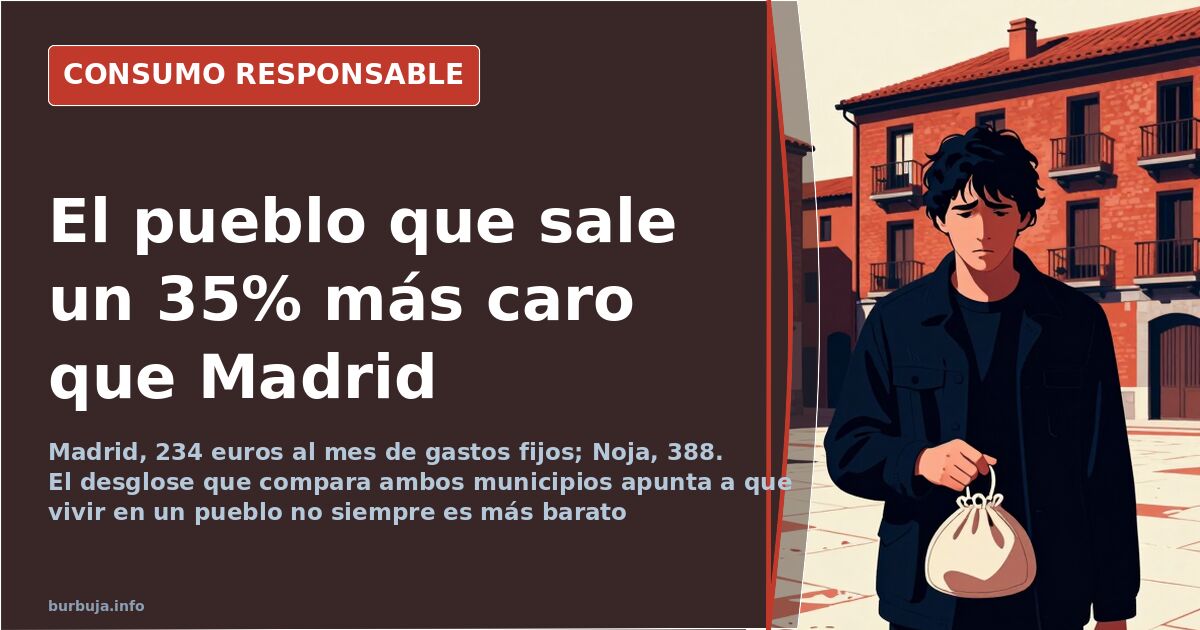
Living in a village costs up to 35% more than in Madrid
Is it cheaper to live in a village than in a big city? Intuition says yes. A breakdown of minimum fixed expenses says otherwise: 234 euros monthly in Madrid versus 388 in Noja, on the Cantabria coast, covering the same categories—IBI, waste, water, community fees, electricity, gas, heating, and transport. That is almost a 35% difference. And the energy bill does not explain the gap: some recall that electricity and gas cost the same anywhere in the country. What skyrockets is everything surrounding the house.
The calculation: 234 euros in Madrid versus 388 in Noja
The tally purposely excludes food, clothing, and leisure: it only sums what is essential to maintain the house and move around, taxes included. By that criterion, the capital wins. The underlying argument is about scale: where there are millions of customers, the same product sells more and cheaper, because commerce adjusts prices and compensates with volume.
The comparison with Noja is what heats up the conversation. Noja is a seasonal municipality, with second homes, vacationers, and peak-season prices. That is the trap, argues part of the analysis: measuring Madrid against a summer destination does not measure rural living costs, it measures the cost of a vacation. The same exercise done with inland Cantabria or a municipality without a beach yields a different result.
Why does the village cost more than the city?
Because the car stops being a luxury and becomes mandatory. Someone living in a big city who does not use it saves on fuel, insurance, vehicle inspection, circulation taxes, and, above all, time. Someone living in a small village depends on a vehicle for even the most basic tasks, and public transport, when it exists, is scarce. There goes the savings on municipal rates.
Then there is the grocery cart. A testimonial from a village in Málaga is blunt: filling the cart costs double what it does in the capital, and a kilo of tomatoes costs more in the village that produces them 500 meters away than in the city. Less competition, less turnover, and a captive clientele that cannot compare prices. The average conversation goes in that direction.
And the paradox of social life appears. In the village, there is nowhere to spend; in the city, spending is not mandatory either. The difference is that in the city, choosing does not cost money.
Villages with 3,000 residents: there is DIA and a flea market on Thursdays
The portrait of a village with nothing is false more often than it seems. A municipality of about 3,000 inhabitants may have about twenty food stores, a discount chain, and a weekly flea market with cheaper fruit and clothing. In such localities, IBI, water, and waste fees are lower than in the capital, and the savings are real.
Another matter is the village of 50 inhabitants. There, there is nothing to compare, and isolation carries a price: traveling for a shopping alucinación, a pharmacy, or an emergency costs money and time. The methodological error, they repeat, is choosing the worst possible village to prove a thesis. An honest comparison would use mid-sized localities—La Roda, Almazán, La Bañeza, Lorca—and not a coastal tourist hub.
Housing, the expense nobody puts in the equation
All the previous calculation starts with a paid-off house. And that is the most repeated criticism, because bricks are the largest expense in any household economy. Here, the city does not win: with the square meter at 3,000 euros in Madrid and 2,000 in a provincial capital, selling a 100-square-meter apartment in the capital and buying the equivalent elsewhere leaves a capital cushion. In mid-sized cities, that same apartment with a garage and storage unit appears between 80,000 and 100,000 euros.
The phenomenon has a name in personal finance: geo-arbitrage, saving or earning in an expensive place and living in a cheap one. In rentals, villages in Aragon move between 250 and 300 euros, a figure that ties with provincial capitals, and on the Andalusian coast, there are municipalities with rents of 200 to 250 euros and mild climates. With a paid-off house, arbitrage loses steam: it does not free up monthly income, only equity.
The defense of the village: butcher meat and a beach ten minutes away
Against the narrative of car dependency appears the other: in small villages, meat comes from local farmers, vegetables are from the garden, and quality is not paid for. A menu at a bar in southern Toledo may cost 4.50 euros, and for 10 euros per person, one dines well. In Madrid, that figure provokes laughter; in the village, it is proof that the cost of living is not measured only by bills.
Time is the invisible argument. In a big city, going to the hospital or resolving a paperwork can cost two hours of transport; in a village with minimal services, there is a beach ten minutes walking away. And then there is the air, the point where the discussion becomes almost theological: some install purifiers at home to breathe clean air amidst the capital's traffic.
The conclusion nobody signs is the most honest: the village is cheaper until you need something, and the city is cheaper until you need space. With a paid-off house, a pension, and a doctor nearby, the balance is decided less by the water bill than by habit. And if someone finds cheaper tomatoes, let them know: they probably brought them from the city.
Is it cheaper to live in a village than in a big city? Intuition says yes. A breakdown of minimum fixed expenses says otherwise: 234 euros monthly in Madrid versus 388 in Noja, on the Cantabria coast, covering the same categories—IBI, waste, water, community fees, electricity, gas, heating, and transport. That is almost a 35% difference. And the energy bill does not explain the gap: some recall that electricity and gas cost the same anywhere in the country. What skyrockets is everything surrounding the house.
The calculation: 234 euros in Madrid versus 388 in Noja
The tally purposely excludes food, clothing, and leisure: it only sums what is essential to maintain the house and move around, taxes included. By that criterion, the capital wins. The underlying argument is about scale: where there are millions of customers, the same product sells more and cheaper, because commerce adjusts prices and compensates with volume.
The comparison with Noja is what heats up the conversation. Noja is a seasonal municipality, with second homes, vacationers, and peak-season prices. That is the trap, argues part of the analysis: measuring Madrid against a summer destination does not measure rural living costs, it measures the cost of a vacation. The same exercise done with inland Cantabria or a municipality without a beach yields a different result.
Why does the village cost more than the city?
Because the car stops being a luxury and becomes mandatory. Someone living in a big city who does not use it saves on fuel, insurance, vehicle inspection, circulation taxes, and, above all, time. Someone living in a small village depends on a vehicle for even the most basic tasks, and public transport, when it exists, is scarce. There goes the savings on municipal rates.
Then there is the grocery cart. A testimonial from a village in Málaga is blunt: filling the cart costs double what it does in the capital, and a kilo of tomatoes costs more in the village that produces them 500 meters away than in the city. Less competition, less turnover, and a captive clientele that cannot compare prices. The average conversation goes in that direction.
And the paradox of social life appears. In the village, there is nowhere to spend; in the city, spending is not mandatory either. The difference is that in the city, choosing does not cost money.
Villages with 3,000 residents: there is DIA and a flea market on Thursdays
The portrait of a village with nothing is false more often than it seems. A municipality of about 3,000 inhabitants may have about twenty food stores, a discount chain, and a weekly flea market with cheaper fruit and clothing. In such localities, IBI, water, and waste fees are lower than in the capital, and the savings are real.
Another matter is the village of 50 inhabitants. There, there is nothing to compare, and isolation carries a price: traveling for a shopping alucinación, a pharmacy, or an emergency costs money and time. The methodological error, they repeat, is choosing the worst possible village to prove a thesis. An honest comparison would use mid-sized localities—La Roda, Almazán, La Bañeza, Lorca—and not a coastal tourist hub.
Housing, the expense nobody puts in the equation
All the previous calculation starts with a paid-off house. And that is the most repeated criticism, because bricks are the largest expense in any household economy. Here, the city does not win: with the square meter at 3,000 euros in Madrid and 2,000 in a provincial capital, selling a 100-square-meter apartment in the capital and buying the equivalent elsewhere leaves a capital cushion. In mid-sized cities, that same apartment with a garage and storage unit appears between 80,000 and 100,000 euros.
The phenomenon has a name in personal finance: geo-arbitrage, saving or earning in an expensive place and living in a cheap one. In rentals, villages in Aragon move between 250 and 300 euros, a figure that ties with provincial capitals, and on the Andalusian coast, there are municipalities with rents of 200 to 250 euros and mild climates. With a paid-off house, arbitrage loses steam: it does not free up monthly income, only equity.
The defense of the village: butcher meat and a beach ten minutes away
Against the narrative of car dependency appears the other: in small villages, meat comes from local farmers, vegetables are from the garden, and quality is not paid for. A menu at a bar in southern Toledo may cost 4.50 euros, and for 10 euros per person, one dines well. In Madrid, that figure provokes laughter; in the village, it is proof that the cost of living is not measured only by bills.
Time is the invisible argument. In a big city, going to the hospital or resolving a paperwork can cost two hours of transport; in a village with minimal services, there is a beach ten minutes walking away. And then there is the air, the point where the discussion becomes almost theological: some install purifiers at home to breathe clean air amidst the capital's traffic.
The conclusion nobody signs is the most honest: the village is cheaper until you need something, and the city is cheaper until you need space. With a paid-off house, a pension, and a doctor nearby, the balance is decided less by the water bill than by habit. And if someone finds cheaper tomatoes, let them know: they probably brought them from the city.
Summary of a discussion on Burbuja.info - Foro de economía, actualidad y política., translated from Spanish and reviewed before publication. Read the full discussion (315 replies).
More summaries
-
Fleeing Madrid: Where to Live Better on a Civil Servant's Salary
Madrid offers jobs but charges high prices; outside, there's a 40% difference in housing costs and flats from €100,000. The math of leaving Madrid, in detail.
-
Cheap Living in Spain: City and Town Cost Analysis
Analysis of affordable Spanish cities: comparing housing prices, quality of life, and job opportunities across various municipalities.
-
Heating oil: fill the tank now or wait?
Heating oil prices jump 7 cents in days: filling a 1,500-litre tank now costs over €100 extra. When it pays to wait.
-
Thermomix Review: Culinary Innovation or Marketing Scheme?
Is the Thermomix a pyramid scheme or a premium kitchen tool? This analysis breaks down its costs and functionality.
-
Childless Couple Captures 7,500 Photos in 13 Days
A childless couple took 7,500 photos during a 13-day India trip. Experts warn this creates an unmanageable digital archive.
-
Spain’s Winter Menu: Cocido, Stews, and Potatoes
Cocido, legumes, potatoes, and soups dominate Spain’s winter comfort food. Cantabrian stews lead the debate among hot dishes.