
Living in a 24/7 Gym: The 25-Euro Housing Solution in Barcelona
Sleeping in a 24/7 gym with shower and locker costs about 300 euros monthly, four times less than a standard room with separate bills.
English · Original discussion in Spanish · Published
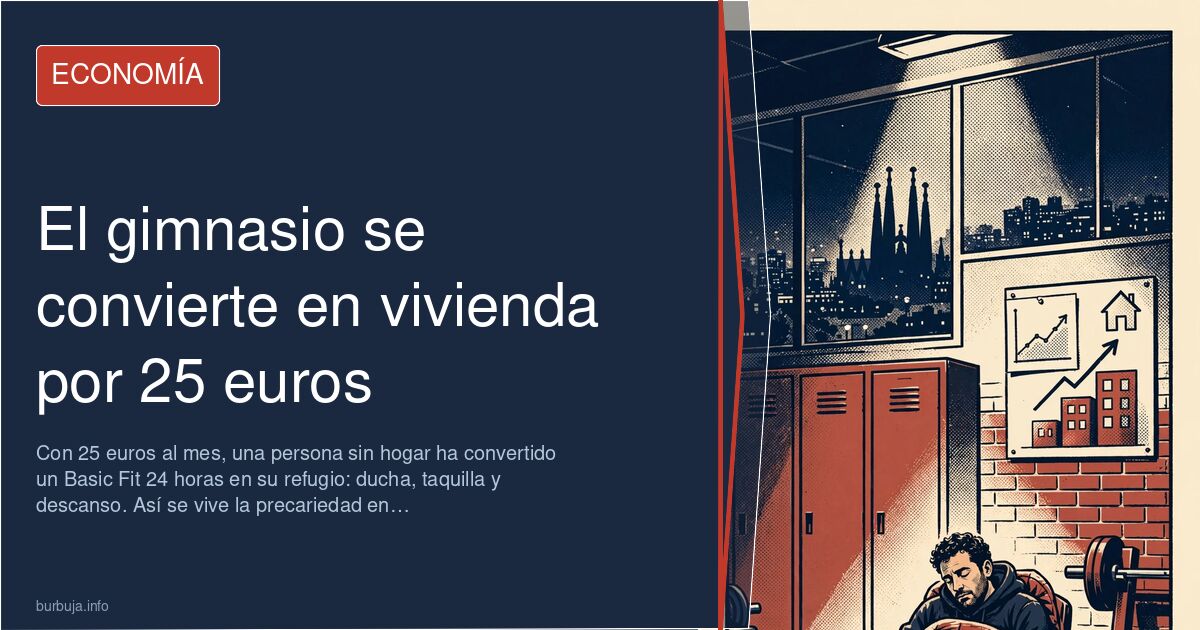
Sleeping for 25 euros a month: the 24/7 gym as last resort housing
It is three in the morning, and the lights of the 24/7 gym remain on. Passersby at that hour claim to have seen someone sleeping on a massage chair, with a shower towel drying on a machine. There is no receptionist. No security guard. There is a turnstile, a member card, and a fee of just over twenty euros a month: lockers for bags, a hot shower, and drinking water available at will. In practice, it is Barcelona’s cheapest roof.
The issue is discussed with more sarcasm than statistics, but the core is textbook: when housing prices detach from wages, demand does not disappear; it relocates to market interstices. The setting is Vallcarca, a neighborhood in the upper part of the city where chalets, squatted premises, and low-cost gyms coexist. The prevailing diagnosis is not friendly, nor is it new.
How much does it cost to sleep among rowing machines?
The arithmetic is stubborn. A fee of just over twenty euros, a locker serving as a wardrobe, daily shower, and potable water. Add the nearby Mercadona for food and a self-service laundry for clothes: the full package, now called extreme lonchafina, closes at around 300 euros a month. For someone sleeping on the street, any mattress is a palace, and there is little room for debate.
The contrast presented is no less significant: the alternative housing cited costs four times more, with separate bills and no gym. With these figures, the question shifts from why someone lives in a gym to why more people do not.
Lights on at 3:00 AM, no one at reception
The 24/7 model is the piece enabling the rest. Without night staff, control is delegated to cameras, turnstiles, and access cards: theory suggests the system detects those who do not leave overnight and blocks entry without needing a security guard. Practice, according to those who frequent these chains at odd hours, is different: at midnight, no one is present, and as long as the fee is paid, monitoring who enters and exits matters little. In franchises, even less.
Some object that lockers are not storage rooms and that cameras eventually catch on. Others reply that this would require continuous surveillance no operating budget can sustain. Between these extremes lies the uncomfortable question: why is a premises with showers, lockers, and permanent lights open all night authorized, only to feign surprise when someone uses it as intended.
3-square-meter capsules and cybercafes: the business already calculated
Where some see misery, others see margin. Plans with numbers are already circulating: a large premises, four private rooms of three square meters at 30 euros for ten hours plus shower rental, yielding 120 euros daily. Or the hybrid gym-housing: ten-square-meter rooms with lockers at 100 euros a month, a figure argued to be lower than any conventional room today.
The brake is regulatory, not aesthetic. A gym lacks a habitability certificate, and converting a sports facility into residential use strains municipal licenses precisely in the business municipalities exploit. The imported reference is Japan, where capsule accommodation has been sold as a technological product for decades. Skeptics note the difference: the Japanese capsule is high tech, while the local bunk is a locker with a curtain.
What appears when housing leaves the market
The gym is the visible tip of an informal residence system not reflected in any official statistics. In accounts from those who have spent time on the street, minibuses transport groups to the center in the morning and pick them up at night, warehouses with pallets that are logistics by day and kitchens by night, and people sleeping in electrical transformation centers. None of this is new; what is new is that it is now spoken aloud, with tariffs displayed.
Ultimately, the disconcerting calculation is not about dignity, but the supermarket checkout belt: 300 euros a month covers roof, shower, food, and laundry within a three-block radius. In Japan, they called it capsules and sold it as innovation. Here, it is called a locker, and the pending question is how long it will take someone to add a door and charge it as rent.
It is three in the morning, and the lights of the 24/7 gym remain on. Passersby at that hour claim to have seen someone sleeping on a massage chair, with a shower towel drying on a machine. There is no receptionist. No security guard. There is a turnstile, a member card, and a fee of just over twenty euros a month: lockers for bags, a hot shower, and drinking water available at will. In practice, it is Barcelona’s cheapest roof.
The issue is discussed with more sarcasm than statistics, but the core is textbook: when housing prices detach from wages, demand does not disappear; it relocates to market interstices. The setting is Vallcarca, a neighborhood in the upper part of the city where chalets, squatted premises, and low-cost gyms coexist. The prevailing diagnosis is not friendly, nor is it new.
How much does it cost to sleep among rowing machines?
The arithmetic is stubborn. A fee of just over twenty euros, a locker serving as a wardrobe, daily shower, and potable water. Add the nearby Mercadona for food and a self-service laundry for clothes: the full package, now called extreme lonchafina, closes at around 300 euros a month. For someone sleeping on the street, any mattress is a palace, and there is little room for debate.
The contrast presented is no less significant: the alternative housing cited costs four times more, with separate bills and no gym. With these figures, the question shifts from why someone lives in a gym to why more people do not.
Lights on at 3:00 AM, no one at reception
The 24/7 model is the piece enabling the rest. Without night staff, control is delegated to cameras, turnstiles, and access cards: theory suggests the system detects those who do not leave overnight and blocks entry without needing a security guard. Practice, according to those who frequent these chains at odd hours, is different: at midnight, no one is present, and as long as the fee is paid, monitoring who enters and exits matters little. In franchises, even less.
Some object that lockers are not storage rooms and that cameras eventually catch on. Others reply that this would require continuous surveillance no operating budget can sustain. Between these extremes lies the uncomfortable question: why is a premises with showers, lockers, and permanent lights open all night authorized, only to feign surprise when someone uses it as intended.
3-square-meter capsules and cybercafes: the business already calculated
Where some see misery, others see margin. Plans with numbers are already circulating: a large premises, four private rooms of three square meters at 30 euros for ten hours plus shower rental, yielding 120 euros daily. Or the hybrid gym-housing: ten-square-meter rooms with lockers at 100 euros a month, a figure argued to be lower than any conventional room today.
The brake is regulatory, not aesthetic. A gym lacks a habitability certificate, and converting a sports facility into residential use strains municipal licenses precisely in the business municipalities exploit. The imported reference is Japan, where capsule accommodation has been sold as a technological product for decades. Skeptics note the difference: the Japanese capsule is high tech, while the local bunk is a locker with a curtain.
What appears when housing leaves the market
The gym is the visible tip of an informal residence system not reflected in any official statistics. In accounts from those who have spent time on the street, minibuses transport groups to the center in the morning and pick them up at night, warehouses with pallets that are logistics by day and kitchens by night, and people sleeping in electrical transformation centers. None of this is new; what is new is that it is now spoken aloud, with tariffs displayed.
Ultimately, the disconcerting calculation is not about dignity, but the supermarket checkout belt: 300 euros a month covers roof, shower, food, and laundry within a three-block radius. In Japan, they called it capsules and sold it as innovation. Here, it is called a locker, and the pending question is how long it will take someone to add a door and charge it as rent.
Also available in: Deutsch
Summary of a discussion on Burbuja.info - Foro de economía, actualidad y política., translated from Spanish and reviewed before publication. Read the full discussion (153 replies).
More summaries
-
Enigmatic Streamer 'serres' Dies, Avoiding Fame Until the End
Cult streamer 'serres' is found dead in his room. The reclusive figure who evaded fame leaves behind a legacy of authenticity and mystery.
-
Mossos arrest Isaac Andic's son for Mango founder's murder
Jonathan Andic arrested by Mossos d'Esquadra for killing his father, Mango founder. Forum debates digital evidence reliability and family dynamics in wealthy estates.
-
Spain's Left Gains Edge Through State-Linked Voter Base
Over 9.5 million pensioners and 3.647 million public employees form a voting bloc focused on paychecks rather than fiscal deficits.
-
Madrid cinema defies decline with dozens of weekly screenings for 'La Bola Negra'
Over 3,000 tickets sold in pre-sale for 'La Bola Negra' in Madrid. The film challenges predictions of cinema's decline.
-
Spain's Economy: Forum Warns of Imminent Collapse
Analysis of Burbuja.info threads on Spain's economic stability amid debt and inflation pressures.
-
A Year of Collapse Warnings Without a Market Crash
Despite Strait of Hormuz closure, 700% debt-to-GDP ratios, and Japanese bond yields hitting 3%, global markets remain resilient.