
Lithuania's jump from 1,300 to 44,000 migrants stirs the Baltics
A post claims the number of Muslim-origin residents in Lithuania rose from 1,300 to 44,000, reopening the debate on demographics, the EU and migration flows in Eastern Europe.
English · Original discussion in Spanish · Published
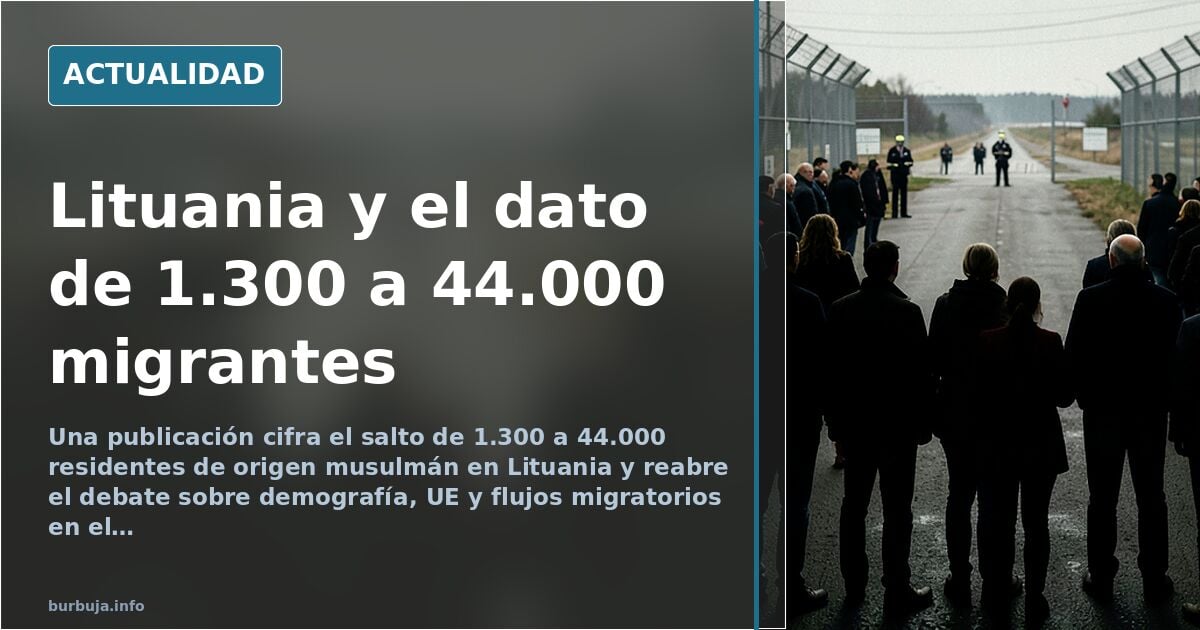
Lithuania goes from 1,300 to 44,000 migrants and the figure causes a stir
How does a country go from registering around 1,300 Muslim-origin migrants to counting 44,000? That is the jump reported in a post circulating about Lithuania, and it has peine the discussion about what is happening on the eastern flank of the European Union. The figure, presented as an abrupt increase, comes with the warning that the Baltic country is not an isolated case. The number circulates without any breakdown: no period is specified, no methodology, nor how many of those residents arrived through regular channels.
What the figure actually says about Lithuania
The post that has sparked the conversation speaks of growth from approximately 1,300 to 44,000 people of Muslim origin in Lithuania, and calls it shocking. That material contains neither a time frame nor a cited statistical source. It is the kind of figure that performs well on social media and poorly in serious analysis: without a historical series, the multiplier impresses, but it does not reveal whether the jump spans a decade or three.
Lithuania has a small population and a very limited migration tradition, which amplifies any absolute variation. Going from four digits to tens of thousands in a country of that size visibly changes the demographic landscape. Hence the uproar.
The context slipping into the conversation: NATO and European funds
The thread does not stop at Lithuania. Romania and EU accession appear as a backdrop. The argument goes that countries which sought to join the EU to protect themselves from Russia now face a migratory pressure they had not anticipated. It is a reading that mixes geopolitics and demographics, and it ultimately raises an uncomfortable question: if membership in the European club brings funds, does it also bring reception obligations?
Some claim the phenomenon responds to resettlement policies designed from the top down; others reply that most Jovenlandeses in former Soviet republics are not involved in religious conflicts and that the EU's legal framework imposes no such quotas. The discussion moves between both trenches, with neither side providing the missing breakdown.
Demographics as an argument: birth rates and population replacement
The other axis of the debate is birth rates. An average of 3 or 4 children per woman in the countries of origin is compared with the 1.1 or 1.2 of European women, dropping to 0.6 in Spain's case according to the interpretation circulating. With those differentials, the projection over several generations is arithmetic: the composition changes even if flows stabilize.
The conclusion drawn is that demographic replacement is irreversible. It is a strong claim, built on estimates with no verifiable source in the material. What is verifiable is the underlying trend: Europe is aging and needs workers, and that economic pull explains much of the flows better than any secret plan.
Pakistan, Romania and the networks of intermediaries
The conversation drifts toward Romania and the Pakistani community, with mentions of patronage networks and opaque business dealings. These are suspicions thrown into the air, with no names or case files. It is worth separating the migration phenomenon from the informal economy that sometimes surrounds it: the latter is tackled with inspections and the law, not with headlines.
The thread closes with a warning: by the time replacement is assumed to be irreversible, it will be too late to debate it. Fine irony for a country, Lithuania, that three decades ago did not even figure on Europe's migration maps.
Also available in: Deutsch
Summary of a discussion on Burbuja.info - Foro de economía, actualidad y política., translated from Spanish and reviewed before publication. Read the full discussion (17 replies).
More summaries
-
Meme turns anonymous pedestrian into the EU's unofficial new logo
An anonymous woman has become a meme as the EU's new logo, and the joke has spiralled into a debate over voting, immigration and misinformation spreading faster than corrections.
-
France has not run a surplus since 1974, forum participant claims
A participant argues that France has not had a budget surplus since 1974; the debate mixes diesel prices, the 25% of Ukraine and NATO withdrawal demands.
-
Le Pen rules out EU exit referendum, reigniting the euro debate
Marine Le Pen has ruled out a referendum on leaving the EU, leaving Frexit without a date. The Brexit precedent and pressure on French debt explain the shift.
-
Spanish singer Paracetamol arrested on hate crime charges in Zaragoza
The arrest of singer Paracetamol in Zaragoza, Spain, over alleged hate speech in his songs reopens the debate on freedom of expression and censorship.
-
Spain isn't burning: the discontent that can't find its fire
A debate on why Spain hasn't lit the fuse other European countries already have, caught between the revolutionary reproach and the narrative of chaos.
-
UK tax office writes to high earners amid tax flight speculation
HMRC has written to high earners, according to the discussion, and the 10-year gilt stands at 5.3% versus France's 4.9%. Speculation is growing about a tax exodus.