
Lidl Egg Cooker: 250W, 14 Minutes vs. Stovetop
A €8.99 Lidl egg cooker uses 250W for 14 minutes. Critics argue a stovetop pot is faster and more efficient.
English · Original discussion in Spanish · Published
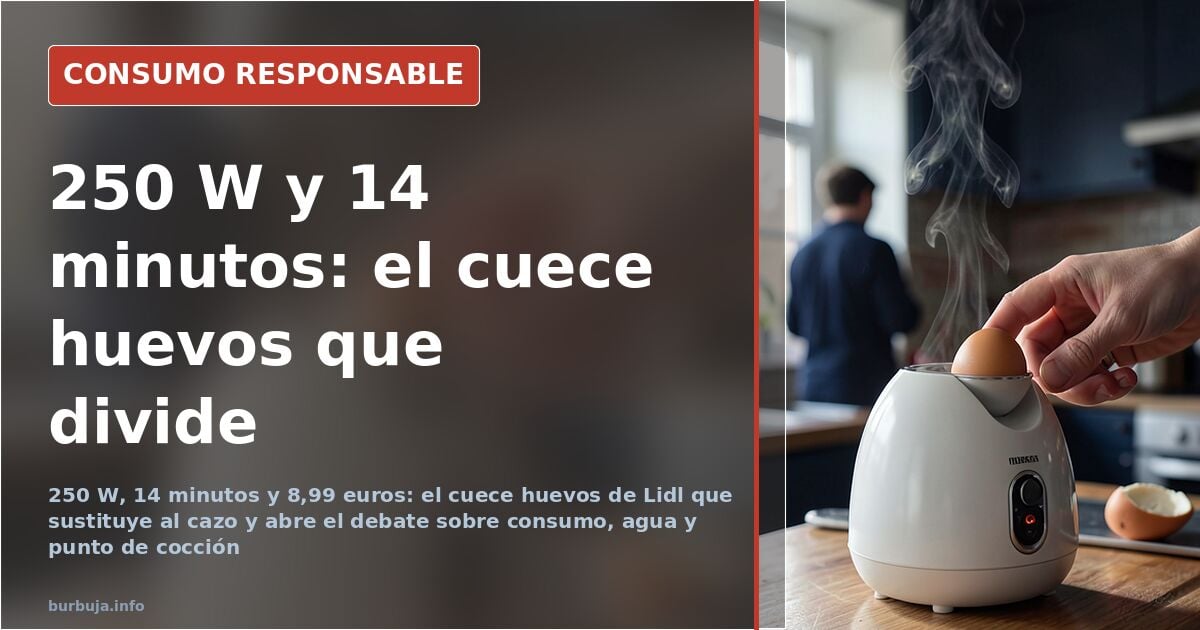
250 watts and 14 minutes: the boiled egg debate
An €8.99 appliance from Lidl has sparked a discussion that goes far beyond how to boil an egg. The device, a **250 W** heating element with a timer, cooks eggs in **14 minutes** using three-quarters of the measuring cup as water, according to user data. This figure has raised eyebrows: some claim a stovetop pot gets them ready in just **8 minutes boiling**. Defenders of the gadget argue that a pot takes longer to reach a boil and wastes more water. The full calculation, including energy consumption and real time, is where things get interesting.
How much does it cost to cook an egg with the Lidl device?
The key metric isn't power, but total energy. **250 W for 14 minutes** equates to just over 0.058 kWh per batch, a figure that translates to cents at current electricity prices. In contrast, a pot on a gas or induction hob requires heating water from tap temperature to boiling, consuming significant energy in the process. A direct comparison isn't as simple as it seems: the egg cooker doesn't bring water to a boil but steams the eggs using the heating element, according to user descriptions. This nuance changes everything.
Choosing the doneness level also raises questions. The device has no hardness buttons: **it is regulated by the amount of water** poured into the measuring cup. Less water means a runnier yolk; more water means a firmer egg. The system includes a pin at the bottom of the cup to **pierce the shell** before cooking, a step some users recall as the Achilles' heel of these gadgets: if the shell is thin, the egg breaks in your hand and the white leaks out through the hole.
The perfect boiled egg: 7 minutes from room temperature
In contrast to the appliance method, others defend traditional cooking with precise parameters: **7 minutes from room temperature and 9 from the fridge** for a large (size L) egg. Overcooking has visible consequences: **metallic oxides** appear on the surface of the yolk, creating that greenish layer that makes it crumbly. According to this school of thought, a well-cooked yolk should be orange and creamy. Personal taste also matters: some consider **5 minutes** sufficient.
The buyer profile is another point of contention. Some people literally don't own a pot, and the device has peine the door to eating eggs for them. For others, it's just another clutter item that will end up like the sandwich maker or blender: **dusty at the back of the cupboard**. Cleaning, space, and frequency of use are the arguments that tip the balance one way or the other. One user confesses that 90% of their dinners for the past two years have been soup, an egg, and hibiscus tea, part of a diet that took them from **90 kg to 75 kg**.
Is it worth buying an egg cooker?
The answer depends on how many eggs you boil per week. For daily use, the device makes sense: no need to watch the stove, no pots to clean, and consistent results. For occasional use, the pot wins hands down. Irony runs throughout the conversation: from those who ask if the gadget makes you feel superior to the masses, to those who remind us that the invention is nothing more than **a resistor with a thermistor** that shuts off when it runs out of water, according to one user's hypothesis. The technology, in this case, is so simple it's almost offensive.
The exact point where the analysis stalls is the usual one: nobody has precisely measured how much energy a pot consumes to reach a boil compared to the device's 14 minutes. Without that data, the comparison is faith-based. Meanwhile, the egg cooker continues to sell.
Also available in: Deutsch
Summary of a discussion on Burbuja.info - Foro de economía, actualidad y política., translated from Spanish and reviewed before publication. Read the full discussion (50 replies).
More summaries
-
The egg omelette: from cheese to tripe, the fridge decides the filling
From tuna to tripe, including Iberian ham warmed between layers of egg: an omelette filling can take almost anything you have in the fridge
-
Shaving your testicles: cream, razor or laser, the real debate
Cream, razor, trimmer or laser: the method for shaving testicles that causes the fewest cuts, according to those who have tried everything.
-
Chickens or rabbits: which to raise for self-sufficiency
According to calculations shared on the forum, two hens lay a dozen eggs a week for about 2 euros per month each. Rabbits, however, die far more easily.
-
Albo and frozen Louriño, the most recommended callos on the forum
Several forum members criticise Litoral and recommend Albo, La Nora and, above all, the frozen Louriño
-
CaixaBank charges up to €3 for branch cash deposits
CaixaBank charges nearly €3 for branch cash deposits, pushing users to ATMs that don't give change. Other banks like Sabadell may follow suit.
-
Gym: Rest is more important than anything
Sleep triggers growth hormone release. Overtraining without rest activates stress responses, causing muscle loss.