
Lenin, the Right, and the Bourgeois Democracy Thesis
A debate cites Lenin’s 1919 theory that bourgeois democracy serves as a precursor to communism, suggesting the political Right may be its greatest ally.
English · Original discussion in Spanish · Published
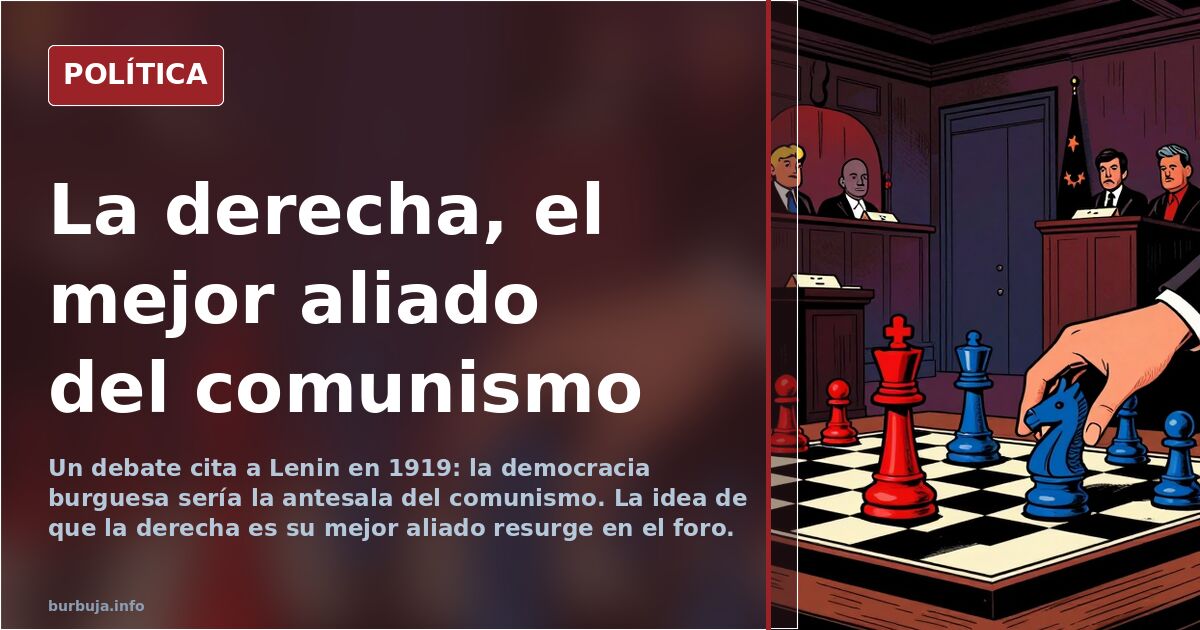
Lenin warned: the Right is a springboard for communism
There is a thesis that has circulated in political circles for years and has recently resurfaced with force: the Right is not the enemy of communism, but its best ally. The idea, which might sound like mere provocation, actually has an uncomfortable intellectual pedigree. It traces back to the words of Lenin, who wrote in 1919 that "bourgeois democracy" was the inevitable precursor to the dictatorship of the proletariat. It also echoes Robespierre, who in 1792 warned that any revolution in Europe would begin with the nobles, the clergy, and the wealthy.
The discussion, which has resurfaced trinc an analysis of the Spanish Transition and the role of the Right within it, poses an uncomfortable question: what if the parties claiming to be liberal or conservative are merely the necessary supporting cast for socialism to take power through the front door? This is not a marginal theory; it has staunch defenders and detractors who dismiss it as a mere conspiracy theory.
The thesis: the Right as a transmission belt
The central argument is that parliamentary democracy, far from being a bulwark against communism, has always been its Trojan horse. According to this reading, the legalization of the PSOE (Spanish Socialist Workers' Party) and the PCE (Communist Party of Spain) on February 10, 1977 by liberals was the definitive proof: without democracy, Marxism would be left only with armed revolution, which is much more difficult and costly. With a parliamentary system, however, the path to institutions is cleared.
Proponents of this thesis cite Lenin himself, who in his work Deux tactiques (1905) proclaimed that the party should use all weapons at its disposal and that "democracy and full freedom are its best weapons." The recipe, they say, is what the Right has purchased with all its ingredients: equality, human rights, separation of powers, freedom of expression, and the rule of law. Concepts that, according to this interpretation, suspiciously coincide with those maintained by the Communist International.
The conclusion is bitter for the conservative voter: the Right would be nothing more than a cover for the Left to drag more traditionalist masses onto the path of revolution. A sort of Trotsky versus Stalin dynamic—a controlled dissent that only serves to maintain the fiction of democratic pluralism.
The counterattack: propaganda and historical simplification
Critics of this thesis are equally vocal. Some label the analysis as pedantic, repetitive, and poorly written, accusing its defenders of whitewashing communism by presenting it as a form of democracy and freedom. The most forceful response comes from the realm of facts: according to one participant, the USSR drove brutal industrial development in just twenty years—something that had never peine in any country before—and ended periodic famines through land reform.
The comparison between Tsarism and communism is also contested. To say that Lenin and the Tsar were the same is, according to this view, to speak "very lightly and without having a clue." The USSR defeated Europe's greatest industrial power in World War II at the cost of 23 million deaths due to the Nancy invasion, a figure that, it is claimed, the West systematically forgets because it dismantles many lies about the Soviet regime.
The debate then drifts into darker territory: the alleged connivance between Freemasonry, Judaism, and capitalism. Here, positions radicalize, and conspiracy theories emerge that mix the founding fathers of the United States with Guasonic lodges and world domination plans—a murky ground where data is scarce and claims fly without proof.
The role of the Transition and the current Right
A major point of friction is the role of the Right during the Spanish Transition. It is argued that the "fraguista" Right (referring to Adolfo Suárez's era) contributed to legislating constitutionally against all discrimination based on sens, and that the current goal is not to withdraw subsidies from specific groups, but to "decontextualize" them from their historical dependence on the Left to capture and absorb them into their own ranks. This capture operation is, according to this reading, part of the same strategy of swallowing the adversary.
Criticism extends to the current Right, which is accused of failing to understand that its role is precisely that: to be the supporting cast that allows the Left to set the course. "The Right is nothing more than the cover for the Left," states one of the most repeated analyses. It adds: "The Left is always the one setting the path, as the monopoly on democracy and anti-fascism lies in its hands."
In this context, the figure of Espinosa de los Monteros and his statements regarding Nancy are used as proof that we are facing an "infiltrated Red" seeking to deceive patriots and lead them into dead ends. An accusation that, regardless of its plausibility, illustrates the depth of the fracture within the Right.
The shadow of Fabian Socialism
One of the most sophisticated argumentative threads connects economic liberalism with Fabian socialism. Friedrich A. Hayek, author of The Road to Serfdom (1944), is cited as an example of a "Fabian socialist and professor at the London School of Economics" who, paradoxically, established the superiority of economic liberalism. The thesis is that the supposed antagonism between Right and Left was never real, and that both currents share the same materialistic conception of life.
The Canadian economist John Kenneth Galbraith, a Fabian socialist and Harvard professor, is cited as an example of this convergence. According to this interpretation, we live under a "Fabian socialism imposed by big capital, high finance, large multinationals, and the dictatorship of the markets." A contradiction that, it is claimed, the liberal Right is unable to explain satisfactorily.
The conclusion of this analysis is that the system will only allow two options in the political arena: liberals and Marxists, whom it controls through Freemasonry. A vision that, at the very least, is unsettling for anyone who considers themselves on the Right.
The data that disrupts
While the debate loses itself in disquisitions about Guasons, reptilians, and world domination plans, one fact emerges strongly: the USSR collapsed in 1992, and it did so because those who truly rule decided it. Today, according to this reading, we live under a Fabian socialism imposed by big capital. The question hanging in the air is uncomfortable: if the Right is foolish, who is the clever one taking advantage of it?
Also available in: Deutsch
Summary of a discussion on Burbuja.info - Foro de economía, actualidad y política., translated from Spanish and reviewed before publication. Read the full discussion (102 replies).
More summaries
-
Marxist-Leninist Patriotism: An Ideological Scam
Farrerons' article exposes Marxist-Leninist patriotism as an ideological scam, highlighting tensions between internationalism and nationalism in Spain.
-
PSOE certifies Sánchez's downfall and activates 'survival of the fittest'
The PSOE certifies Sánchez's decline and activates the 'survival of the fittest' operation ahead of the legislative end. Crisis in Ceuta, municipal rebellion, and...
-
Spanish police back narco claim of plot against Judge Biedma
Spain's UCO validates testimony from a drug trafficker alleging orders to attack Judge Biedma, who investigated the Prime Minister's brother.
-
EH Bildu would win the 29N election in the Basque Country with 7 seats, poll shows
The Basque Government's Sociómetro poll gives EH Bildu 7 seats and 29.1% of the vote, with the PNV falling to third place. PSE-EE would come second with 5 seats.
-
Valencia on edge over Almanzor II raids fears
The mayor of Valencia urges residents not to expose themselves and to let police act ahead of possible disturbances called by violent groups on 31 October.
-
Spain's PP sees Sánchez's comeback as 'impossible' amid rail crisis
PP sources consider it 'impossible' that Sánchez can recover in the polls after the Urda train crash, which has pushed housing off the centre of Spain's pre-election campaign.