
LED light and excess blue: the debate over its health effects
White LED contains a blue component and colour temperature makes the difference. The debate over public and home lighting and its effect on health.
English · Original discussion in Spanish · Published
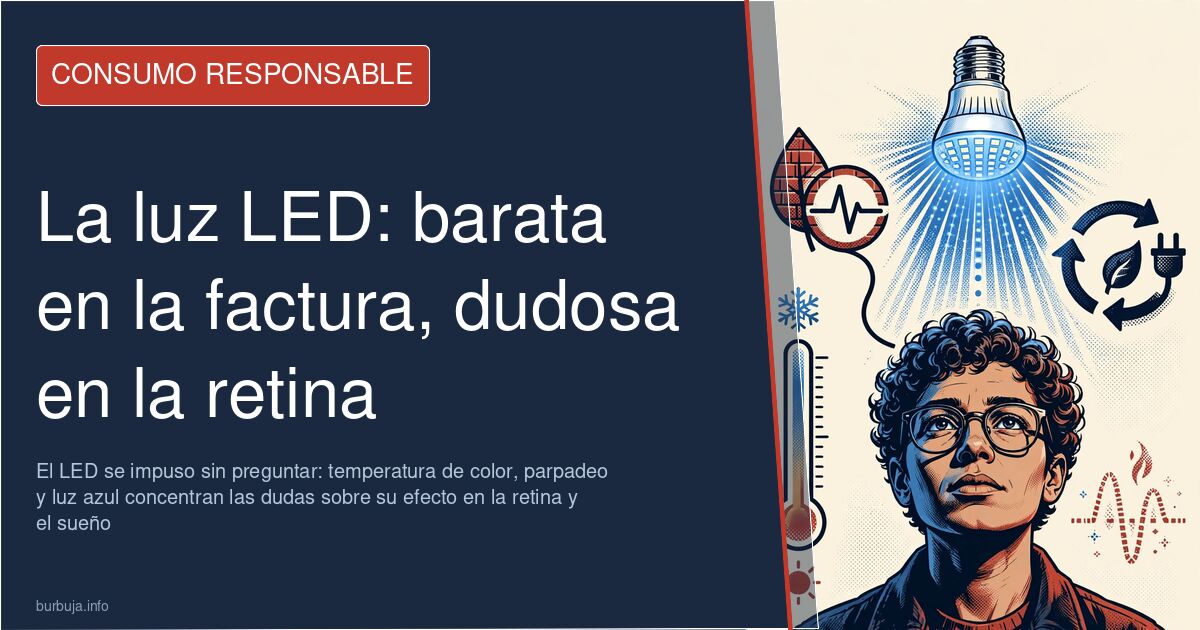
LED light and excess blue: the debate over its health effects
Is LED lighting an invention that is stealing our health, or a neutral technology that can be used well or badly? The discussion about lighting has stopped being a matter of decoration and has become a small battleground. One argument holds that streetlights no longer illuminate but flash, that blue light is "ultra-harmful", and that daily exposure, along with other frequencies, is wrecking our health. The more technical answer comes immediately: an LED can emit any spectrum, and the problem is not the technology but the colour temperature and the intensity at which it is installed.
What LED light is and why its colour temperature is debated
The technical starting point is simple: most white LEDs are actually blue LEDs covered by a phosphor layer that converts that light into white. That is why it is stressed that **every white LED contains a blue component**, whatever the final tone. Colour temperature is measured in kelvin: below 3,000 K it is called warm light, around 4,000 K neutral light, and above 5,000 K cool light. That scale is what allows you to choose between a restful and a working environment, and it explains why bulbs of different tones coexist in the same home depending on the room.
The most widespread criticism is not against the LED itself, but against its indiscriminate use in street lighting: very intense streetlights with cool colour temperatures that generate light pollution and glare. Some argue that a well-chosen home installation, with warm light in bedrooms and living room and neutral light in kitchen and bathroom, need not be harmful. The discussion therefore shifts from the bulb to the design of the installation.
Flicker, 5G and the claims that get mixed together
Alongside colour, another front appears: switching frequency. Some dimmable luminaires flicker to control intensity, and that flicker has been linked to effects on mood. This is an area where evidence should be separated from rumour. Into the same conversation slips the accusation that 5G is part of the same problem, even though it is a frequency of the radio spectrum far lower than that of visible light, and one that was already in use before. Mixing the two issues weakens the serious argument and fuels distrust of any criticism.
The most reasonable part of the scepticism points to public lighting and screens. About screens there is a recurring complaint: the LEDs in monitors and phones are looked at directly and for long periods, and those who spend many hours in front of them notice eye strain. The solution mentioned involves reducing brightness, using reading modes or turning to e-ink devices, which do not emit blue light in the same way. None of that turns the LED into a poison, but it does invite moderation.
Consumption and the home choice: where LED really wins
In economic terms, the LED has an advantage that is hard to dispute: it uses less electricity than an incandescent bulb for the same light. That is why it has spread so quickly, and also why many households have replaced all their bulbs at once. The problem arises when one bulb is swapped for another without regard to colour temperature or intensity, and you end up with a house that looks like an office or a hospital.
The home choice allows combining tones: warm light for rest areas, neutral light for kitchen and bathroom, and cool light for the garage or passageways. There are also dimmable bulbs that let you adjust intensity and even temperature, though they require a compatible circuit. That flexibility is what separates a well-designed installation from an imposition. The debate over lighting is not so much a war against the LED as a discussion about who decides how a street is lit and on what criteria.
In the end, the question left hanging is the same one asked by anyone who walks into a bar with white spotlights: if the light is so neutral and so good, why do we feel better when we flip the switch down?
Also available in: Deutsch
Summary of a discussion on Burbuja.info - Foro de economía, actualidad y política., translated from Spanish and reviewed before publication. Read the full discussion (60 replies).
More summaries
-
LED Flicker: Myth or Genuine Health Risk?
Most LED bulbs flicker at 100-120 Hz. Is it dangerous? We analyze the risks and IEEE 1789 recommendations.
-
White LED light keeping Spain awake: the complaint uniting half the country
White LED streetlights on all night, glowing signs sweeping across facades and closed windows: the light pollution complaint uniting half of Spain
-
Full Butane Bottle No Gas: Combustion Failure Diagnosis
A full butane bottle not igniting. Technical analysis of the fault between gas pressure and the stove.
-
Post-war food prejudices: inheritance or survival?
White bread was not a whim, but protection against adulteration. Grandmothers kissed the bread. Superstition or wisdom born of scarcity?
-
Gluten intolerance: most self-diagnoses don't hold up
A double-blind study shows that most people who believe they are gluten intolerant experience no real symptoms when consuming it. The myth of…
-
Walking barefoot to cure tinnitus: pseudoscience that doesn't hold up
A viral fake video claims tinnitus can be cured by walking barefoot to discharge the body's 'magnetic charge'. There is no clinical evidence. Real treatments, here.