
Leaving the Euro: Haircuts, Bank Runs, and Cash Fate
Euro exit would convert accounts into devalued new pesetas. Only foreign cash and metals retain value.
English · Original discussion in Spanish · Published
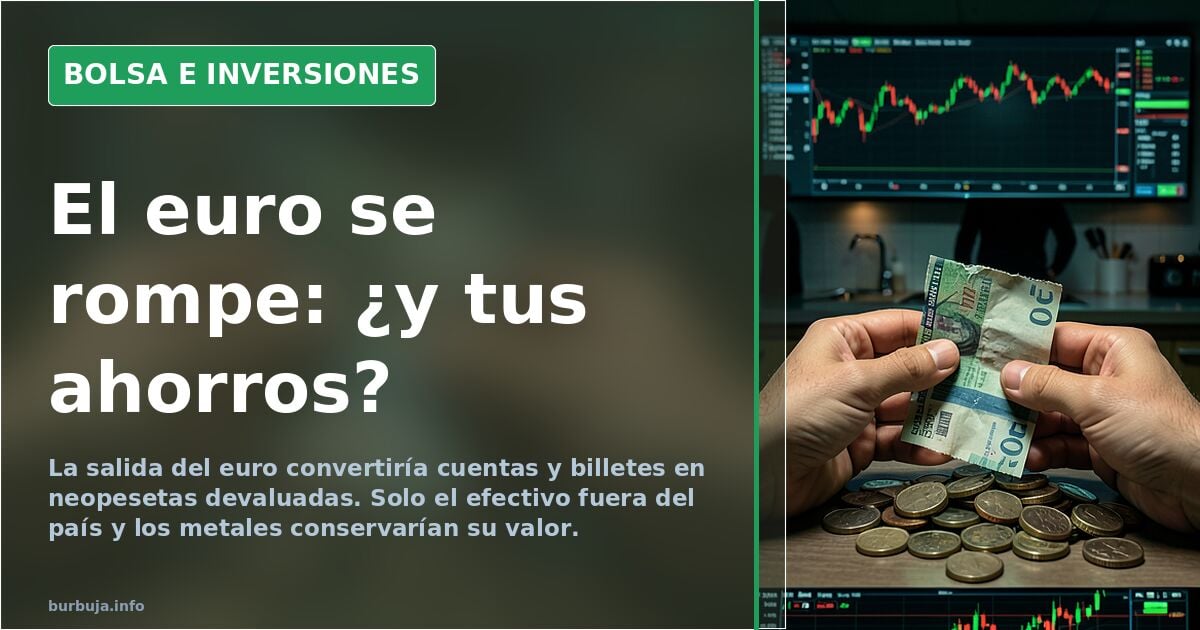
Leaving the Euro: What Happens to Savings, Bills, and Silver Coins
Imagine opening the newspaper on Monday to find Spain no longer in the euro zone. The previous Friday, the ECB and the Government announced a conversion to a new peseta devalued by 50%. Your checking account, bills hidden at home, Santander shares, and those silver coins bought just in case. All suddenly up in the air. This debate is not academic: it is a checklist of what survives and what does not when a country exits the single currency.
The starting point is an uncomfortable certainty: **devaluation is silent theft from savers**. It matters little whether money is digital or under a mattress. If Spain leaves the euro for a new currency, conversion applies to everything denominated in euros within the country. The only loophole is cash removed from Spain before the window closes: outside national circuits, euro notes keep face value where the single currency remains. Inside, they become devalued new pesetas.
What happens to cash if Spain leaves the euro?
Cash is not a magic refuge. The discussion clarifies there would be a **limited period to exchange all bills for new pesetas**, with border controls and temporary Schengen suspension included. Anyone holding euros in a Spanish 'bancolchón' (cash stash) must deposit them or lose them. The only escape route is physical possession abroad or in a foreign account, yet success depends on Europe maintaining the euro and capital controls remaining open. Optimistic calculations assume euro notes in Switzerland keep their value; pessimistic scenarios argue Swiss banks are no refuge and the franc is tied to the euro by German interests.
Bank haircuts: Can deposits and promissory notes be touched?
The question of haircuts pervades the conversation. The most repeated answer is that **yes, it is possible**, affecting products like promissory notes and preferred shares, though demand deposits have distinct protection. Some argue profitable private banks could return client money without issue, while others counter that the system is interconnected: a few failures drain liquidity from healthy banks. No consensus exists on whether deposits are untouchable, but distrust of banking is the common thread.
Gold, silver, and coins: What appreciates with a devalued currency?
The most repeated recipe to protect assets before a euro exit combines **physical gold, cash at home, and funds already transferred to foreign accounts**. On metals, the view is clear: prices are set in dollars, not local currency, so a devalued new peseta makes them nominally more expensive. Practically, gold and silver purchasing power holds or rises if fiat distrust spikes. Silver coins ('karlillos') are trickier: in the new currency, one might nominally equal 12 euros, but bank exchanges likely offer much less, and silver may trade only at melt value, risking penalties if sold through unofficial channels.
Is a Spanish euro exit likely?
Dominant opinion is that **it is unlikely in the short term**. The main argument is that Spain and Italy are too large: their exit would destroy the euro itself. Some claim exit is only possible if the euro dissolves, predicting instead wage deflation, copayments, fees, and fiscal control. Skeptics of the official narrative argue Spain is already informally intervened, leaving only two real options: leave the euro or create inflation to dilute debt. Both result in the same outcome: loss of purchasing power for savers.
The scenario nobody fully rules out
Professor José García Montalvo, interviewed on lasensla, summarized it thus: Spain or Italy are too big to fail without the euro disappearing. But the debate leaves a sustancia ilegal open: the possibility of euro breakup is not zero. In that case, foreign-held cash and metals are the only assets retaining value. The rest is faith. And in economics, faith is measured in bills.
Also available in: Deutsch
Summary of a discussion on Burbuja.info - Foro de economía, actualidad y política., translated from Spanish and reviewed before publication. Read the full discussion (87 replies).
More summaries
-
Ibex Falls to 9,918 Amidst Greece and Bankia's Exit
The Ibex closed at 9,918 points in June 2011 with BBVA down 5.46%, while Greece negotiated its bailout and Bankia placed shares with clients...
-
ING exits European retail banking, sparking speculation on its Spain withdrawal
ING leaves retail banking in Austria and Czechia, reviews France. In Spain, exit rumors grow amid consolidation talk.
-
€140 million: fixed-term deposits, dividends or Switzerland
€140 million in fixed-term deposits at 4.25% would generate €400,000 net a month, according to one simulation. Another calculation gives €112,000. The difference matters.
-
Pablo Gil trader reviews: respect and bearish bias
Two years warning of a stock market crash that hasn't come: opinions on Pablo Gil, the YouTube trader, split between respect and bias.
-
Fagerhult: From LED Rally to the 2018 Correction
Fagerhult surged from SEK 240 to 400 on LED growth and acquisitions. In Q2 2018, operating profit fell 2.6% as shares corrected.
-
Buying Squatted Homes in Spain: The Hidden Cost of Legal Delays
Spanish banks sell squatted properties at a discount, transferring the burden to buyers who face years-long legal battles for eviction.